The TWZ Newsletter
Weekly insights and analysis on the latest developments in military technology, strategy, and foreign policy.
Scattering mines around remote missile facilities and launch points would make sense in order to further degrade Iranian launches. The post Is The U.S. Dropping Mines To Stop Iranian Missile Launchers? appeared first on The War Zone.

The TWZ Newsletter
Weekly insights and analysis on the latest developments in military technology, strategy, and foreign policy.
Iran is accusing the U.S. of dropping anti-tank landmines in an area near one of its underground missile facilities (often referred to as missile cities) that it claims killed several people. While we cannot independently verify the provenance of the images provided by Iranian media or the casualty claims, the use of these munitions would make sense. Despite an intense bombing campaign against Iran’s missiles and launch sites, the Islamic Republic is still firing these weapons at targets across the Middle East. A highly-targeted area-denial campaign around specific missile facilities using mines could help reduce that threat.
The accusation about the landmines came Thursday morning in the form of social media posts by Iran’s official Tasnim news agency.
“These explosive packages resemble ready-made canned food, are somewhat larger than tuna cans, and contain explosives that detonate after being opened, causing casualties,” Tasnim wrote on Telegram. “These packages have been dropped in the skies over the southern suburbs of Shiraz, especially in the village of Kafari, and unfortunately have caused the martyrdom of several people in these areas.”
The Tasnim posts included several pictures of what appear to be BLU-91/B scatterable anti-tank landmines.
جنایت جدید آمریکایی ـ صهیونی در برخی مناطق کشور
رهاسازی بستههای انفجاری با جنگنده
این بستههای انفجاری شبیه کنسرو آماده بوده و حاوی مواد منفجرهای است که بعد از بازگشایی منفجر شده و باعث تلفات جانی میگردد
#انتقام_سخت pic.twitter.com/0mChpxVhLP
In its story about the landmines, the Bellingcat open source investigations collective “geolocated some to the village of Kafari, Iran…,” the organization stated, citing a video from Canadian lawyer and activist Dimitri Lascaris, who is in Shiraz.
“This video shows at least three mines approximately two kilometres away from the entrance to what is reported to be Shiraz South Missile Base, an Iranian ‘missile city,’” Bellingcat added. The video shows several of the mines scattered in a village.
“The US is the only participant in the war known to possess these mines,” Bellingcat posited. “They were developed after the US stopped supplying arms to Iran. A review of Stockholm International Peace Research Institute’s (SIPRI) Arms Transfer Database, and US Major Arms Sales does not show any transfers of these mines to Israel.”
We cannot independently verify the origin of the mines seen in the video, but it seems unlikely that Iranians would have access to them. Still, it is possible they did, or have produced dummies or clones, and placed them there for propaganda value. U.S. Central Command declined to say if these mines are being used during Epic Fury.
Iran has been able to preserve a number of its missile launchers, which could involve moving them in and out of underground facilities like the one near Shiraz or hiding them elsewhere in the area and moving them to designated launch points. This is occurring even after these facilities have been repeatedly bombed. These aerial attacks have focused on keeping their entrances caved in. These strikes are on top of the vast, resource-consuming interdiction effort to hunt for and strike launchers that are exposed. So, continued launches from these areas would be a major reason why resorting to deploying anti-tank mines there makes sense and would have a high military value. Mining the entrances of the underground missile cities would also make it harder for heavy equipment to access them in order to open them back up.
🚨 WATCH: CENTCOM releases footage of strikes on fortified missile bases in southern Iran. The first footage includes hits on tunnel entrances and on mobile and stationary launchers at the missile base in Hajjiabad, Iran. pic.twitter.com/wuoi5GEhqp
— Major Sammer Pal Toorr (Infantry Combat Veteran) (@samartoor3086) March 22, 2026The IDF publishes footage showing a recent airstrike on an Iranian ballistic missile launcher in western Iran that it says was primed for an attack on Israel.
In additional strikes yesterday, the military says the Israeli Air Force hit several ballistic missile storage and… pic.twitter.com/UVE5bTAJNd
CENTCOM:
The Iranian regime is using mobile launchers to indiscriminately fire missiles in an attempt to inflict maximum harm across the region.
U.S. forces are hunting these threats down and without apology or hesitation, we are taking them out.pic.twitter.com/l4lxbTlAf4
Designed to attack tanks and trucks, the mines could destroy or disable the launchers and likely the payloads they carry. They could also make roads to and around the underground missile cities unpassable. Even limiting where the launchers could go within these areas could make them more vulnerable.
The mines are part of the Gator family of systems that includes the air-delivered BLU-91/B and a companion anti-personnel type (BLU-92/B). Different mixes of the mines can be loaded with several types of bomb-like air-dropped dispensers, which break open after release to disperse their payloads over a targeted area.
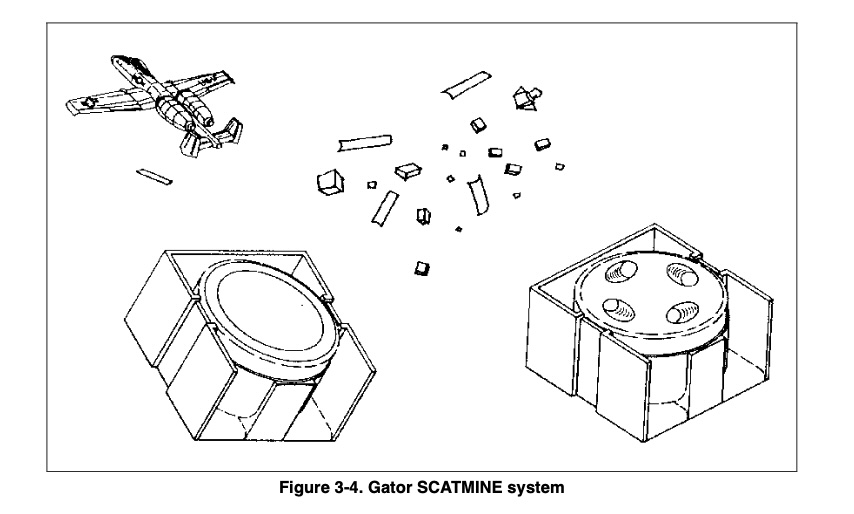
Each mine and dispenser combination has its own designation. Cluster munitions loaded with Gator mines can be employed by many of the U.S. combat aircraft known to be taking part in Operation Epic Fury today, including bombers. The last known combat employment of Gator mines appears to have been during the Gulf War in 1991. There were unconfirmed reports of Gator use in the opening phases of the war in Afghanistan in 2001.
Air-delivered BLU-91s and BLU-92s both have box-like “aeroballistic adaptors.” That feature is absent on related mines in U.S. Army service that are laid via launchers mounted on UH-60 Black Hawk helicopters and trucks.
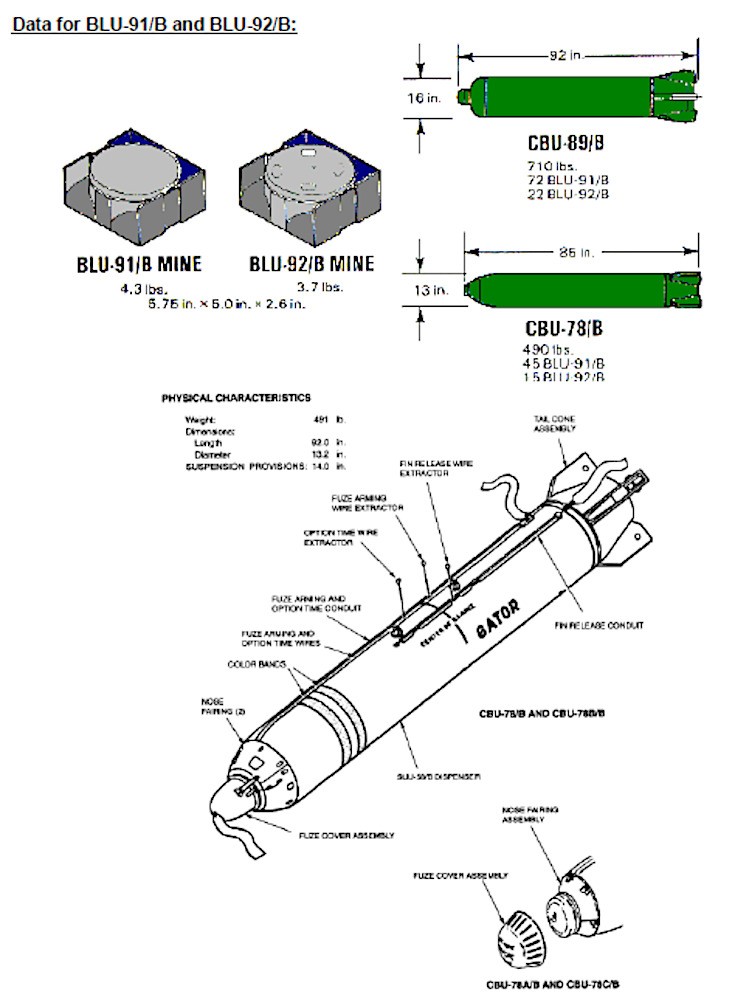
From a humanitarian viewpoint, there is concern about collateral damage from civilians inadvertently setting them off or picking them up without knowing what they are. BLU-91s are not known to have anti-handling features, but can still be dangerous to move. They can also be preset to self-destruct after four hours, 48 hours, or 15 days. It’s worth noting that the mines do not always detonate themselves or otherwise function as intended, as is the case with all munitions.
That being said, the missile cities are removed from urban areas and sit within large, tightly controlled perimeters. Mining these areas, where civilians have no access, would present a far lower danger to innocent lives than mining random roads or ones near military bases in urban areas.
Of note is that in terms of the mines themselves, the pictures circulating online so far only appear to show BLU-91s having been used in Iran. These are readily distinguishable from BLU-92 anti-personnel mines, which have four ports on top of their main bodies through which spring-loaded trip wires are fired after the mine activates. The tops of the BLU-91s are flat. Gator mine cluster munitions are typically loaded with some amount of both types of mine, but types containing only BLU-91s have at least been tested in the past.
The distinction is important. While the U.S. is not a signatory to the international treaty known as the Ottawa Convention, which banned the application or storage of anti-personnel landmines, it does not allow the use of them. There are no such preclusions against anti-tank mines.
It remains to be seen whether the mines, if truly dropped by the U.S., are an isolated incident or part of a broader campaign as Epic Fury drags into a second month. However, deploying an area denial capability like air-dropped anti-tank mines in places where the missiles are known to be stored and around known launch points could prove to be an effective measure in trying to stop Iran’s barrages from continuing.
Contact the author: howard@thewarzone.com

Russian forces attacked a children’s hospital in Kherson with a combat drone this morning; bomb disposal experts neutralized the UAV.

A network recruiting locals to carry out sabotage and destabilization operations in European countries on behalf of the Russian Federation has been uncovered in Eastern Europe.

Rescue teams now hope the whale will swim out of the shallow waters of Lübeck Bay and into the wider sea.

In the Sumy region, a 54-year-old man was killed, and two others were wounded over the past 24 hours as a result of Russian strikes.