

A specialized group of Marines operating in SOUTHCOM will now support Operation Southern Spear, the U.S. campaign to stop maritime drug trafficking, as the 22nd Marine Expeditionary Unit heads home.
The 24th Marine Expeditionary Unit will operate as Littoral Combat Force-24, providing a Marine Air-Ground Task Force that will work under the Joint Task Force Southern Spear, the Marine Corps announced Friday. The group of Marines and sailors are taking over the duties of the 22nd Marine Expeditionary Unit, which has been embarked on the Iwo Jima Amphibious Ready Group for nearly 10 months.
LCF-24 will serve as the “immediate crisis response force” in SOUTHCOM, according to a Marine Corps news release. LCF-24 can conduct maritime interdiction operations, as well as perform embassy reinforcement and tactical recovery of aircraft crew. The unit will also be able to participate in humanitarian efforts, if required.
The littoral combat force is different from a typical MEU deployment with an amphibious ready group. Instead of operating from a three-ship ARG, the specialized MAGTF will be spread across the region, with a headquarters and shore-based nodes, including in Puerto Rico and amphibious transport dock USS Fort Lauderdale (LPD-28), a Joint Task Force-Southern Spear spokesperson told USNI News.
The littoral combat force deployment comes after top Navy and Marine Corps officials have said that the Marines will have to figure out how to operate differently due to the shortage of amphibious ships.

The Marine Corps is looking to deploy Marines on platforms like the Expeditionary Fast Transport and the Expeditionary Sea Base to meet the demands in the Caribbean, Lt. Gen. Jay Bargeron, the deputy commandant for plans, policies and operations, said in April at Modern Day Marine. The release does not mention if LCF-24 will use those platforms.
“And make no mistake, that’s no ARG/MEU. That is a MEU. It’s sub-optimized, but it will be available to provide some capability. And I think that perhaps there will be another single ship deployed that will help them have some capability,” Bargeron said in April.
At the time, Bargeron said there could also be an independently deployed amphibious warship that the Marines could use if they need a platform for some of their tasks. According to the Marine Corps release, LCF-24 could use Fort Lauderdale, which is currently part of the Iwo Jima Amphibious Ready Group, with the 22nd Marine Expeditionary Unit embarked.
The 22nd MEU is expected home Monday. Fort Lauderdale, which has been deployed approximately 10 months, will remain in the Caribbean.
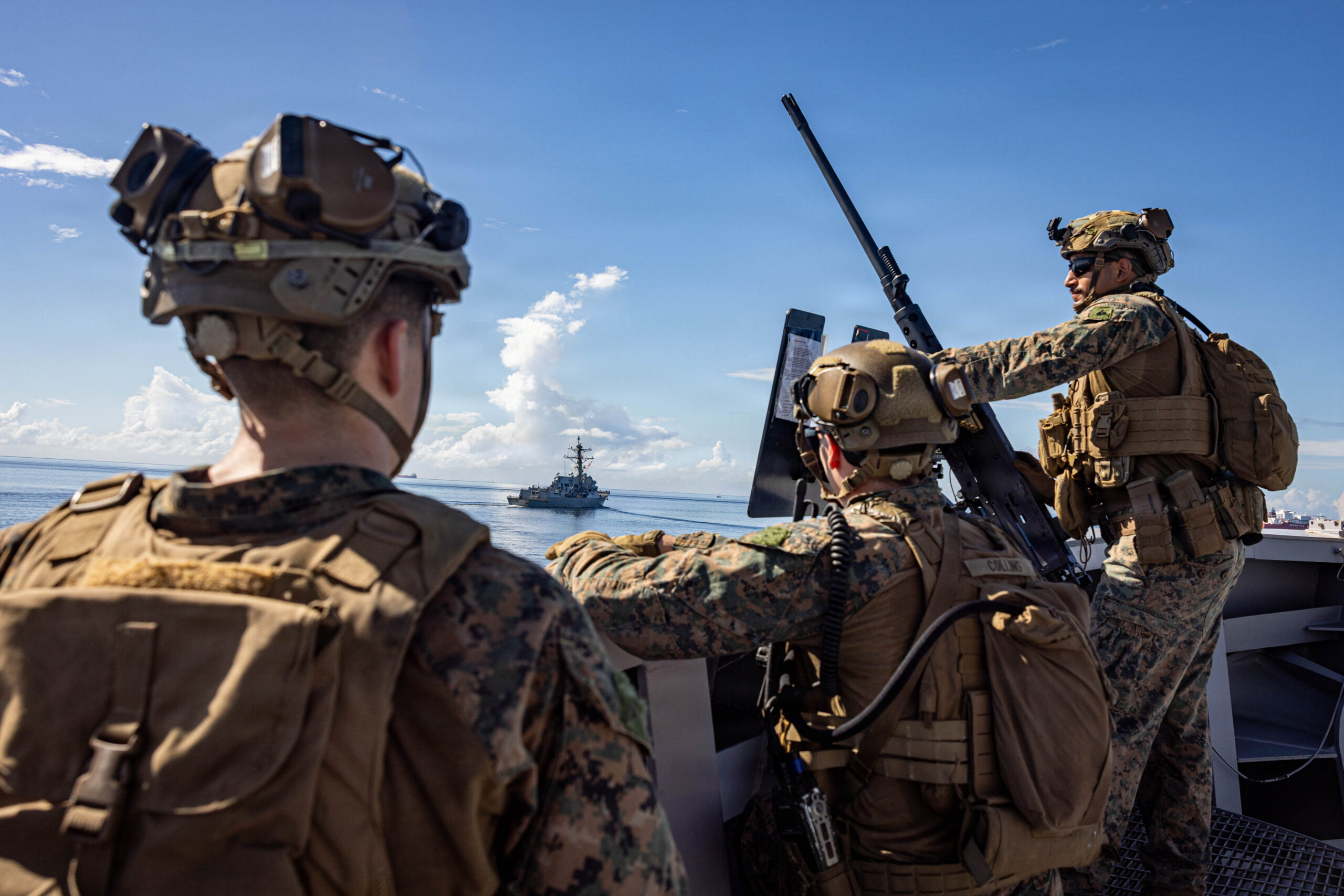
The U.S. amassed naval warships, including the Iwo Jima Amphibious Ready Group and the Gerald R. Ford Carrier Strike Group, ahead of the January raid on Venezuelan President Nicolás Maduro and his wife, Cilia Flores. At the height of the buildup, there were more than 10 naval ships in the Caribbean, a destination that aircraft carrier strike groups are seldom tasked.
With USS Iwo Jima (LHD-7) expected to return home, there will be three naval warships left – guided-missile cruiser USS Lake Erie (CG-70), Littoral Combat Ship USS Billings (LCS-15) and Fort Lauderdale.
While aircraft carrier USS Nimitz (CVN-68) and destroyer escort USS Gridley (DDG-101) are in the Caribbean, the two ships are expected to participate in exercise Southern Seas and are not currently part of the Operation Southern Spears efforts.
Chief of Naval Operations Adm. Daryl Caudle said in April that the naval package that meets SOUTHCOM needs likely won’t include an aircraft carrier. Maritime interdiction, like what is done under Operation Southern Spear, does not require an aircraft carrier, whereas the firepower and abilities it brings are more suited for power projection and deterrence, he said.
“This is all about force optimization,” Caudle told USNI News in January.
Carrier strike groups and other naval assets are being stressed as they attempt to meet the demands of combat commands. The Gerald R. Ford returned home in May after a record-breaking 11-month deployment, which included sailing to SOUTHCOM and U.S. Central Command. The remainder of the 22nd MEU, likely with Iwo Jima, is set to return after 10 months.


