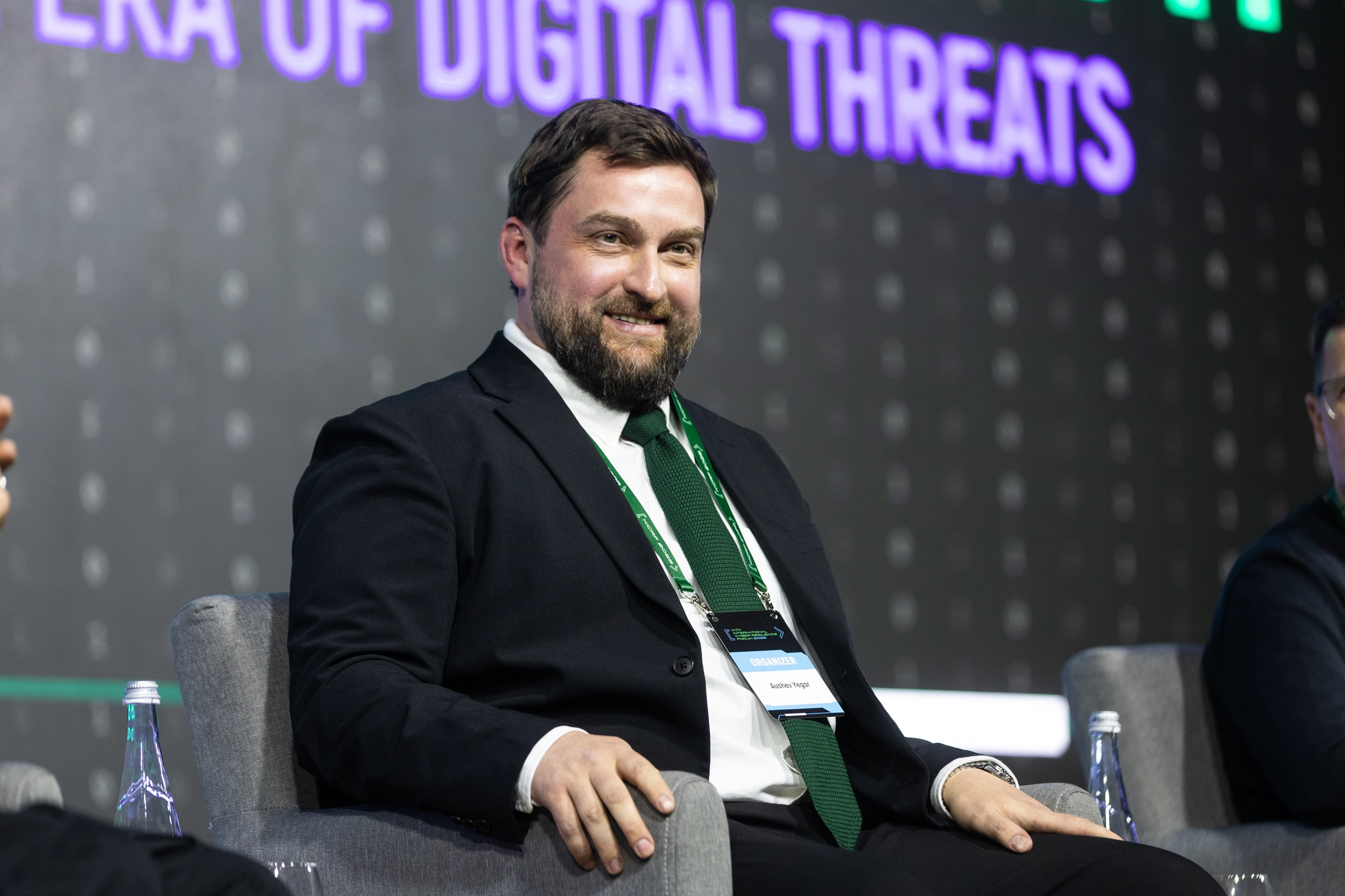
In Ukraine we tested an AI team challenging other human teams in a cybersecurity game
For the first time ever in the world we had this AI team, and that was really surprising for everyone. This is something new when AI works better than hackers do… We showed that this technology is actually being implemented right now in Ukraine. Companies should come here, either to invest, or to touch this technology, and then go back home and make more business based on this experience.
Conferences like yours are often an exposition of technology, not a real sharing of experiences. Is your forum’s aim also to help create opportunities between Ukrainian defense tech firms and foreign companies?
Before the full-scale invasion, something like 10 and 5 years ago, many Western governments and technology players came to Ukraine and brought us a lot of knowledge. And this knowledge is actually what allowed us to survive during the initial invasion.
Today, my idea is that now is the time when we can actually show and teach. We can be useful for our partners. For example, for drones or cyber security, every couple of months a new technology appears. So basically, you need to adapt right now. You have to be able to adopt new technology fast. It means that you should be in touch with new challenges, with new requests from the world.
How big was the Forum this year?
In this forum there were more than 2,000 people; around 500 people from different countries and 1,500 from Ukraine. My initial objective was to create a forum for our Ukrainian government to have a platform for communication with international partners. But then we understood that it’s also very important to have these connections on different layers: government to government, private sector to private sector, education to education, universities to universities. And we like to create those connections. We need a lot of different connections, horizontal ones, because new information happens to arrive so fast, and they need direct connections that allow everyone to be up to date all the time.
Putting together private sector and governments is like combining different sciences. This is the condition for making a discovery.
Usually, industry conferences are attended by private players who can understand each other and take decisions. But with governments it’s different. They have a protocol, bureaucracy. They don’t take decisions quickly. How did you create this dialogue between governments and industry? Did it work?
To work just with business is much easier, but big things are happening in different ways. For example, I have a PhD in physics, I achieved it 15 years ago, and my professor used to tell me how to make a discovery. Discoveries are happening when you put two different sciences in contact.
In the conference it is of course more comfortable for us to speak with just the private sector, while for governments it’s more comfortable for them not to meet the private sector. But here we often had 50-50 panels: half were government officials and half private players. For example, we had one panel discussion with a representative from the European Union, together with the Ukrainian National Cyber Security Agency, National Security and Defense Council, and the CEOs of private companies. It was the highest level with different opinions, and it was a strategic panel. My personal panel was just for business with CEOs and owners of big companies. The next panel was represented by military servicemen. So, it was a combination of different speakers and it’s quite challenging to do it like that.
Did you see some changes from the previous editions of this cybersecurity forum? Were there any surprises?
We are actually learning a lot from the geopolitical situation also. For example, the Forum was established three years ago, in 2022. The first edition was completely reliant on donors. The United States, in particular, wanted to start this forum. But because of geopolitical situation, the US decided not to support it anymore.
This year, the founder of Signal messenger app Moxie Marlinspike (pseudonym for Matthew Rosenfeld) was in Kyiv during our forum. He’s the guy who created Signal messenger with 100 million users. And he came from Los Angeles to Kyiv, during a war.
I think from the organizational point of view, the most challenging thing was to include the geopolitical situation, because some people are willing to support Ukraine, but then they don’’ know how to act. Even some big companies. So, we keep this balance. And now for the third edition of our conference, we finally managed to learn how to do it.
Did you see an increase in speed from countries and companies in their attitude to work?
We used to do everything quite fast, and some countries adapted to this, because they can finally take some decision here on the ground. But some companies are still old-fashioned. They try to, but they are still late. They start all their rounds of bureaucracy, and when they are come back, say in six months, what they offer isn’t needed anymore.
Unfortunately, they’re still too slow. Especially, in the European Union. It’s like moving 9-10 months for every decision, but after 9 months, the situation is completely different here in Ukraine. In my opinion, decisions should be somehow adapted, not for marathon but for result-oriented sprints.
What is your dream for the future?
I hope in future we will build an even bigger conference. I would like to have a European RSA Conference like the big Cyber Security RSAC in California. Every year, tens of thousands of people are going there. I think that we should have something like that in Eastern Europe. Now, we have a name already and a lot of people’s recognition. When we become part of European Union, we should definitely have this big conference here in Ukraine with a lot of Ukrainian products, as well as European and American ones.