Ukrainian Director Oleksandr Khomenko: Turning Historical Figures Into Rock Stars
Mur theater’s Khomenko on history, war, and why teenagers are cosplaying Ukrainian poets instead of superheroes.
Kyiv Post
75
6 мин чтения
0 просмотров
At just over 20, Oleksandr Khomenko has already become one of the most striking new voices in Ukrainian theater. As a director, actor, and founder of the Mur creative association, he creates musical stage productions that bring Ukraine’s turbulent 20th-century history to life for a new generation.
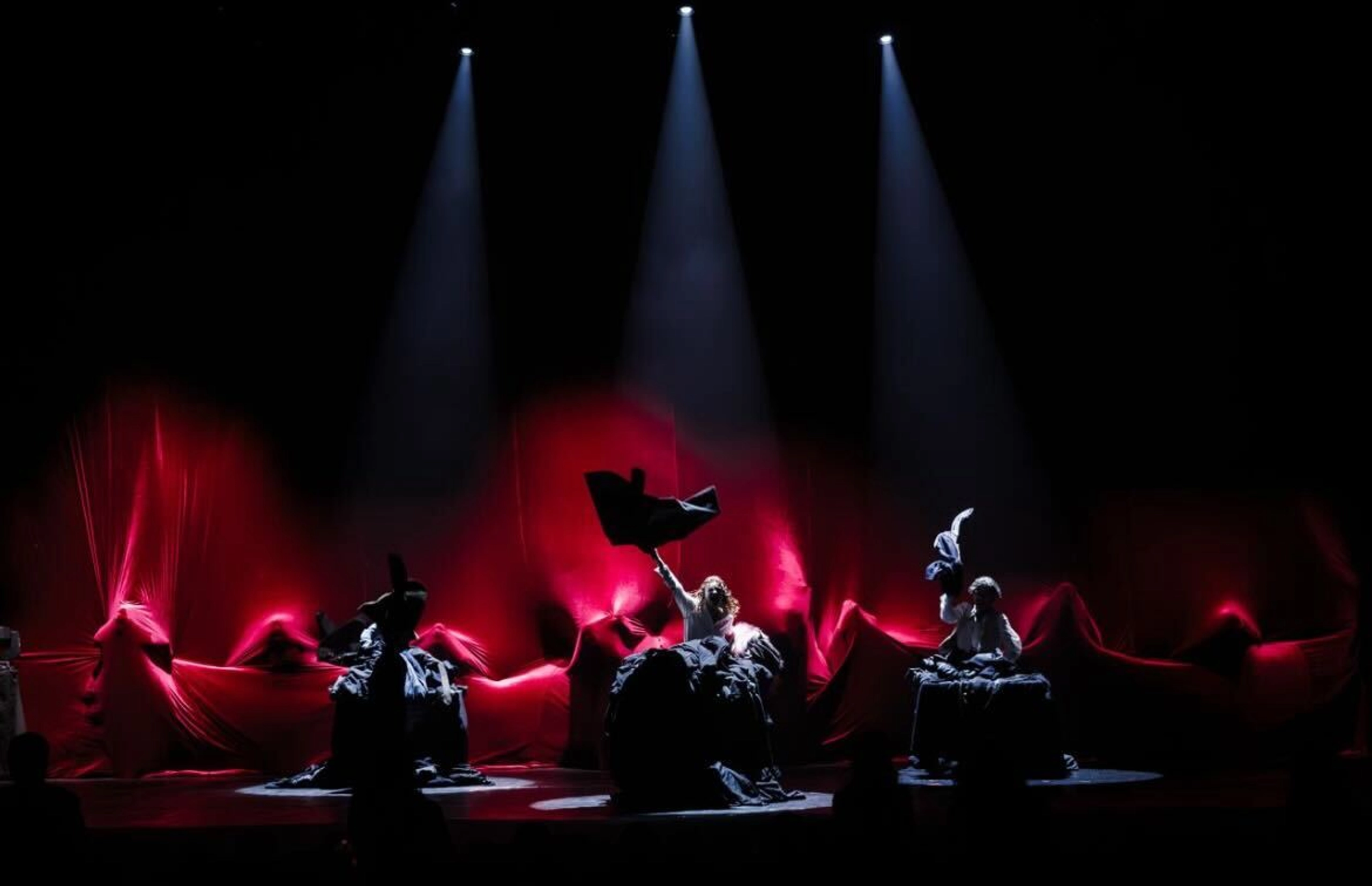
Mur’s performances blend theater, music, and historical storytelling, transforming writers, dissidents, and political figures into vivid stage characters. Their productions explore Soviet repression of Ukrainian culture, the intellectual resistance of the 1960s, and the long struggle for Ukraine’s independence.
During the company’s spring tour across Ukraine, Kyiv Post spoke with Khomenko about creating theater during wartime, confronting the legacy of Russian imperialism, and why making historical figures feel like “rock stars” may be one of the most powerful ways to reconnect young audiences with their country’s past.
Kyiv Post:In your early twenties, you created a project that some already call historic. How much did your personal experience of war and the rethinking of identity shape your work?
I think my own background played an important role. I studied in a Russian-language school and grew up in a Russian-speaking environment in Kyiv. Paradoxically, that probably helps us reach a very wide Ukrainian audience today.
A century ago, “The Biosphere” by Volodymyr Verdanky, the first President of the Ukrainian Academy of Sciences, highlighted the interconnected nature of life on Earth.
Not everyone grew up deeply immersed in Ukrainian culture or literature. Many people are discovering it only now. And I understand that journey – from indifference or ignorance to genuine curiosity.
Some members of the Ukrainian intelligentsia have been deeply rooted in national culture since the 1990s. Sometimes there is frustration: how could others not know these things? But my own experience helps build a bridge. I used to be someone who didn’t know these names either, so I can talk to people without any sense of superiority.
What does theater look like in wartime?
I think the current explosion of Ukrainian art is connected to a very simple feeling: many artists literally feel death breathing down their necks.
You realize you might disappear before you manage to say everything you wanted to say. That pushes you to act faster – not to wait for the perfect moment, but to experiment, try new forms, and take risks.
Strangely enough, the awareness of life’s fragility becomes one of the strongest motivations for creativity.
What is the mission of theater today?
Theater happens here and now. The actor you see on stage has just lived the same life as the audience – read the same news, heard the same explosions, experienced the same war.
Because of that, texts about power, freedom, or moral choices suddenly sound very different. We are all living in the same reality, and that gives words a completely new weight.
You worked extensively with historical sources while creating Rebeliia. What surprised you the most?
The strongest realization was how consistently conflict with Russia appears throughout Ukrainian history.
We actually tried to move away from that theme. At some point, we wanted to create a performance without Russians as the obvious antagonists. But when you open the archives, you keep seeing the same pattern of imperial pressure.
Before 2022, many people – including me – didn’t take Russian cultural chauvinism very seriously. It felt exaggerated, almost like a bad joke. Now it’s clear that it’s a system that has been functioning for centuries.
Where do you draw the line between artistic freedom and responsibility toward historical truth?
We always emphasize that this is a work of art, not a history textbook.
Art can do something a textbook cannot – it can create emotion. After a performance, people start reading and exploring history on their own.
Photo courtesy of the MUR press office.
One of the characters in the performance, for example, is Mykola Vinhranovskyi – a Ukrainian poet, filmmaker, and member of the “Sixtiers,” a generation of intellectuals and artists in the 1960s who pushed for cultural freedom within the Soviet Union.
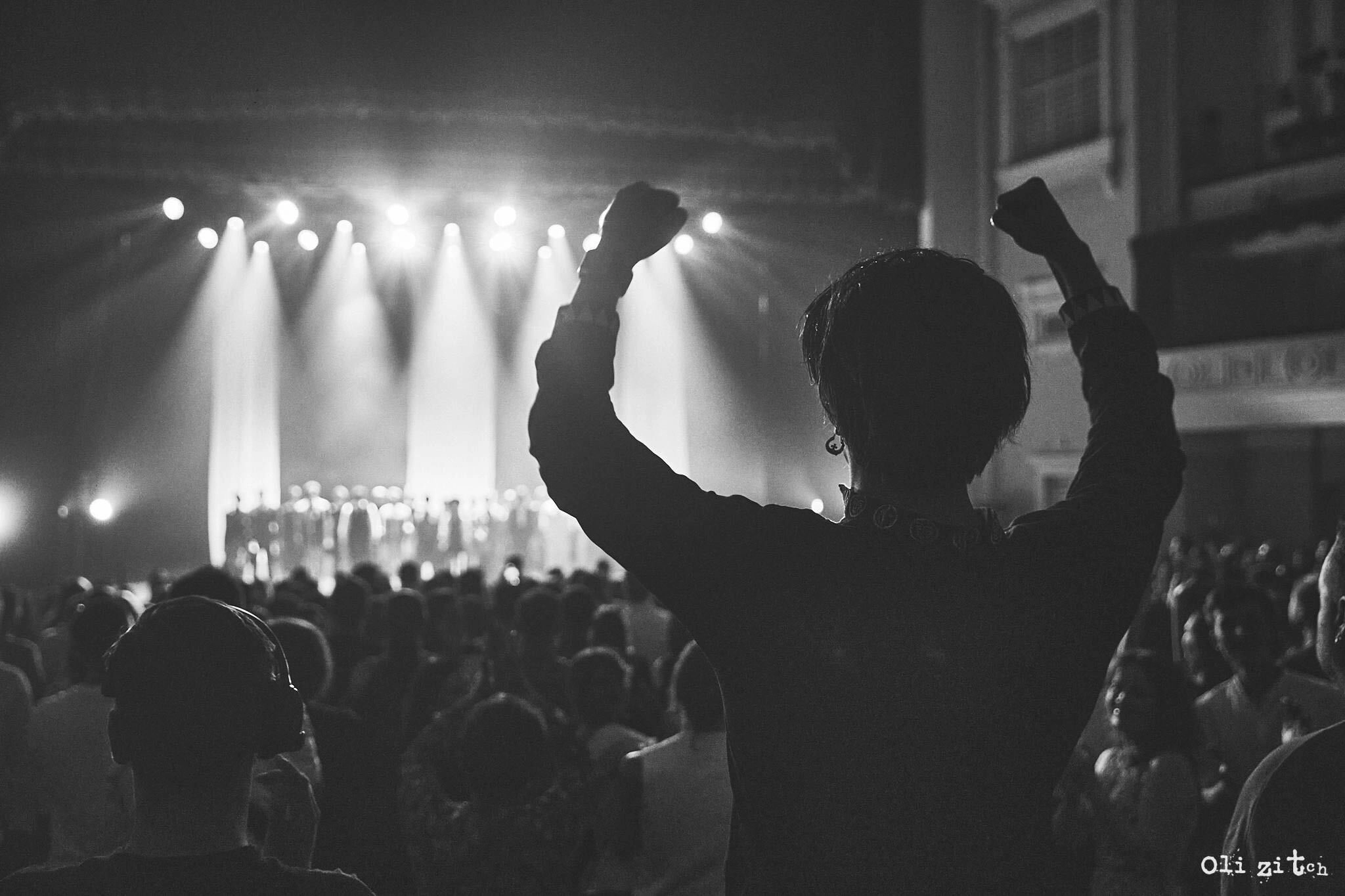
When teenagers started doing cosplay of characters from our show, that was the greatest compliment for me. Imagine that: instead of comic-book superheroes, they are dressing up as Ukrainian poets. And I think this is the most important mission we’ve accomplished – both in “Ty” [Romantyka] and in “Rebeliia.” The heroes of our performance, these historical figures, have become for the Ukrainian audience rock ’n’ roll icons, absolute legends – I can’t find a better word for it. (Smiles.)
We are trying to capture the spirit of the era, not to create a museum reconstruction.
KP: Will Rebeliia be understandable to international audiences?
OK: We really want to create cultural products in Ukraine that are interesting to international audiences. My dream is to stage an English-language production at the level of the West End or Broadway about the Slovo House in Kharkiv. It’s the story of how Soviet authorities gathered some of the most talented Ukrainian writers into one building – and then later destroyed almost all of them. For Western audiences, it may sound like the plot of a political thriller. But for Ukraine, it’s a real historical story.
KP: Can you reveal anything about your next project?
OK: The next production will be a biopic. The premiere is planned for fall 2026.
It will tell the story of a somewhat overlooked but very important historical figure – Yevhen Chykalenko, a Ukrainian philanthropist, publisher, and key financial supporter of the Ukrainian national movement in the early 20th century.
Myroslava Makarevych has more than 30 years of experience as a journalist and editor. She has worked for BBC Ukrainian Service; for a number of publishing houses in Ukraine, like HFS (ELLE Ukraine), Edipresse and Sanoma Media (Sensa.Ukraine editor-in-chief). She collaborates with various socio-political media including zn.ua; nv.ua. She is the author of 7 original fairy tale books for children, and 3 publicist books.