
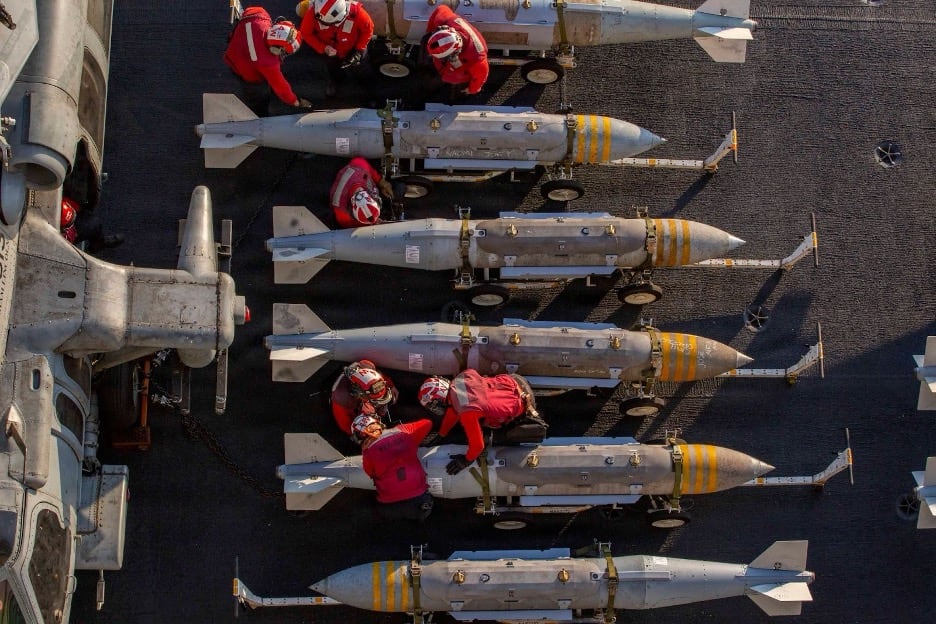
U.S. sailors partook in a time-honored tradition of writing messages or their own names on bombs loaded onto planes during Operation Epic Fury.
Sailors aboard the USS Abraham Lincoln marked the ordnances they helped prepare for the mission, according to recent photos posted by the U.S. Central Command. Task & Purpose senior editor Matt White was first to notice the trend.
The photos show ordnances — which appear to be GBU-31s, a 2,000-pound class Joint Direct Attack Munition — being staged on Feb. 28 by red-vested aviation ordnancemen prior to being loaded onto strike fighter aircraft in support of Operation Epic Fury, according to CENTCOM photos.
It is unclear if the ordnancemen seen in the photos are those with their names on the bombs.
On the tails, noses and sides of the bombs, names and messages are scribbled in chalk and marker.
While visible names include “Jose,” “Alex,” “Naomi,” “Joey” messages written in smaller script and on the tails are less visible.
But messages of bravado inscribed on bombs, missiles and other munitions are nothing new.
A lead sling bullet, now housed at The British Museum, can be seen with the tongue-in-cheek inscription of DEXAI or “Catch!” in Greek.
Historian John McCaul in "On Inscribed Sling-Bullets," notes that slings and lead bullets were frequently employed during sieges with town names and deities also inscribed on the projectiles.
The more ironic ones have stood the test of time, with zingers like the one found near the city of Argos, Greece, with the inscription “Bite it in vain” — aka the ancient equivalent to the idiom “This is a hard nut to crack.”
In 1945, the atomic bomb “Fat Man” was dropped by the U.S. at Nagasaki, Japan, and photos of its assembly show that names and messages were etched into the atomic bomb by people involved in its creation. Norman Ramsey, a physicist and member of the Manhattan Project, can be seen signing his name on “Fat Man” prior to its polar cap being placed on.
Photos from the National Museum of the U.S. Navy shows messages on the atomic bomb, like “Here’s to you” and “Lots of love.”
This action can be seen throughout history and is still prevalent today for many countries’ military members.
In 2015, Jordanian pilots used chalk to write messages on missiles headed for Syria vowing to eliminate the Islamic State. The messages included quotes from the Quran and statements meant for its target: “For you, the enemies of Islam,” according to BBC reporting at the time.
More recently, Ukrainian artillerymen have been writing messages on rockets, mortar shells or explosive drones used during the war in Ukraine as a way to symbolically voice their anger. Charity groups and even the military itself have capitalized on this idea by using this as a way to raise funds, per New York Times reporting.
While such expressions may appear infantile bordering on the obscene, the impulse to personalize weapons of war taps into, according to an American pilot who served in Vietnam, “the very primitive magical notion that, once you have named something, you have control over it.”
Cristina Stassis is a reporter covering stories surrounding the defense industry, national security, military/veteran affairs and more. She previously worked as an editorial fellow for Defense News in 2024 where she assisted the newsroom in breaking news across Sightline Media Group.

