Does China’s Jiuzhang 4.0 computer herald the age of quantum supremacy?

China has unveiled its latest photonic quantum computer, Jiuzhang 4.0, with researchers saying it can outperform the world’s fastest classical supercomputer by a vast margin, further strengthening Beijing’s push towards quantum supremacy. The results, published on May 13 in the peer-reviewed journal

South China Morning Post
75
2 min read
0 views
Does China’s Jiuzhang 4.0 computer herald the age of quantum supremacy?

China has unveiled its latest photonic quantum computer, Jiuzhang 4.0, with researchers saying it can outperform the world’s fastest classical supercomputer by a vast margin, further strengthening Beijing’s push towards quantum supremacy.

The results, published on May 13 in the peer-reviewed journal Nature, mark the latest milestone in China’s rapidly advancing quantum programme led by a team of scientists at the University of Science and Technology of China headed by Chinese quantum physicist Pan Jianwei.
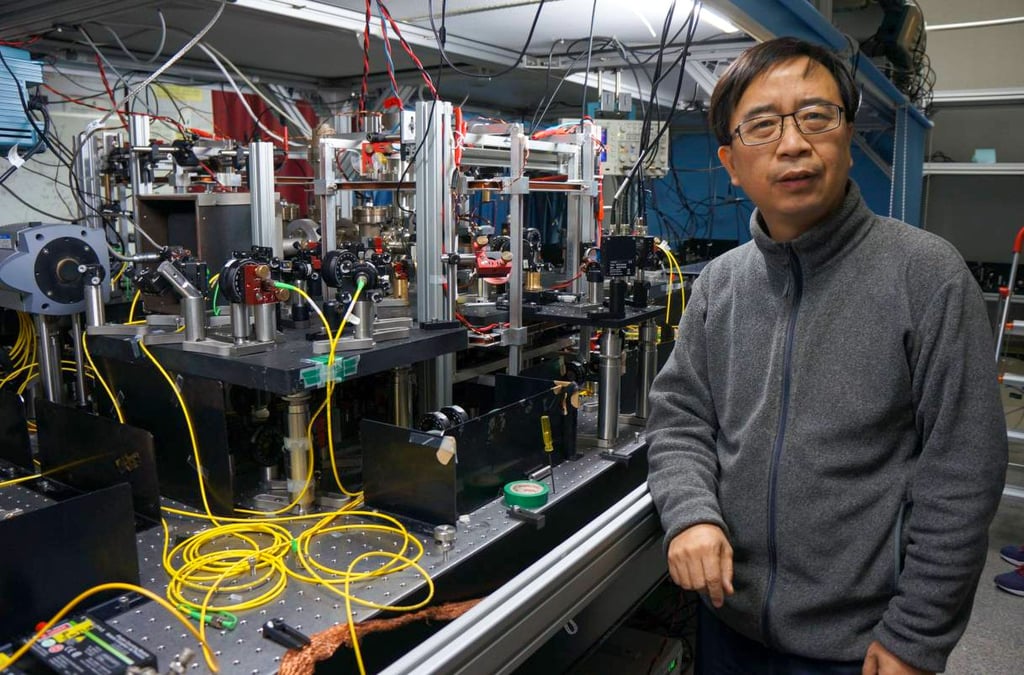
Quantum physicist Pan Jianwei leads the University of Science and Technology of China team behind Jiuzhang 4.0, the country’s latest photonic quantum computer. Photo: Soho

Quantum physicist Pan Jianwei leads the University of Science and Technology of China team behind Jiuzhang 4.0, the country’s latest photonic quantum computer. Photo: Soho

Jiuzhang 4.0 completed a Gaussian boson sampling task in just 25 microseconds – a calculation they estimated would take the world’s most powerful supercomputer, El Capitan in the United States, more than 10^42 years to finish, according to the university in the eastern city of Hefei.

A Gaussian boson sampling task is a quantum computing task that is computationally difficult for classical computers to handle.

“No realistic classical computing resources, to our knowledge, can bring the MPS [matrix product state] algorithm anywhere near the accuracy achieved by our experiment,” the team said in a statement.

Jiuzhang 4.0 operates with 1,024 squeezed-state inputs across an 8,176-mode interferometric network, and can manipulate and detect up to 3,050 photons – more than 10 times the scale achieved in previous experiments.

Share this article

Related Articles

Trump brought top CEOs to Beijing but few big deals emerge
🇨🇳🇹🇼China vs Taiwan
BBC News - Asia

Trump brought top CEOs to Beijing but few big deals emerge

There were plenty of choreographed ceremonies but no sweeping trade breakthrough as Trump met Xi in Beijing.

yaklaşık 2 saat önce7 min
Xi-Trump summit: can ‘aspirational’ new vision for stability survive strategic rivalry?
🇨🇳🇹🇼China vs Taiwan
South China Morning Post

Xi-Trump summit: can ‘aspirational’ new vision for stability survive strategic rivalry?

President Xi Jinping’s new formula for China-US relations is “aspirational”, but the “real test” will be ensuring the two powers can work together despite their deepening rivalry, a leading Chinese political observer has cautioned. During his much-anticipated summit with US President Donald Trump in

yaklaşık 2 saat önce1 min
Xi-Trump summit aside, 2 meetings in Asia matter for global trade
🇨🇳🇹🇼China vs Taiwan
South China Morning Post

Xi-Trump summit aside, 2 meetings in Asia matter for global trade

Most readers of foreign news pages this weekend will be assuming that US President Donald Trump’s summit with Chinese President Xi Jinping in Beijing has been dominating everyone’s attention. But across Asia, Trump, with his massive business entourage, was not the only act in town this week. At leas

yaklaşık 2 saat önce2 min
Top Singapore-based physicist relocates to China after superconductor breakthrough
🇨🇳🇹🇼China vs Taiwan
South China Morning Post

Top Singapore-based physicist relocates to China after superconductor breakthrough

Stephen Lin Er Chow, a physicist who designed a groundbreaking copper-free superconducting oxide capable of high-temperature superconductivity, has joined Zhejiang University from the National University of Singapore (NUS). Last year, at 27, Chow published the findings in the journal Nature, marking

yaklaşık 2 saat önce1 min