Italy restores lucky testicles on bull mosaic worn down by tourists
7 hours ago
Yang Tian
The artwork is the centre of a tradition that involves visitors performing three spins on it for good fortune.

7 hours ago
Yang Tian

 Pier Marco Tacca via Getty Images
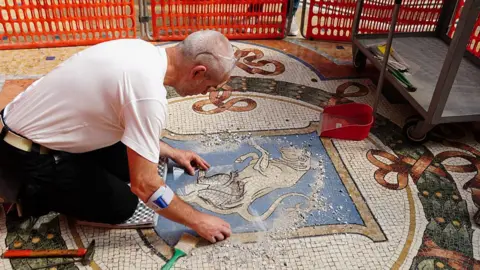
A famous bull mosaic in one of Italy's grand arcades is getting some much-needed care after being worn down by tourists honouring a tradition involving its delicate body parts.
As the legend goes, tourists in Milan who grind their heels on the bull's testicles and spin in place three times are guaranteed good fortune and are destined to return.
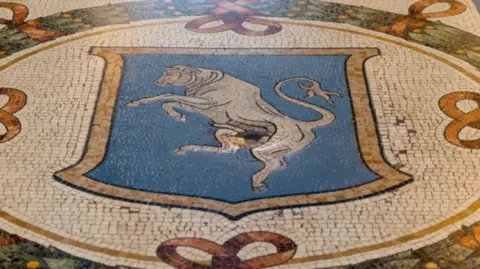
Visitors twirling clockwise for luck have left a small crater on the bull's "lucky spot".
"Thousands of people every day have performed the famous heel-spinning gesture," city councillors said. "The pink tiles that make up its testicles are being worn away."
 Getty Images
The beige and blue mosaic of a prancing bull surrounded by a coat of arms is located in the city's historic 19th-Century Galleria Vittorio Emanuele II arcade. It is representative of the city of Turin, which was the first capital of Italy.
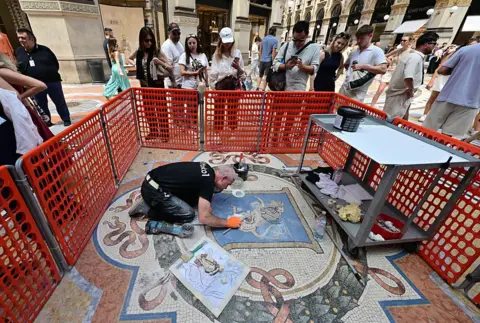
Restoration began this week, with a small construction site erected around the mosaic and a restorer working to return the artwork to its former glory, Milan's city council said in a statement.
Artisan Gianluca Galli was seen kneeling before the mosaic, working to cut new pieces of stone by hand as curious onlookers gathered around him.
Of the spinning ritual, which was popular among Milanese in the 19th Century, Galli told AFP news agency: "It's probably a charming gesture, but also quite damaging for a work of art."
City councillors Emmanuel Conte and Marco Granelli said the last restoration of the bull mosaic was in 2017.
"The Galleria is a living heritage, which can wear away precisely because it is loved and experienced: we take care of it so that it continues to be so," they added.
 Stefano Rellandini/AFP via Getty Images
Japan has made its first contribution to NATO’s PURL mechanism for supporting Ukraine, allocating nearly $14.7 million for the purchase of nonlethal equipment, Japan’s Foreign Ministry reported.

Ukrainian missile forensics experts have debunked key Kremlin claims regarding the “Oreshnik” intermediate-range ballistic missile, revealing that the weapon is nearly a decade old and contains exclusively Russian and Belarusian components. Presenting recovered electronic circuitry from a January 20

Ukraine's Unmanned Systems Forces have established fire control over key access routes to the Russian-occupied city of Debaltseve in the Donetsk region and severed a major transport link connecting Debaltseve and Alchevsk.