8 hours ago
Tom Edgington,
Joshua Cheethamand
Thomas Spencer,BBC Verify

 Getty Images
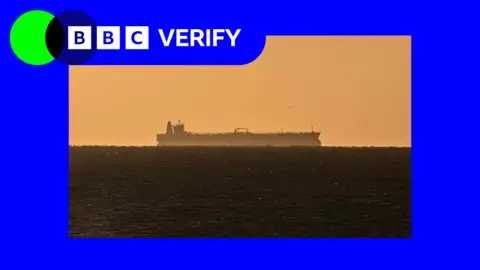
BBC Verify analysis of ship-tracking data suggests "shadow fleet" vessels sailed into UK water despite the government threatening to board them.

8 hours ago
Tom Edgington,
Joshua Cheethamand
Thomas Spencer,BBC Verify
Getty Images
Almost 200 so-called Russian "shadow fleet" vessels have entered UK waters since the prime minister threatened to intercept them nearly seven weeks ago, BBC Verify analysis suggests.
In March, Sir Keir Starmer announced that British armed forces "are now able to board sanctioned vessels that are passing through our waters".
However, BBC Verify has identified 184 UK-sanctioned vessels making 238 journeys through UK waters since then and the government has not publicly stated or offered evidence that any have been boarded.
The Ministry of Defence (MoD) say it is "disrupting and deterring" shadow fleet vessels, without providing specific details. One former Royal Navy commander has called the lack of action "pathetic".
Each ship entered the UK's Exclusive Economic Zone (EEZ) - an area that reaches up to 200 nautical miles (230 miles; 370km) from the coastline. Most of the journeys were through the English Channel.
In at least 94 instances, the ship briefly crossed into UK territorial waters - a smaller zone that extends up to 12 nautical miles (14 miles; 23km) from the coast.
BBC Verify understands the UK's interception policy applies to both the UK's territorial waters and the EEZ.
Russia has been operating a "shadow fleet" of tankers with obscure ownership structures to evade international sanctions imposed on its oil exports.
All 184 UK-sanctioned ships were tracked by BBC Verify using data from MarineTraffic between 25 March and 15:00 BST on 11 May.
The sanctions ban the vessels from entering UK ports and also prohibit British firms and individuals from providing financial, insurance, or brokerage services to ships that supply or deliver Russian oil.
The government has said it is targeting Russia's oil revenues to "choke off funding for Russia's war machine" in Ukraine.
The vast majority of ships tracked were oil tankers (173), 10 were Liquified Natural Gas tankers, while one was listed as a "multipurpose offshore vessel", according to MarineTraffic.
MarineTraffic data is based on ships' onboard tracker systems - known as AIS (Automatic Identification System).
However, these systems can be turned off to conceal a ship's true identity and location. MarineTraffic data shows many have data gaps west of Scotland and Ireland.
Former Royal Navy warship commander Tom Sharpe told BBC Verify it was "utterly confusing" and "pathetic" that no boardings had been carried out.
"We have the military capability, whether that's warships, boarding teams, Customs and Excise.
"We've got no maritime spine in us. I see it time and time again with the way we operate our warships. We are risk averse, we're poorly coordinated."
One sanctioned oil tanker - Universal - appears to have been escorted by a Russian warship, based on satellite images obtained by BBC Verify.
By matching vessel dimensions and other reports, including one by the Telegraph, experts from the intelligence firm MAIAR concluded the warship was highly likely to be the Russian frigate Admiral Grigorovich.
Ship-tracking data shows the tanker entered UK waters in the early hours of 8 April before transiting the Channel.
Alessio Patalano, professor of war and strategy at King's College London, said the fact the tanker had been escorted by a warship suggested the UK was "keeping the Russians under pressure".
The Kremlin has criticised the UK's threat to detain Russian vessels calling it "another deeply hostile step directed at Russia" and warned such actions "have consequences".
 Royal Navy
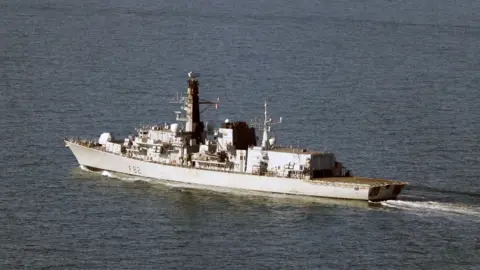
It is possible legal constraints may be preventing the UK from actively boarding and seizing tankers, said James M Turner KC, a shipping lawyer at Quadrant Chambers.
"The position with very few exceptions is that you can't seize vessels that are flying the flag of another country," he told BBC Verify.
Turner explained that if a ship travels through UK waters under a flag it is entitled to fly then there is "very little" a coastal state can do - regardless of whether the vessel has been sanctioned or is carrying sanctioned goods.
"I am wondering how this policy was formulated. It will have been carefully vetted and lawyered but it is incapable of being applied unless a tanker is false-flagged or has no flag.
"This is a case where rhetoric and reality do not coincide".
A "falsely-flagged" ship is one that incorrectly reports it is registered to a certain flag state. This is often used to help conceal the ship's true identity.
The tracking data also reveals several ships - including an oil tanker called the Yi Tong - changing their usual travel pattern.
Yi Tong is registered to a Chinese company called Pacific Shipmanagement based in the eastern province of Shandong.
In 2025, the ship travelled to and from the Port of Ust-Luga in north-west Russia to China via the English Channel.
Last month, however, the Yi Tong took a longer route around Ireland and the north of Scotland - avoiding the Channel and the UK's territorial waters.
The re-routing suggests the UK's policy is having some impact, added Prof Patalano.
"The Russians are probably already thinking how to test the UK more, and we should expect ships taking a longer route bringing some measure of challenge to UK defences and infrastructure."
Longer journeys use additional fuel, making it more costly and time-consuming for those involved in the sale of the ships' cargo.
BBC Verify asked the MoD if the UK's armed forces had intercepted any sanctioned vessels since 25 March.
The MoD did not answer our question directly but said it was "disrupting and deterring" the shadow fleet and more than 700 suspected vessels had been challenged since October 2024.
It added it would not comment on specific operations "as this could compromise our ability to successfully take action against these ships".
We went back to the MoD to ask what it meant by "challenging" vessels, but it did not provide us with further details.
Graphics by Sally Nicholls
Additional reporting by Nicholas Barrett and Yi Ma

Estonian President Alar Karis has appointed Tiina Intelmann as the new ambassador to Ukraine.

The 28-year-old Iraqi Kurd has evaded arrest by operating under the alias “Kardo Ranya”.

Russian forces carried out 24 strikes on settlements in the Chernihiv region over the past day, mainly using FPV drones.

As of the morning of May 12, consumers in the Donetsk, Kharkiv, Sumy, Chernihiv, and Mykolaiv regions are experiencing power outages due to Russian attacks. In the Zakarpattia region, six settlements were left without electricity because of bad weather.