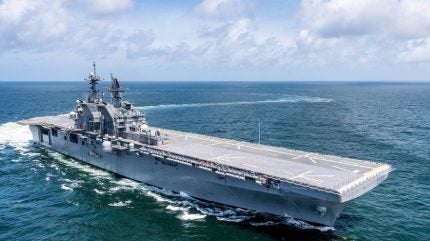
USS Tripoli arrives in Middle East with 3,500 troops aboard
The US Central Command has announced on 28 March 2026 that the amphibious assault ship USS Tripoli has entered its “area of responsibility”.
The post USS Tripoli arrives in Middle East with 3,500 troops aboard appeared first on Naval Technology.
Naval Technology
75
3 min read
0 views
The America-class ship leads the Tripoli Amphibious Ready Group and 31st MEU, comprising roughly 3,500 Sailors and Marines.
USS Tripoli (LHA 7) is an America-class amphibious assault ship. Credit: Derek Fountain/HII
The US Central Command (CENTCOM) has announced on 28 March 2026 that the amphibious assault ship USS Tripoli has entered its “area of responsibility”.
The America-class warship serves as the flagship for the Tripoli Amphibious Ready Group and the 31st Marine Expeditionary Unit (MEU).
Discover B2B Marketing That Performs
Combine business intelligence and editorial excellence to reach engaged professionals across 36 leading media platforms.
Find out more
It brings approximately 3,500 Sailors and Marines to the region along with its complement of transport and strike fighter aircraft and additional amphibious and tactical resources.
The update from CENTCOM a week after a report from CNN, citing maritime tracking data, indicated that a US Navy warship carrying Marines and Sailors was nearing the Malacca Strait off Singapore as it moved towards the Middle East earlier in the week.
Tracking data reportedly showed USS Tripoli approaching Singapore at the southwestern edge of the South China Sea.
USS Tripoli (LHA 7), built by Huntington Ingalls Industries’ Ingalls Shipbuilding Division, was delivered to the US Navy in 2020.
With a displacement of roughly 44,971 tonnes, LHA 7 measures 844ft in length and reaches speeds exceeding 20 knots.
The vessel features a gas turbine propulsion plant, zonal electrical distribution, and electric auxiliary systems initially employed on USS Makin Island (LHD 8). The ship supports operations with MV-22 tilt-rotor aircraft and F-35B Joint Strike Fighters.
The ship can carry out various missions including humanitarian assistance, disaster relief, maritime security and antipiracy operations. It is equipped with an enlarged hangar deck and expanded JP-5 fuel capacity for increased air support capabilities.
The vessel’s arrival follows a period of speculation regarding potential US ground troop deployments in Iran.
Iran has already reacted to the speculation with parliament speaker Mohammad Bagher Ghalibaf warning that his country’s forces were “waiting for American soldiers.”
He also warned that Iran would “rain fire” on any US troops attempting to enter Iranian territory, according to a BBC report.
Meanwhile, US President Donald Trump stated that the US would target Iran’s electric generating plants, oil wells, Kharg Island, and potentially all desalinisation plants if a deal to end military operations in Iran is not reached.
In a post on Truth Social, Trump said: “The United States of America is in serious discussions with A NEW, AND MORE REASONABLE, REGIME to end our Military Operations in Iran.
“Great progress has been made but, if for any reason a deal is not shortly reached, which it probably will be, and if the Hormuz Strait is not immediately ‘Open for Business,’ we will conclude our lovely ‘stay’ in Iran by blowing up and completely obliterating all of their Electric Generating Plants, Oil Wells and Kharg Island (and possibly all desalinisation plants!), which we have purposefully not yet ‘touched’.”
Last week, the USS Gerald R. Ford (CVN 78) arrived at Naval Support Activity Souda Bay on the Greek island of Crete on 23 March 2026 to undergo maintenance and repairs after operating in the Red Sea.