
The European left can make Europe’s China policy more socially intelligent. But leftists must not forget that Chinese society is more than the Chinese state.
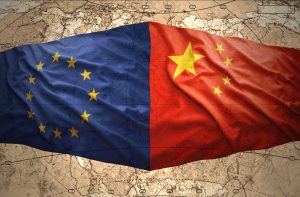
The European left has never had one China. It has had several: China as the last great revolution still standing; China as a developmental state that appears to have escaped neoliberal decline; China as authoritarian capitalism; China as a climate and trade partner; China as a strategic counterweight to American primacy; and China as the negative image of what socialism becomes when the party-state devours society. These Chinas coexist, compete, and often appear in the same speech. The result is not a single left-wing China policy, but a field of interpretations in which empire, capitalism, sovereignty, class, development, and democracy are constantly rearranged.
That field now matters for Europe. The European Union’s 2019 strategic outlook described China at once as a cooperation partner, negotiating partner, economic competitor, and systemic rival. Six years later, this formula is harder to sustain without political imagination. Eurostat reported that in 2025 the EU exported 199.6 billion euros in goods to China, imported 559.4 billion euros’ worth, and ran a deficit of 359.8 billion euros. Meanwhile, the 2025 China-EU summit showed how crowded the agenda has become: market access, rare-earth dependencies, climate cooperation, Russia’s war against Ukraine, Taiwan, and the South China Sea now sit on the same diplomatic table.
Public opinion has also shifted: Pew Research Center found in 2025 that people on the ideological left were more likely than those on the right to prioritize a close economic relationship with China. The left’s China debate is therefore not marginal. It is one of the places where Europe tests whether strategic autonomy is more than a slogan.
The political danger lies in false symmetry. Liberal hawks often reduce China to a security threat and mistake alignment with Washington for strategy. Campist leftists often reduce China to a counterweight and mistake opposition to Washington for analysis. Both flatten China; both turn Chinese society into an object of European argument. A better approach begins by distinguishing among the different meanings of left-wing sympathy, critique, and engagement with China.
Yet “the pro-China left” is a misleading category. Sympathy is not alignment; alignment is not dependence; contact is not capture. Conversely, opposition to war, sanctions, or American primacy does not automatically amount to democratic internationalism. The relevant question is more precise: under what conditions does criticism of U.S. power become uncritical accommodation of Chinese state power? And under what conditions can left-wing skepticism toward securitized China policy improve Europe’s judgment?
One influential grammar is anti-hegemonic, often couched in anti-imperialist language. It reads China less as a regime than as a geopolitical function: the main obstacle to a U.S.-led order. Campaigns such as No Cold War, peace movements critical of AUKUS and NATO expansion, and figures such as Yanis Varoufakis frame de-escalation with China as a precondition for global survival. In this register, China represents not utopia but leverage: proof that the Washington consensus was not destiny, that industrial policy can work, and that the Global South need not accept a permanent hierarchy designed in the North Atlantic.
Similar motifs appear in statements by parts of the European parliamentary left. Helmut Scholz warned already in 2019 against “anti-China hysteria,” while the French National Assembly’s 2025 report by Sophia Chikirou called for abandoning the EU’s partner-competitor-rival triptych in favor of cooperation respectful of sovereignty. Chinese state media and Chinese Academy of Social Sciences-linked platforms have also highlighted Pablo Iglesias’ appeals for stronger China-EU ties and reduced dependence on the United States.
This current gets something important right. European China policy often dresses weakness as virtue: dependence on Chinese supply chains is denounced only after it has been built; deindustrialization is treated as Beijing’s fault rather than as a result of European policy choices; and human rights language is applied with striking selectivity. The left is right to ask who pays for de-risking, whether it becomes another name for militarized industrial policy, and how a Europe that cannot build enough batteries, grids, trains, affordable housing, or public digital infrastructure expects to bargain with a state that has made planning capacity a core instrument of power. It is also right to take China’s developmental record seriously. The World Bank’s estimate that nearly 800 million people in China were lifted out of poverty is not a propaganda footnote; it is a historical fact that any serious account of global inequality must explain.
But this is where the left’s strongest critique can become its weakest reflex. Admiration for state capacity becomes evasive when it loses interest in the state as domination. A democratic socialist analysis of China cannot stop at growth, poverty reduction, or multipolarity. It has to ask what happens to workers, lawyers, feminists, Uyghurs, Tibetans, Hong Kong democrats, Taiwanese citizens, and Chinese Marxists who contest the party-state’s monopoly over political meaning. The U.N. human rights office’s Xinjiang assessment concluded that the scale of arbitrary and discriminatory detention of Uyghurs and other predominantly Muslim minorities may constitute international crimes. U.N. human rights officials have also warned that Hong Kong’s expanded national security regime can criminalize conduct protected under international human rights law. These are not incidental liberal talking points. They concern the elementary socialist question of whether society can speak back to power.
A second grammar is democratic-internationalist. It begins from the same unease with U.S. primacy and European hypocrisy, but refuses to translate anti-imperialism into camp loyalty. Here China is neither a civilizational enemy nor a progressive surrogate. It is a powerful authoritarian-capitalist state whose cooperation is indispensable on climate, debt, trade, health, and war, and whose political model remains incompatible with democratic socialism. This position is often found among green-left, social-democratic, trade union, human rights, and China studies voices. Its difficulty is political rather than analytical: it lacks the emotional simplicity of both hawkish liberalism and campist anti-imperialism. It asks Europe to compete, cooperate, and criticize at the same time.
A third grammar is governmental and pragmatic. Once left parties enter office or coalition, China becomes less a symbol than a dossier: investment, ports, universities, electric vehicles, rare earths, sanctions, Russia, Taiwan, and industrial policy. The British government’s 2025 China audit, framed under Labor as “progressive realism,” captured this tension by insisting that engagement with China is unavoidable while identifying security, repression, and support for Russia as serious challenges. This pragmatism can be responsible. It can also become evasive if it treats China policy as technocratic management and leaves normative questions to activists or conservatives.
National idioms matter. In Spain, China is often filtered through Podemos, Latin American anti-imperialism, and debates about U.S. power. In France, the issue intersects with republican sovereignty, La France Insoumise, protectionism, and the old Gaullist suspicion of Atlantic discipline. In the United Kingdom, China is refracted through the anti-war movement, Hong Kong’s postcolonial afterlife, Labor’s return to government, and an increasingly security-conscious state. The same word – sovereignty, peace, sanctions, multipolarity – therefore carries different meanings in different arenas.
This is why a better analysis would not ask whether “the European left” is pro-China. It would compare how left actors in Spain, France, and the United Kingdom construct China as model, partner, rival, warning, or anti-hegemonic reference point. Spain reveals the Iberian and Latin American afterlife of anti-imperialism; France the fusion of sovereignty, republicanism, and protectionism; Britain the tension between peace activism, Hong Kong, and a Labor government trying to rebuild channels to Beijing without appearing naive about security.
Influence networks are the most delicate part of the story. There is no need for conspiracy thinking. The more interesting question is how narratives travel through conferences, friendship associations, parliamentary delegations, party-to-party diplomacy, think tanks, media appearances, and mutually flattering interviews. Recent work by Julia Bader and Christine Hackenesch showed that the Chinese Communist Party’s International Department has been an underappreciated actor in Europe, aiming to build elite networks and external legitimacy. Their dataset found that left-leaning parties account for more than 60 percent of the CCP International Department’s contacts in Europe and more than 70 percent of its opposition-party contacts.
The department itself stated in November 2025 that the CCP wanted to enhance exchanges with left-wing parties in Western Europe and Latin America, strengthen theoretical exchange, and consolidate political mutual trust. None of this proves control. It does show that elective affinity is politically useful before it becomes direct influence.
Voting behavior in the European Parliament points in the same direction. China-critical resolutions often command broad majorities, yet the distribution of dissent, abstention, and rhetorical framing reveals recurring patterns. A 2025 China Observers analysis of parliamentary votes found that on a 2024 Taiwan-related resolution concerning Beijing’s interpretation of U.N. Resolution 2758, opposition and abstention were higher than on a preceding Uyghur-related motion; some members of the left, far-right groups, and non-attached MEPs voted against it, though the authors cautioned that such votes cannot simply be read as explicit support for China.
That caveat is essential. Effects and intentions are not the same. A vote may express anti-militarism, hostility to U.S. policy, distrust of conservative rapporteurs, or concern about escalation rather than sympathy for Beijing. But political effects still matter. If a position repeatedly amplifies the preferences of an authoritarian great power while silencing the voices of those most exposed to it, the burden of explanation rises.
The problem for Europe is not that parts of the left speak to China. Dialogue is necessary, and refusing contact can itself become a form of strategic ignorance. The problem begins when contact narrows the range of acceptable criticism, when Chinese official framings are reproduced as independent European insight, or when peace politics treats Taiwan’s agency, Uyghur testimony, or Hong Kong’s civic space as inconvenient details. A left that denounces domination only when it is Western has not escaped imperial reasoning; it has merely inverted its geography.
The advantage for Europe is equally real. Left dissent can prevent China policy from collapsing into a moralized security consensus in which every social question disappears behind the language of threat. It can force policymakers to ask what de-risking means for workers, whether green industrial policy is possible without Chinese technology, how Europe can reduce dependency without reproducing austerity, and whether a continent that aspires to strategic autonomy can simply subcontract its Asia policy to Washington. A serious left can also remind Europe that criticism of China is strongest when it is not hypocritical – when it is tied to labor rights, democratic accountability, social justice, and the same concern for civilian life in Gaza, Ukraine, Xinjiang, and Taiwan.
A serious study of the European left’s China debate should therefore separate four levels that public debate too often fuses: rhetorical sympathy, policy alignment, organizational contact, and material dependence. It should read speeches, parliamentary votes, reports, travel, conference invitations, media ecosystems, funding channels, and silences. It should also track reception: when Chinese official outlets highlight a European left-wing statement, what is selected, translated, amplified, or omitted? The issue is not whether Europeans are allowed to disagree with the dominant China consensus. They must. The issue is whether disagreement remains analytically independent.
The way forward is not to choose between campism and Atlanticism. Campism mistakes the enemy of one’s adversary for an ally. Atlanticism accepts a U.S.-centered strategic script and calls it realism. A democratic European China policy should be harder than both: anti-war without being apologetic, anti-authoritarian without being imperial, strategically autonomous without being neutral between democracy and repression, and materially serious about the social foundations of power. The European left will matter in this debate precisely because it can make Europe’s China policy more socially intelligent. It will fail precisely where it forgets that Chinese society is more than the Chinese state.


