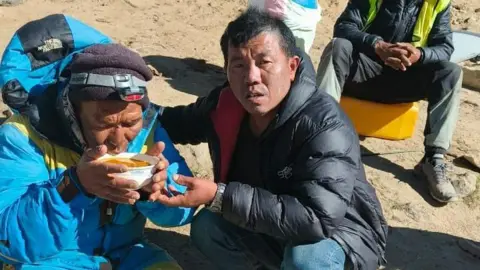
Everest guide survived six-day ordeal by eating chocolate and 'chewing ice'
Dawa Sherpa was spotted alive by a cleaning crew as he slid slowly down the world's tallest mountain and spoke to the BBC from hospital.
BBC News - Asia
75
5 хв читання
0 переглядів
13 hours ago
Kamal Pariyar, BBC Nepali,
Toby Mannand
Flora Drury
The Nepali guide discovered crawling down Everest six days after he was last seen alive has told the BBC he survived by "chewing ice" and eating a few chocolates he found in his pocket.
Dawa Sherpa was adamant he did not "go missing" on the descent down, but instead was forced to "stay behind" after his oxygen ran out.
It had been assumed Dawa Sherpa had perished on the mountain, with his family back in Nepal's capital Kathmandu starting to perform last rites before he was spotted by a clean up team "sliding" down the mountain towards Base Camp.
He was airlifted to hospital in Kathmandu, where he spoke to the BBC while receiving treatment for dehydration, frostbite and a fractured bone.
"I didn't think I would be alive," he told BBC Nepali on Friday. "I thought I would perish this way."
Climber Chris Thrall was the last person known to have seen Dawa Sherpa alive before he was rescued near the Khumbu Icefall on Thursday.
The former British soldier said the 57-year-old was sitting on his backpack just above Camp 3 - around 7,500m (24,600ft) - "as he had done hundreds of times before to take a short rest".
Thrall continued to descend alone for what he estimated to be about 50-100m before he came across another member of their group, a "Polish climber with no oxygen, battling fairly severe frostbite".
"So immediately my attention turned to the weakest member of the trio. And that was that," he told the BBC's Newshour programme.
"As Ilookback up the mountain, as I helped this guy descend, Hillary Dawa didn't appear to have moved, and certainly wasn't descending, because we would have seen his head torch."
Trapped in a crevasse
Up above, Dawa Sherpa told the BBC he had found himself in trouble.
"As the oxygen ran out, I couldn't walk," he explained.
"I didn't eat anything for the first two days. Then I began chewing ice. It hurt my teeth. I chewed the ice hard."
Then he discovered chocolates in his pocket, and managed to get some melted ice to drink.
He made his way down slowly - only to fall into a crevasse, according to two different people who spoke to Dawa Sherpa about his ordeal.
For two-and-a-half days he was trapped, they said, unable to find a way out.
Sagarmatha Pollution Control Committee (SPCC)
Dawa Sherpa (L), who was feared dead after going missing on Everest last week, has been found
Then an avalanche sent snow tumbling into the crevasse, and gave him the first hope he had had in days.
"Stepping on the snow, I stood up and looked above... It felt I could get out from there," he told the BBC.
Once he had scrambled out, he found ropes nearby which helped his manoeuvre further down the world's tallest mountain.
Another avalanche threatened his progress, but he was determined to keep going.
"I got through the snow and moved downwards. I walked throughout that night.
"Then, I came close to the base camp."
It was there he saw the first people he had seen in almost a week.
"Boys were going up to collect the waste. I met them. They carried me down."
'Beyond words'
News of his survival was met with shock and delight by the wider sherpa community, the climbers he had been with, and his own family.
Five people have died during this year's climbing season, with more than 300 dying since records began in the 1920s.
Pemba Sherpa, executive director of 8K Expeditions which was overseeing search efforts, called it a "true self-rescue".
"Dawa managed to survive against all odds for days. It's nothing short of a miracle," he said.
When Thrall first saw comments on social media saying Dawa Sherpa, also known as Hillary Dawa Sherpa after famed mountaineer Edmund Hillary, had been found alive, he said he thought it was "spam".
"It's kind of crazy one minute to be fighting back tears with his daughter, and then the next minute to see him crawling into town," Thrall told BBC's Newshour. "It's absolutely amazing, beyond words."
His wife, Damu Sherpa, told the BBC that she had given up hope when told by the expedition company a rescue operation was not possible. The family had begun his last rites.
"When I saw him for the first time, I was so surprised. I was in huge tension after we were told that he would never return home. I can't believe how he came back alive. I couldn't believe my eyes about how he returned safely," she said.
"I wonder about how long he remained alive without food and supplies... I can't understand how my husband ate and drank in such a height. I hope no-one will have to face this fate."
She said the Nepalese government should make sure such similar incidents do not happen again.
"He recognised me … is good and speaks," his daughter Mhendo Lhamo Sherpa told Reuters news agency later, after visiting him. "We are happy."
Doctors at Kathmandu's HAMS Hospital say Dawa Sherpa has been "receiving comprehensive medical care in the intensive care unit", but is stable and his "dehydration is showing significant improvement".
More than 1,000 people have summited Everest this season, making it the busiest on record.