3 hours ago
Katya AdlerEurope Editor
It is not the first time that there has been deep energy-linked frustration in the heart of Europe.

3 hours ago
Katya AdlerEurope Editor

 BBC
BBC
The knock-on effects of the conflict now whipping through the Middle East are awakening ghosts of crises past that shook the European Union.
Seven months into Russia's full-scale invasion of Ukraine, launched in February 2022, the President of the European Commission stood at her podium in the European Parliament and accused Russia of manipulating the EU's energy market.
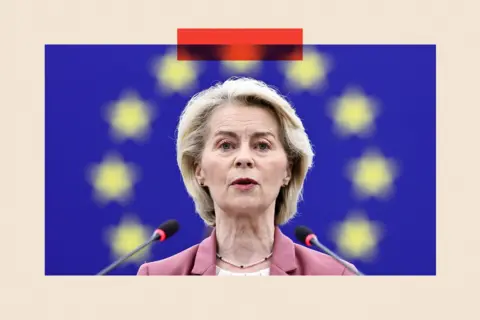
"They prefer to flare the gas than to deliver it," proclaimed Ursula von der Leyen, as spiralling energy prices hit consumers across the continent. "This market is not functioning anymore."
"This is a war on our energy, a war on our economy, a war on our values and a war on our future," she declared, insisting that Europe was already pivoting away from Russian gas and toward more dependable partners such as the US and Norway.
But fast forward four years and you find deep energy-linked frustration in the heart of Europe once again.
"We swore we'd learn. We promised things would change but here we are," a highly frustrated European diplomat told me. He asked for anonymity so as to be able to speak openly.
The focus of his teeth grinding was Europe's growing energy shock, triggered by the burning conflict in the Middle East and threatening to dominate a summit of European leaders in Brussels on Thursday.
"Instead of concentrating on much-needed long-term plans - about how to make Europe more competitive in this increasingly volatile world, [European] prime ministers and presidents are now in a panic over [energy] prices, worried about angry voters and scrambling for short-term solutions.
 EPA/Shutterstock
"Just like the crisis after Russia's fullscale invasion of Ukraine. Different conflict. Same European divisions; same dilemmas over energy. We can't keep going round in these circles. Something's got to give."
You'd be hard-pushed to find a policy-maker in Europe who didn't agree with that last statement.
But can Europe - whether that be the whole continent or even just the 27 member states of the EU, with their diverse range of industries, energy requirements and perspectives on renewables - really secure its own energy?
A lot has changed since 2022, when Europe decided to phase out its reliance on Russian gas, oil and coal and become more energy independent, following Moscow's widespread assault on Ukraine.
Considering the EU's slow-moving reputation, the bloc moved swiftly once it decided to cut ties with Russian energy suppliers. Now only 2% of its oil imports come from Russia, flowing to Moscow-friendly Hungary and Slovakia alone. The EU plans an end to all Russian gas imports - including LNG by next year.
Quite a turnaround from before Russia's invasion of Ukraine when Russia supplied an estimated 55% of German natural gas imports for example, fuelling its energy-hungry industries, especially chemicals and car manufacturing.
 Getty Images
As energy prices skyrocketed in 2022 in reaction to Russia's invasion and the energy standoff between Russia and Europe, many countries, like Italy and the UK, felt forced to help consumers and businesses pay their bills. Coming so soon after the economic shock of the Covid-19 pandemic, already cash-strapped governments really felt the squeeze.
"Diversification" became the buzzword in Brussels corridors. The EU decided it would never again allow itself to be so dependent on a single energy supplier.
But four years later, the dependency is still there, even though there is more than one supplier. Europe now heavily relies on Norway and the US for its energy. Simply taking Russia out of the equation hasn't solved the continent's issue with energy security.
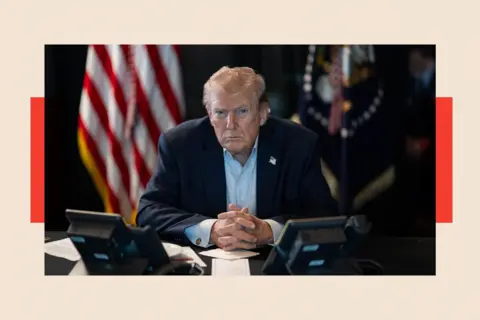
President Donald Trump's US has become one lynchpin in Europe's energy provisions, replacing Russia.
Europe made a rapid shift from Russian pipeline gas to liquified natural gas (LNG) in 2022. This continent is now the world's largest LNG importer and the biggest single LNG supplier (to a tune of 57% of total LNG imports to the EU) is the US.
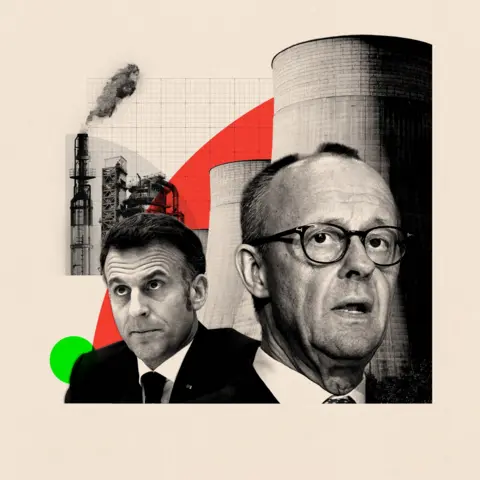
Energy-hungry Germany gets as much as 96% of its LNG from the US now. This dependence might explain why the German Chancellor Friedrich Merz remained silent when he sat next to Trump in the White House two weeks ago, as the US president berated and threatened to impose a trade embargo on Spain, because it had not allowed him to use military bases on its territory to launch attacks on Iran.
Perhaps the spluttering German economy and its current thirst for US energy were on Merz's mind. Perhaps he did not want to risk the wrath of the American president, with his reputation for vengefulness. But it wasn't a good look for European unity that day.
Since returning to the White House just over a year ago, Trump has used economic leverage and Europe's desperation for the US to help find a sustainable peace in Ukraine, to lean on the EU to commit to buying more expensive US LNG.
 Global Images Ukraine via Getty Images
Back in July, Trump threatened the bloc with painful 30% tariffs on all its exports to the US, bar commodities like steel that already faced even higher levies.
The President of the European Commission, Ursula von der Leyen duly flew to Trump's Turnberry golf resort in Scotland, where the US president was on holiday, and signed up to spending $750bn (£568bn) on US oil, LNG and nuclear technologies over the next three years.
The EU promised to levy zero tariffs on US imports. In exchange, Trump "reduced" his 30% tariff threat to 15% on most EU exports to the US.
Von der Leyen presented this deal as a strategic response to lessen EU reliance on Russian fossil fuel. But it placed the bloc in a clear position of weakness vis a vis the US.
The Trump administration, meanwhile, celebrated striking the largest trade deal in history, positioning itself as shrinking its much-resented trade deficit with the EU and ensuring a massive amount of EU investment in US energy, military hardware and more.
But it's actually not at all clear that either EU energy demands or US exports can support the scale envisioned in the deal, which is currently being debated in the European parliament.
And European reliance on LNG makes it extremely vulnerable to global price volatility in times of crisis, as we now see in the Gulf.
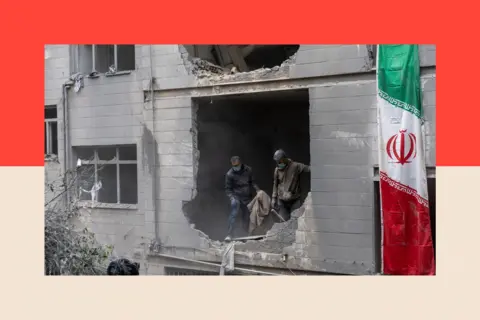
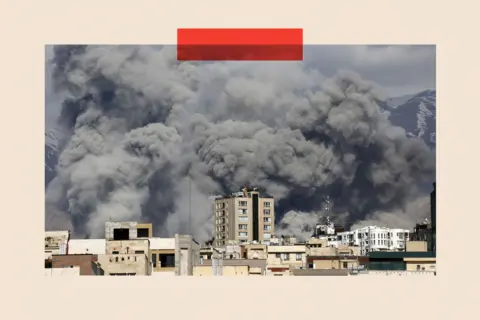
The Strait of Hormuz is one of the world's most important shipping routes, and its most vital oil transit choke point. Around 20% of global oil supply passes through it. The Strait has been effectively blocked by Iran, except for a handful of vessels carrying Iranian oil to India and China, since Israel and the US attacked Tehran on 28 February.
Although Europe does not buy much oil or LNG from the Middle East, both commodities are global markets: any blockage of the Strait of Hormuz - now or in the future - can provoke price spikes affecting Europe, regardless of its limited physical imports.
The sudden scarcity of supply, plus uncertainty about how long the current crisis will last, saw oil prices spike about 8% percent and the European gas price about 20% on the morning of 2 March.
"This choice between Russian energy and global market volatility is a very bad choice for Europe," Dan Marks, a specialist in energy security at the defence think tank, the Royal United Services Institute (Rusi), told me.
He says Europe will still manage to secure energy supplies in the current crisis, despite the effective closure of the Strait of Hormuz, because the wealthy continent can out-pay other regions in a crisis. But the problem is cost and competitiveness.
Long-term, he says, Europe needs to think about how to better build energy stockpiles and reduce or reorganise energy consumption to attain more control over sudden supply changes, like we're seeing now.
Marks also warns that continued European reliance on outside actors, like the US, for crucial energy supplies, throws up "wildcards" often not considered.
What if Trump suddenly decided to keep energy supplies for US domestic consumption only, in an attempt to reduce petrol prices in the US or as a way to punish European countries for not immediately sending warships to the Strait of Hormuz to keep the waterway open, as he demanded this week.
Marks also raises the possibility of the US suffering terrible storms or fires in the future, destroying LNG terminals.
"It's a layering of risk. There are no easy answers here," Marks concludes.
Even the increased use of gas from democratic ally Norway comes with challenges.
 The White House via X Account/Anadolu via Getty Images
Norway is now the EU's largest gas supplier, essentially taking the place of Russia, providing a third of the bloc's annual gas consumption and half of the UK's.
Norway has also made clear that it is already operating close to maximum output. This presents a dilemma for the EU because increasing supply would require new exploration and investment.
Oslo suggests the EU is shooting itself in the foot with plans to put an end to oil and gas development in the European Arctic as part of a push to mitigate climate change. It points out that Russia has huge plans to expand liquefied natural gas production in the Russian Arctic.
Norway is lobbying Brussels hard to change its policies. This is just one of a host of ways environmental decisions are being sucked into the vortex that is Europe's energy debate.
The hunt for short-term answers will dominate Thursday's EU summit. There is deep concern among a number of leaders that spiralling energy and possible inflationary rises, (coupled with possible refugee influxes to Europe on the back of the growing Middle East crisis) will alienate voters and play into the hands of populist nationalist politicians on the right and left of the European political spectrum.
"It is crucial that we reduce the cost impact [from the Iran war]," Ursula von der Leyen said this week in the run-up to the summit. "We must deliver relief now… [We need] a comprehensive look at how to reduce people's energy bills."
EU leaders are considering reviewing taxes, introducing price caps for consumers and other measures as a quick fix for struggling industries.
Outside the bloc, the UK government has also been coming under pressure to help support households with rising energy costs. Last week, British Chancellor of the Exchequer Rachel Reeves said that Treasury officials were re-examining preparatory work undertaken during the 2022 Russia-Ukraine energy shock.
EU governments have also asked the European Commission to accelerate the expansion of electrification across the bloc, while keeping costs under control.
They are aware that China is already far ahead in this process. It is true that as the world's biggest oil importer, it has been hit by the de facto closure of the Strait of Hormuz. But Beijing has long pursued an energy security strategy designed exactly for moments like this.
At its core is electrification: shifting more of the economy away from direct oil and gas consumption. The aim is to reduce exposure to volatile oil and gas markets vulnerable to geopolitical disruption.
More than 30% of China's final energy consumption now comes from electricity, compared with just over 20% globally, and less than a quarter in the EU.
Policies aimed at energy security, as much as emissions reduction targets, have resulted in more than half of the cars sold in China being electric, rather than combustion-engine driven.
But unlike in China, in the EU, division is everywhere. Supporters and opponents of Green policies and alternative energy supplies are all using the Iran war to support their distinct point of view, for example.
 WPA Pool/Getty Images
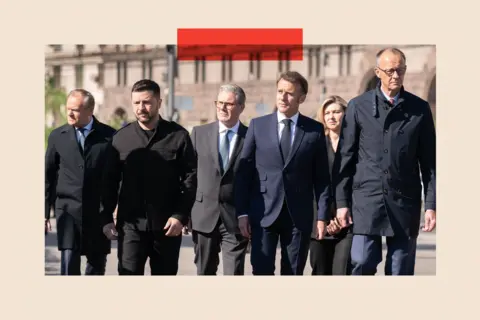
Belgium's Prime Minister, Bart De Wever, shocked many this weekend, including members of his own coalition government, calling for the EU to normalise relations with Russia to regain access to cheap energy.
"It is common sense," he asserted. "In private European leaders tell me I am right, but no one dares say it out loud."
You do, at times, hear deeply off-the-record mutterings from parts of German industry to this effect. The hard-right AfD party, which tops German opinion polls, calls for sanctions on Russia to be lifted immediately.
Elsewhere in Europe, soaring energy costs provoked by events in the Middle East are being used as yet another argument to weaken the EU's two decade old Emissions Trading System (ETS).
The ETS forces industry to pay a carbon price for polluting practices. It is designed to wean companies off using fossil fuels in the long-term.
A raging row is expected at Thursday's EU leaders' summit between countries that want to maintain the ETS and those that want to weaken or abolish it.
 Anadolu via Getty Images
A number of EU member states, including Spain, Sweden and Denmark have made clear their belief that weakening the ETS would penalise companies that have sought to modernise and become greener and reward the laggards - those industries clinging to long-term reliance on fossil fuels.
On the other side of the argument, Central European countries are fundamentally opposed to the ETS, while Austria and Italy want to tackle the impact of the ETS on electricity prices.
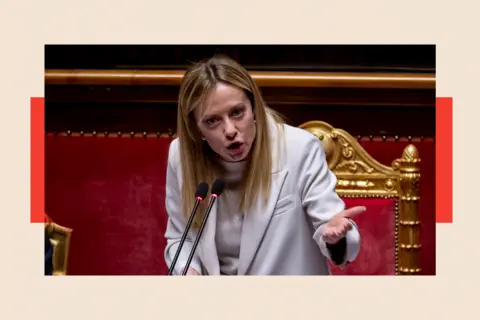
Italian Prime Minister, Giorgia Meloni, said last week: "With the outbreak of the crisis in the Middle East, the issue of energy prices has clearly become even more important, which is why, at European level, we are also calling for the urgent suspension of the application of the ETS to electricity production."
One proposal by the European Commission, which admits the ETS system needs a revamp, would be to use revenues earned from the ETS to help industries in EU member states struggling with rising costs.
"We are in a complex world of trade-offs," says Georg Zachmann, a specialist in EU energy and climate policies from the Brussels-based Bruegel think tank.
"If Europe wants to get invested in nuclear or renewable energies with the aim of being more self-reliant and energy secure, that will take time."
He describes it as "madness" that sunshine drenched southern Italy doesn't put up more solar panels, for example.
"You need a long-term plan but also a realistic one. The EU has one, but new targets for 2030 and particularly 2040 are very ambitious."
The EU has set a legally binding target to reduce net greenhouse gas emissions by 90% by 2040, compared to 1990 levels. "Are they actually credible?" he asks.
 Getty Images
Zachmann says EU governments are also afraid of costs. "Europe broadly wants to push oil and gas out of the [energy] mix but policy makers are sensitive to cost implications." And voter reactions.
Politics are also getting in the way of closer cooperation between the EU and the UK over energy, he says.
"On a sectoral level, both EU and UK energy people want to work more together because it makes a lot of sense. From a purely economic perspective everyone would benefit."
But the shadow of Brexit politics hangs over the conversation, he says. Ultimately the EU defers to the European Court of Justice to ensure the bloc's single market works properly. "And the UK doesn't accept that."
Rusi's Dan Marks says the EU needs to think more flexibly and the UK could do with being more ambitious when it comes to energy cooperation.
"The reality that Europe faces will keep bringing the two parties back together," he says. "The UK has the biggest offshore wind fleet and biggest plans for the North Sea, whereas the British government will want to ensure that in a crisis, France wouldn't cut off energy supplies to the UK," he adds. There's a mutual interest in assured energy security.
So, will the Iran war prove a turning point in Europe achieving - or at least making significant strides - in attaining better energy security?
"Every time there's an oil and gas crisis, everyone thinks it's a turning point," says Marks.
"Think back to the 1970s and 80s and US congress looking at reducing dependency and energy consumption. Now it's 2026 and lo and behold, there's another gas crisis and we're just as exposed as ever we were."
There is no denying that this is a significant moment. EU leaders meeting in Brussels are more than aware of that. The question is whether they will have the unity, or the courage, to change much.
Top image credit: Bloomberg / AFP / Getty Images
More from InDepth

The Pentagon has asked the White House to approve a more than $200 billion request to Congress to fund the war in Iran.

Commander-in-Chief of the Ukrainian Armed Forces Oleksandr Syrskyi has said that enemy activity along the frontline is increasing, while Russia plans to recruit an additional 409,000 troops in 2026 and continues preparations for further aggression against Ukraine.

US intelligence says Russia believes it can win in Ukraine and sees no reason to stop, warning the war could escalate into direct conflict with NATO and reshape global security.

For many years she has shunned the media and made few public appearances. This chosen role as a recluse has only added to the enigma and reverence surrounding this brilliant and defiant Ukrainian.