
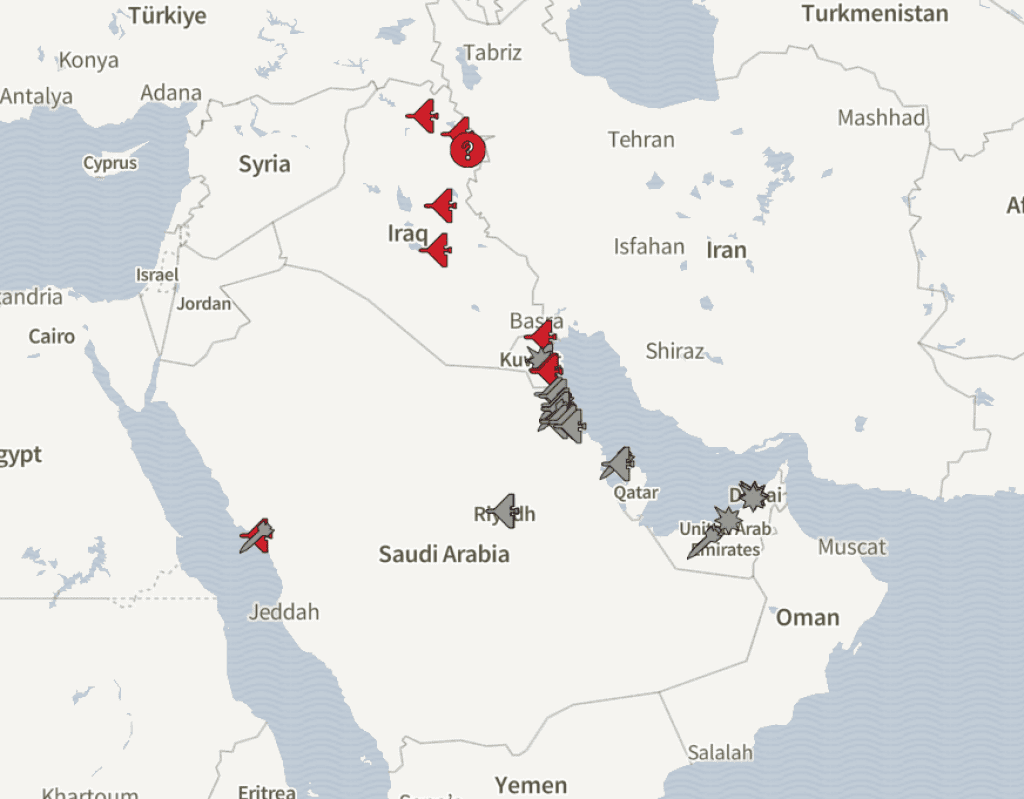
Between March 17 and March 19, Iran and its allied militias continued launching drones, missiles, and rockets across the Middle East, targeting energy infrastructure, airports, military bases, diplomatic facilities, and residential areas in Saudi Arabia, the United Arab Emirates, Qatar, Kuwait, Bahrain, and Iraq. Air defense systems intercepted many incoming projectiles, but several strikes still caused deaths, injuries, fires, and infrastructure damage, particularly in the United Arab Emirates, Qatar, and Baghdad, Kirkuk, and the Kurdistan Region in Iraq.
The following is a list of the attacks that Iran and its affiliated militias launched against Arab states between March 17 and 19.
March 17
In Saudi Arabia, Iranian attacks again concentrated heavily on the Eastern Province. Saudi authorities reported intercepting repeated drone waves there, including in groups of three, three, six, two, 12, two, three, seven, four, and three. Saudi defenses also intercepted a ballistic missile targeting Al Kharj.
In the United Arab Emirates, the Ministry of Defense announced multiple rounds of interceptions during the day, including one major wave of 45 drones and 10 ballistic missiles, in addition to several other attacks involving undisclosed numbers of drones and missiles. In Abu Dhabi, falling shrapnel from an intercepted missile killed a Pakistani civilian.
In Qatar, the Defense Ministry announced that it intercepted two separate Iranian missile attacks and later reported intercepting nine missiles and an undisclosed number of drones in another attack. In Kuwait, the Kuwait Armed Forces announced that it intercepted two missiles and 13 drones. Falling shrapnel caused two injuries.
In Bahrain, authorities said they intercepted 12 drones.
In Iraq, drone threats continued against US diplomatic facilities in Baghdad. Two drones were intercepted as they approached the US Embassy, while another reportedly wasn’t intercepted by defenses and impacted nearby. Additionally, an unspecified quantity of rockets was also fired towards the embassy. One drone was intercepted targeting the Baghdad Diplomatic Support Center near Baghdad International Airport. Outside the capital, a drone crashed near Mosul without exploding, and another drone was intercepted over Salah al Din near Samarra.
In Iraqi Kurdistan, two drones targeting Koysinjaq and eight targeting Erbil were intercepted. Iran also launched two missile attacks against Peshmerga forces in Balisan.
March 18
In Saudi Arabia, Iranian attacks remained intense and again focused on Riyadh, Al Kharj, and the Eastern Province. Saudi authorities reported intercepting a drone and a ballistic missile in Al Kharj. In Riyadh, air defenses intercepted four ballistic missiles in one attack, another four ballistic missiles in a separate attack, a drone over the city, and two drones approaching the Diplomatic Quarter. Shrapnel from one interception fell in the capital, and other debris landed near a refinery south of the city. In the Eastern Province, Saudi defenses intercepted repeated drone and missile attacks, including two ballistic missiles in one incident, another in a separate incident, and multiple drone waves of one, one, one, two, four, two, four, three, five, one, six, and six. Saudi authorities also said they shot down a drone approaching a gas production facility and intercepted several drones targeting energy infrastructure.
In the United Arab Emirates, a projectile launched by Iran struck a road near Al Minhad Air Base in Dubai, damaging facilities at the base and sparking a fire, though no casualties were reported. The UAE Ministry of Defense also announced that it confronted 13 ballistic missiles and 27 drones in one wave, along with another separate missile-and-drone attack of an undisclosed size.
In Qatar, a ballistic missile struck Ras Laffan Industrial City, causing a fire in the major liquefied natural gas hub. Qatari defenses also intercepted two ballistic missiles targeting Ras Laffan, then four more ballistic missiles targeting the same area, and later announced intercepting another Iranian missile attack of an undisclosed size.
In Kuwait, the army announced that it intercepted four ballistic missiles. It also said it intercepted 20 drones, while three additional ones fell in uninhabited areas. Separately, the Kuwaiti National Guard reported intercepting seven more drones.
In Bahrain, the Bahrain Defense Force announced that it intercepted one drone and four ballistic missiles.
In Iraq, a drone was intercepted targeting Baghdad International Airport. Later, a drone attack struck the US Embassy complex in Baghdad, sparking a fire. In Kirkuk, the Iraqi Ministry of Defense said that an attack struck Kirkuk Air Base, causing a fire and damage, but no casualties.
In Iraqi Kurdistan, drone attacks continued across multiple areas. In Erbil, a number of drones were intercepted in the morning. In Koysinjaq, a drone strike caused damage and sparked a fire. In Sulaymaniyah province, four drones were intercepted. Peshmerga forces also reported that drones struck their bases in Erbil and Sulaymaniyah provinces, injuring three fighters between the two locations.
March 19
In Saudi Arabia, Iranian attacks focused on the Eastern Province, Riyadh, and Yanbu. Saudi authorities reported intercepting repeated drone waves in the Eastern Province, including groups of two, three, two, four, three, five, two, two, and two, as well as two ballistic missiles targeting the province. In Riyadh, Saudi defenses intercepted two drone attacks consisting of six and five drones. On the Red Sea coast, a drone struck the SAMREF oil refinery in Yanbu, while Saudi forces intercepted a ballistic missile targeting the Port of Yanbu.
In Kuwait, Iranian attacks targeted both strategic energy infrastructure and the country more broadly. One drone struck an operational unit at the Mina al Ahmadi refinery, igniting a small fire but causing no injuries. Another drone struck an operational unit at the Mina al Abdullah refinery, also causing a small fire without casualties. Elsewhere, the Kuwaiti army said that it intercepted 13 drones, and three others fell in open areas. It later reported intercepting a broader missile-and-drone barrage.
In Bahrain, the Bahrain Defense Force announced that it intercepted two missiles and four drones targeting the kingdom.
In the United Arab Emirates, Iranian attacks focused on key energy infrastructure. Emirati authorities announced the interception of missiles targeting the Habshan gas facility and the Bab oil field, both of which were shut after weathering falling debris. The UAE Ministry of Defense also announced several rounds of interceptions during the day, including one wave of seven ballistic missiles and 15 drones, along with additional attacks involving undisclosed numbers of missiles and drones.
In Iraq, suspected Iran-backed militia activity continued across several provinces. A drone crashed in Al Khalis without causing casualties, and another crashed in Al Ibrahimiyah without exploding or causing harm. In Basra, two drones struck the radar system at Umm Qasr naval base, though details on casualties and damage were not provided.
In Iraqi Kurdistan, attacks concentrated on Iranian-Kurdish opposition groups. Four drones targeted the headquarters of the military wing of an Iranian-Kurdish opposition party in Erbil province, sparking fires that caused damage and injuries. Drones also targeted the Komala group’s headquarters in Surdash without causing casualties. In Zirgewez, another Komala facility was attacked, again without reported casualties.
Ahmad Sharawi is a senior research analyst at the Foundation for Defense of Democracies focused on Iranian intervention in Arab affairs and the Levant.
Tags: Iran, Iranian strikes on Arab states, Israel Iran, Operation Epic Fury, Operation Lion’s Roar, US-Iran


