
North Korea announced a second 10-year reforestation campaign in April 2026, pledging to restore degraded forests across the country through 2035 — but satellite imagery analysis reveals structural limits that could undermine the effort without outside support.
On April 1, the Rodong Sinmun, North Korea’s state-run party newspaper, introduced the “Second 10-Year Reforestation Campaign,” declaring forest restoration a core national policy priority for the next decade. The plan follows the first campaign, which ran from 2015 to 2024 under Kim Jong Un, and is divided into two phases: 2026 to 2030, and 2031 to 2035.
The campaign’s central goal is to restore approximately two million jeongbo (about 2 million hectares) of degraded forestland nationwide. Authorities have directed city- and county-level forest management stations and local administrative bodies to meet afforestation targets, while pledging to expand nursery infrastructure and advance what state media describes as the “scientification, industrialization, and intensification” of seedling production.
Satellite data shows mixed results
Vegetation index (NDVI) analysis of long-term satellite imagery shows that North Korean forests have declined steadily since the 1980s, with deforestation accelerating sharply after the famine of the 1990s as hillside farming expanded and firewood collection stripped slopes bare. Since 2015, however, some areas have shown signs of recovery. I estimate that roughly 1.22 million hectares of new forest cover has emerged — reaching approximately 73% of the campaign’s stated targets.
Regional disparities remain stark. Forest cover has increased in areas around Pyongyang and parts of South Hwanghae and Pyongan provinces, while deforestation has continued in mountainous northern regions including Jagang and Ryanggang provinces. I attribute the shortfall to chronic energy deficits driving firewood collection, hillside cultivation, and inadequate staffing and equipment for forest management.
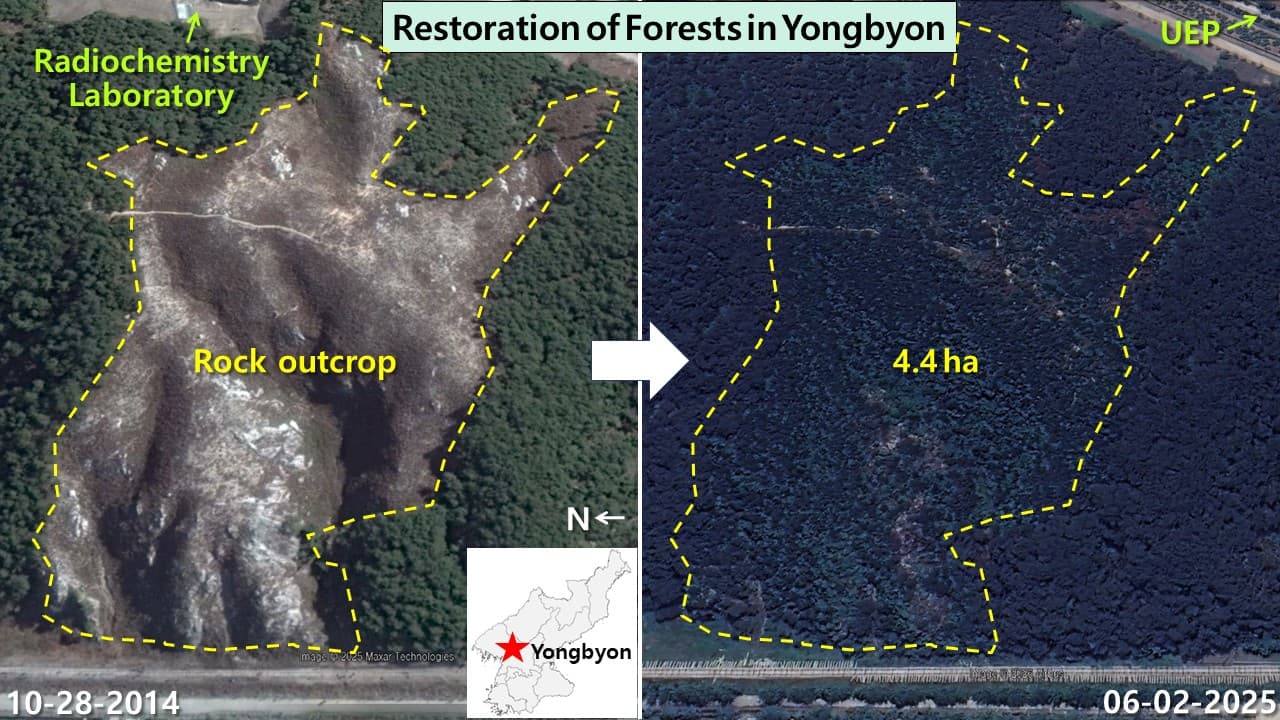
One notable finding from my satellite imagery analysis: a barren rocky area between the radiochemical laboratory and uranium enrichment facility at the Yongbyon Nuclear Scientific Research Center — North Korea’s main nuclear complex — has been transformed into forested land over the past decade, with an estimated 4.4 hectares of new tree cover. I assess that greening activity there was likely intended to prevent soil erosion and strengthen security within the facility.
Inter-Korean nursery cooperation and its limits

The Central Nursery of the Ministry of Land, Infrastructure and Transport in Pyongyang’s Sunan district, photographed by satellite on May 3, 2023. The facility mass-produces seedlings for North Korea’s national reforestation program and served as a key site visited by South Korean business delegates during the 2018 inter-Korean summit. Image: Google Earth/Airbus
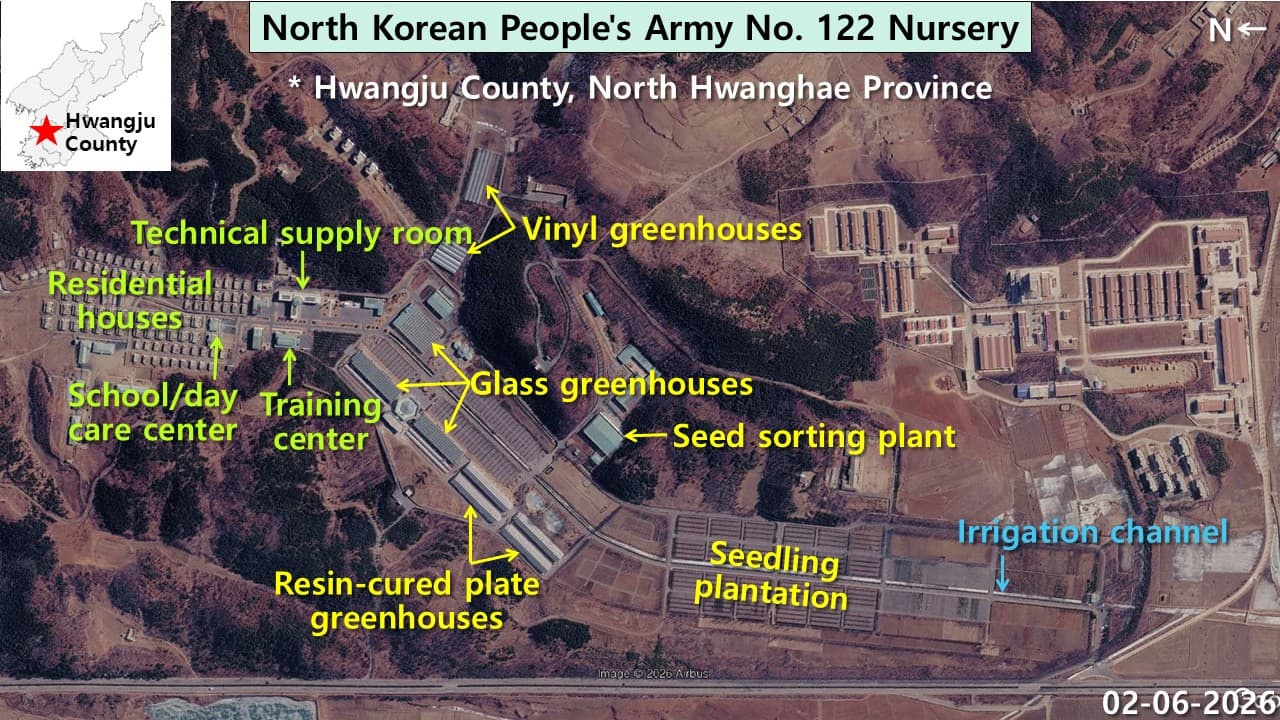
Inter-Korean forest cooperation has centered on nursery development — the seedling production infrastructure that underpins afforestation at scale. Following the 2018 inter-Korean summit, Seoul and Pyongyang agreed in talks held in Kaesong to prioritize modernization of 10 nurseries in the North, including the Central Nursery of the Ministry of Land and Environment in Pyongyang’s Sunan district and the Korean People’s Army Nursery No. 122 in Hwangju county, North Hwanghae province. Planned upgrades included greenhouse-type seedling facilities, container systems, and seed storage infrastructure.
South Korea also established supporting facilities along the border, including the “Peace Nursery” in Goseong, Gangwon province, designed to cultivate tree species suited to North Korean conditions, and a Forest Cooperation Center in Paju for technical exchange.
In practice, however, cooperation remained limited. Questions arose over whether certain nursery equipment fell under international sanctions, delaying progress, and subsequent deterioration in inter-Korean relations shelved most planned activities.
North Korea has since pursued nursery expansion independently, with satellite imagery confirming construction or enlargement of large-scale nurseries across the country — infrastructure I assess as intended to supply seedlings for the nationwide afforestation drive.
Cooperation as a force multiplier
Satellite-based identification of degraded and target zones now provides a reliable foundation for designing targeted international assistance. Priority areas for potential cooperation include nursery modernization, forest management technology, pest and disease control, and wildfire monitoring — all areas where North Korea faces documented shortfalls.
Should inter-Korean relations improve, I expect resumed cooperation in nursery modernization and technical support to significantly accelerate measurable progress on the second reforestation campaign.


