1 hour ago
Suranjana Tewari,Asia business correspondent, Manilaand
Jessica Rawnsley
The war has caused "imminent danger" to the country's energy supplies, President Ferdinand Marcos Jr says.

1 hour ago
Suranjana Tewari,Asia business correspondent, Manilaand
Jessica Rawnsley
The Philippines has become the first country in the world to declare a state of national energy emergency in response to the war in Iran.
President Ferdinand Marcos Jr said he had signed an executive order to safeguard energy security, citing the "imminent danger posed upon the availability and stability" of the country's energy supply.
The US-Israel war with Iran and the effective closure of the Strait of Hormuz - a key shipping route - have sent shock waves through global energy markets, causing shortages and price rises.
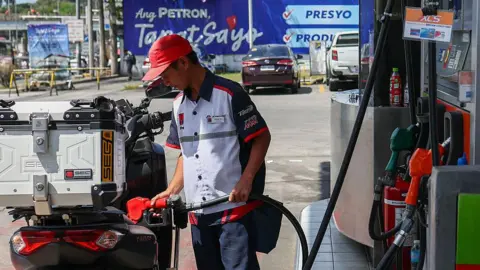
The Philippines imports 98% of its oil from the Gulf, and the price of diesel and petrol has more than doubled in the country since the war broke out on 28 February.
On Tuesday, Marcos said the move would give the government the legal authority to impose measures to ensure energy stability and protect the broader economy.
Under the order, a committee has been formed to oversee the orderly distribution of fuel, food, medicines, and other essential goods.
The government has also been empowered to directly purchase fuel and petroleum products to shore up supplies.
At a press conference on Wednesday, Marcos urged Filipinos not to panic, saying the government was working to secure additional sources of fuel.
Marcos said he was "fairly confident" that enough supply would be secured before the current stock, which is enough for 45 days, runs out.
"We will have a flow of oil. Not just one delivery, not two deliveries, but a flow of oil-related products," he said.
Marcos said "nothing is off the table" when responding to the supply and price crisis.
The declaration will remain in place for one year, unless it is extended or lifted by the president.
It follows calls from several senators, who urged Marcos to acknowledge the "emergency-level" hardship faced by Philippine families due to soaring oil prices.
The price of petrol and diesel spiked again on Tuesday, rising to more than double its pre-war level in February.
One of the country's main labour coalitions, the Kilusang Mayo Uno (KMU) strongly criticised the emergency declaration, calling it an "admission" that the government failed to address the oil crisis.
It also accused the administration of downplaying the situation earlier, saying previous claims that "everything is normal" were misleading.
The KMU also raised concerns about what it describes as "anti-worker provisions" in the executive order - particularly clauses that could restrict activities seen as disrupting economic activity, including strikes.
They warn this could effectively limit workers' ability to protest at a time when fuel prices are already hitting incomes.
But tycoon Manuel V. Pangilinan, who chairs major utilities companies, has backed the emergency powers.
In a statement, he said his companies are feeling the strain of rising energy costs and warned the crisis is beginning to affect business operations, but added that the government "should have every option" available to steer the economy through what he described as a difficult period.

 Getty Images
Transport workers and other groups including ride hailing services are planning a two-day strike on Thursday and Friday, reflecting wider anger over rising fuel costs and what they see as a slow or inadequate response from the government.
Transport union coalition Piston - which is leading planned strike action - has laid out sweeping demands from scrapping fuel taxes and rolling back oil prices, to abandoning deregulation and introducing state controls. They are also pushing for fare increases and higher wages.
Since hostilities in the Middle East began, the government has offered subsidies to transport drivers, reduced ferry services, and implemented a four-day work week for civil servants to save fuel.
Earlier on Tuesday, Energy Secretary Sharon Garin said the country had about 45 days of fuel supply left.
Garin told reporters the country would "temporarily" depend more heavily on coal-fired power plants to meet its energy needs in response to the surging costs of liquefied natural gas (LNG).

Chinese toymaker Pop Mart reported strong annual growth in revenue and net profit for 2025, but not enough to alleviate investor fears that the company remains too reliant on the Labubu phenomenon. Annual revenue jumped 184.7 per cent from a year earlier to 37.12 billion yuan (US$5.4 billion), while

As war in the Middle East escalates, the financial fallout extends beyond energy price and supply-chain disruptions. Vulnerabilities in the US$3 trillion-plus global private-credit market are accelerating, driving investors to safe havens, while global finance undergoes a rapid transformation. China

The woman had taken MDMA and three litres of vodka when she vandalised the piece nicknamed Blue Blob.

A senior Japanese official and the country’s military have expressed regret after a serving officer was arrested on suspicion of trespassing at the Chinese embassy in Tokyo. Tokyo police have identified the 23-year-old suspect as Kodai Murata, a second lieutenant with the Ground Self-Defence Force (