The TWZ Newsletter
Weekly insights and analysis on the latest developments in military technology, strategy, and foreign policy.
By mobilizing the private sector, Ukraine hopes to reduce the air defense burden on its troops while increasing coverage. The post Ukraine Using Private Air Defense Teams To Protect Industry Against Russian Drones appeared first on The War Zone.

The TWZ Newsletter
Weekly insights and analysis on the latest developments in military technology, strategy, and foreign policy.
At a time when Ukraine’s air defense expertise is being sought by Arab nations under fire from Iranian missiles and drones, Kyiv announced its new experimental concept for battling Russian drones is having some positive results. The system relies on the private sector to provide its own air defenses by using Ukrainian interceptor drones and other short-range air defense weapons, under the command and control of the military.
Whether this would be applicable beyond Ukraine is debatable, but officials in Kyiv see private sector air defense as an important move to help spread its burden of defending the skies against ceaseless Russian barrages. Russia has been taking particular aim at Ukraine’s remaining industrial capacity, especially defense-related firms that make drones, missiles and other weapons systems. The constant attacks are a large reason why the country has tried to decentralize production, but not everything can be built in a distributed fashion.
The goal of the program is to take advantage of Ukraine’s large production of counter-Shahed interceptor drones as well as its indigenous automated anti-drone machine gun turrets. By having volunteers operate these systems, it reduces the need to pull troops from the frontlines, officials say.
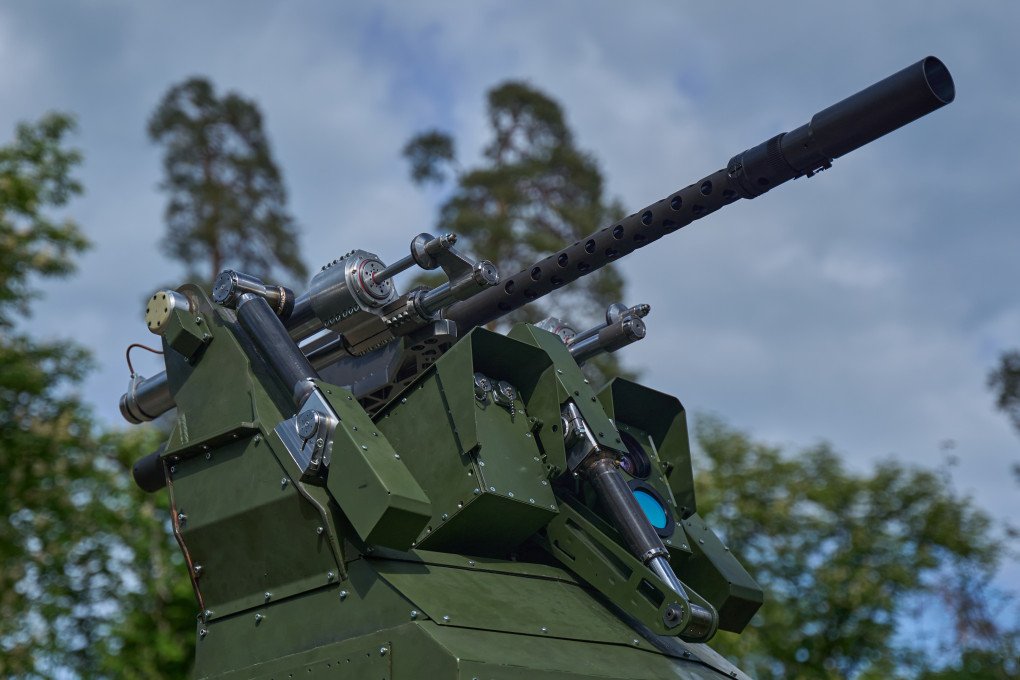
“The experimental project launched by the Government to involve the private sector in the air defense system is already being implemented and yielding initial results,” Ukrainian Defense Minister Mykhailo Fedorov stated on Telegram Monday morning. “One of the companies participating in the project has already prepared its own air defense group. As of today, several enemy drones have been shot down in the Kharkiv region, including Shahed and Zala models.”
Fedorov did not identify the company, but said another 13 are in various states of gearing up to take part.
“As of now, all groups are at different stages of preparation,” Fedorov wrote. “Some are already performing combat tasks, others are undergoing training, and the rest are completing their preparations and will soon strengthen the country’s air defense.”
Private air defense systems “are integrated into a single management system of the Armed Forces Air Force and are already operating within it – protecting objects and participating in the interception of Shaheds,” Fedorov explained. “This is a systemic solution that allows for quickly scaling air defense capabilities without additional burden on frontline units.”
Fedorov did not say which weapons are being used by the private companies, but a video he posted on X of claimed successful engagements shows the use of the Sky Sentinel automated air-defense turrets, equipped with a heavy machine gun and capable of 360° rotation. An official contacted by The War Zone said the Wild Hornet Sting interceptors are being used as well.
Private air defense working. First Shahed & Zala drones downed in Kharkiv by a private firm. 13 more companies joining. Integrated with Air Force command to scale protection without burdening the front. Opening the market to build a resilient, multi-layered sky. pic.twitter.com/GhXuX6a9dS
— Mykhailo Fedorov (@FedorovMykhailo) March 30, 2026The creation of the private sector air defense program was announced earlier this month by Ukrainian Prime Minister Yulia Svyrydenko. In a media release, she explained that critical infrastructure enterprises, regardless of whether publicly or privately owned, can create air defense groups.
These groups must undergo training and certification by the MoD and will use weapons and ammunition temporarily transferred from the ministry.
“This concerns weapons that are not currently used by combat units,” Svyrydenko noted. “In the event of the use of ammunition, replenishment will be carried out according to a simplified procedure based on an act of actual expenses.”
As part of the expansion of site-specific protection for critical infrastructure facilities, the government has authorized the provision of additional weapons to strengthen their air defense capabilities.
We are introducing amendments to the experimental project launched in… pic.twitter.com/hlL0MWpcvn
Ukraine has been developing these weapons and programs because Russia’s launching of thousands of Shaheds and other drones and missiles has depleted its stocks of high-end interceptors like those fired by Patriot and other systems. This has not been lost on leaders of nations now under fire by Iranian drones and missiles.
Fedorov’s announcement about the private sector air defense program comes as Ukrainian President Volodymyr Zelensky wrapped up a tour of the Middle East. While there, the Ukrainian leader said he inked defense cooperation agreements with Saudi Arabia, UAE and Qatar, and had discussions with Jordan.
Zelensky did not announce specific commercial drone sales, “but said talks touched on financial support from Gulf nations that could help Ukraine bridge a delay in European funding after Hungary blocked a 90 billion euro loan package,” The New York Times noted. In addition, Zelensky told reporters that he had also discussed future Ukrainian purchases of energy from the Middle East as Ukraine’s own natural gas industry had been battered by Russian strikes.
“The agreement includes collaboration in technological fields, development of joint investments and the exchange of expertise in countering missiles and unmanned aerial systems,” Qatar’s defense ministry said in a statement during Zelensky’s visit.
Today in Jordan. Security is the top priority, and it is important that all partners make the necessary efforts toward it. Ukraine is doing its part. Important meetings ahead. pic.twitter.com/561KtqoglT
— Volodymyr Zelenskyy / Володимир Зеленський (@ZelenskyyUa) March 29, 2026When it comes to interceptor drones like Sting, Ukraine has enough to spare should its government sign off on providing them.
Ukraine could export about $2 billion worth of weapons as a whole this year, excluding joint production ventures with allies, suggested Ihor Fedirko, CEO of the Ukrainian Council of Defence Industry, a manufacturers’ association.
Ukraine produced 40,000 interceptor drones in January, according to the government, which has made it clear the country will not export any weapons it needs to defend itself, as we noted in a story on Ukrainian laws preventing direct exports of interceptors and other weapons.
“Zelensky says that provided enough financing, Ukraine has the capacity to up its production to 2,000 interceptor drones a day and would only need 1,000 for itself, leaving plenty for export,” Reuters noted.
It is unknown whether the concept of private sector air defenses came up in Zelensky’s talks in the Middle East. However, countries in that region are facing threats similar to Ukraine, with energy infrastructure, data centers and other non-military facilities that likely have limited, if any air defenses, protecting them.
“The Ukrainian model does not surprise me,” retired Army Col. David Shank, who served as Commandant of the Air Defense Artillery School at Fort Sill, Oklahoma, told us. “Other countries have private security forces, some which possess hand-held [counter-drone] capabilities. The U.S. State Department has private security that also possesses capability (up to Stinger I am told).”
The challenge, said Shank, “is system management and command and control of all sensors and shooters.
It is possible the Gulf states could execute a system where companies provide their own air defenses, however, “it would still require strict adherence to authorities.”
Still, Shank sees several downsides, including fratricide, wasted ammunition and a lack of unity of effort from decentralized execution.
Retired Army Gen. Joseph Votel, who commanded U.S. Central Command, raised another concern.
“While it would be up to Arab nations to decide for themselves if this is a good idea, I do think it will complicate integration with partners, including the U.S,” he told us.
Regardless, the Ukrainian program is in its infancy. There is still a long way to go before it establishes its value as a valid means of protecting factories, electric generation plants and refineries against Russian drones. It could turn out to be more destructive than helpful.
However, given Ukraine’s history of battlefield innovation, there will likely be many parties looking to see how it all works out.
Contact the author: howard@thewarzone.com

The National Police and the Security Service of Ukraine have thwarted a series of contract killings organized by Russian agents.

Hungarian Foreign Minister Péter Szijjártó has commented on the leak of audio recordings of his conversations with Russian Foreign Minister Sergei Lavrov and once again criticised the European Union's sanctions policy against Russia.
Ukraine’s refusal to permit European specialists to inspect the Druzhba oil pipeline, through which Russian oil flows to Hungary and Slovakia, has created tension with the EU and deepened divisions within the bloc, Euractiv reported on March 31.

As of March 31 morning, users in five regions are without power due to new Russian attacks on the power grid. Electricity consumption is increasing due to cloudy weather.