By Commander Ronald E. Swart, United States Navy (Retired) and Scott C. Truver, PhD
President Donald J. Trump on March 9, 2026 declared that the United States “will not allow Iran’s terrorist regime to stop global oil supply. The Strait of Hormuz is going to remain safe. We have a lot of Navy ships there. We have the best equipment in the world inspecting for mines,” hinting that Iran had already deployed in the main channel about 80 of its estimated 6,000 mines. “Most of their ships are down at the bottom of the sea,” Trump asserted. “But we will hit them so hard that it will not be possible for them or anybody else helping them to ever recover that section of the world.”
Since February 2026, the spectrum of violence stemming from the conflict in the Strait of Hormuz has been expansive. It was not uncommon to see vessel masters playing “chicken” for better positions among many vessels anchored in the waterway. It included suicide attacks by small fast craft and patrol boats armed by Islamic Revolutionary Guard Corps fighters brandishing small arms and lightweight mines. Five-inch guns and anti-ship missiles were fired from U.S. surface warships and tactical aircraft and attack-helicopters. The U.S. fast-attack submarine USS Charlotte (SSN 766) torpedoed the Iranian frigate Dena in international waters, killing 104 crewmembers.
Six weeks after launching Operation Epic Fury against Iran, Trump ordered the Navy to blockade Iranian ports and to clear the area of any Iranian mines. Vice President J.D. Vance accused Iran of “economic terrorism” by closing the Strait and defended the U.S. blockade of Iranian ports as an equal response: “They basically threatened any ship that’s moving through the Strait of Hormuz.”
On May 3, Trump announced yet another plan to guide ships through the Strait, Project Freedom, which would search for and locate mines to be avoided but not to render them safe. Mine-hunting and sweeping would come later.
In all of this, there has been no indication that U.S. Central Command (CENTCOM) or U.S. Navy planners have seriously considered using American-made naval mines to neutralize what was left of the Iranian navy and other vessels attempting to make runs into and out of Iran’s ports. Minefield objectives that could inform U.S. planning are listed in the Barriers, Obstacles, and Mine Warfare for Joint Operations, Joint Publication 3-15:
The conventional bombs carried by the Navy’s aircraft carriers could easily be converted to unconventional “Quickstrike” naval mines to be planted in water as well as on dry land for offensive and defensive requirements, generating strategic, operational, and tactical implications.
A Proven Weapon
Naval mines have been a constant for the United States since David Bushnell’s semi-submersible Turtle attacked General William Howe’s HMS Eagle on September 6, 1776. More recently, in the early 1960s the Navy bought conversion kits for more than 4,000 Mk-36 Destructor (DST) magnetic-influence bottom mines (maximum operational depth of 300 feet) fashioned from standard-issue Mk-82 500-pound bombs. The DSTs were the provenance of the Mk-62/63 Quickstrike mines that entered service in 1980.
In 1972-1973 Operation Pocket Money, the United States dropped thousands of mines against North Vietnamese ports and waterways, shutting down the port of Haiphong and energizing North Vietnam to return to the Paris Peace Talks. On May 9, 1972, Navy attack aircraft began minelaying strikes against Haiphong harbor. Thirty-six mines were planted, and, to limit provocation of the Soviets, Chinese, and other third parties, the mines were set with a 72-hour delay before they became active.
U.S. President Richard M. Nixon explained:
“All entrances to North Vietnamese ports will be mined to prevent access to these ports and North Vietnamese naval operations from these ports. United States forces have been directed to take appropriate measures within the internal and claimed territorial waters of North Vietnam to interdict the delivery of any supplies. Rail and all other communications will be cut off to the maximum extent possible. Air and naval strikes against military targets in North Vietnam will continue.”
Nixon’s announcement gave other nations’ ships three days to escape the port before becoming trapped. Nine ships departed Haiphong safely, while twenty-seven vessels remained “swinging on the hook.” Several merchant ships headed toward Haiphong turned away because of the mine threat. The Navy continued to reseed the minefields in Haiphong and at other North Vietnamese ports throughout 1972.
43 Years and Counting
The most recently designed mines reached the fleet in 1983. The Mk-65 aircraft-laid bottom mine consists of a thin-walled, purpose-built mine case, nose faring, and tail section adaptable to a parachute option. The Mk-65 is used against submarines and surface targets. The Mk-60 CAPTOR (enCAPsulatedTORpedo) mine was armed with a Mk-46 Mod 4 lightweight homing torpedo. CAPTORS, which were decommissioned in 2001, were able to detect, target, and attack submarines at long ranges, about 17,000 yards.
Since then, some 15 new-design concepts, including foreign navy candidates, never saw the light of day.
As of 2026, U.S. surface warships and special-mission surface craft cannot deploy mines, while only a handful of the 2,000 pound Mk-67 Submarine-Launched Mobile Mines (SLMMs) and the traditional thin-walled air-delivered Mk-65s remain in service. The three-boat Seawolf (SSN 21) nuclear-powered fast-attack submarines and some 26 Virginia (SSN 774)-class boats can deploy mines, should such weapons be used.
The aircraft-deployed shallow-water (about 150 feet) Quickstrike mines are the Navy’s only high-volume mines, and the remaining SLMMs can be launched only by aging Los Angeles-class (SSN 688) attack submarines. Of note, the Navy has repurposed SLMM Mk-13 warheads for the new clandestine delivered mines program.
The Quickstrikes also provide rapid-response capability. Because the Mk-62 500-pound and Mk-63 1,000-pound mines are bomb-conversion weapons, aircraft carrier air do not need to store them in special magazines reserved only for mines. A Mk-62/63 conversion-kit can be applied to a standard dumb bomb to create a naval mine.
The Mk-62 Flounder and Mk-63 Skipjack mines use the general-purpose Mk-82 (500-pound) and Mk-83 (1,000-pound), dumb bomb bodies. The smart bomb includes a variable-influence Mk-57 target detection device (TDD). These mines target submarines and surface ships and are capable of numerous arming delay, target sterilization, self-destruct, and other operational settings. The Mk-57 TDD uses magnetic and seismic influences for target detection and can be set to require combined magnetic and seismic influences of specific magnitudes.
In September 2014, U.S. Pacific Command (PACOM) demonstrated the extended-range Mk-62 Quickstrike-ER, a modification of the 500-pound winged Joint Direct-Attack Munition (JDAM)-ER. Dropped from a B-52H strategic bomber, this was the first-ever deployment of a high-accuracy, razor-sharp-precision, long-standoff aerial mine.
Subsequently, another joint effort between PACOM, the Navy, and the Air Force successfully dropped a 2,000-pound Mk-64 Quickstrike-JDAM-ER launched from a B-52H. It was effective out to ranges of 300 nautical miles, and from cruise altitudes at up to 40,000 feet, and landed with precision at desired drop points.
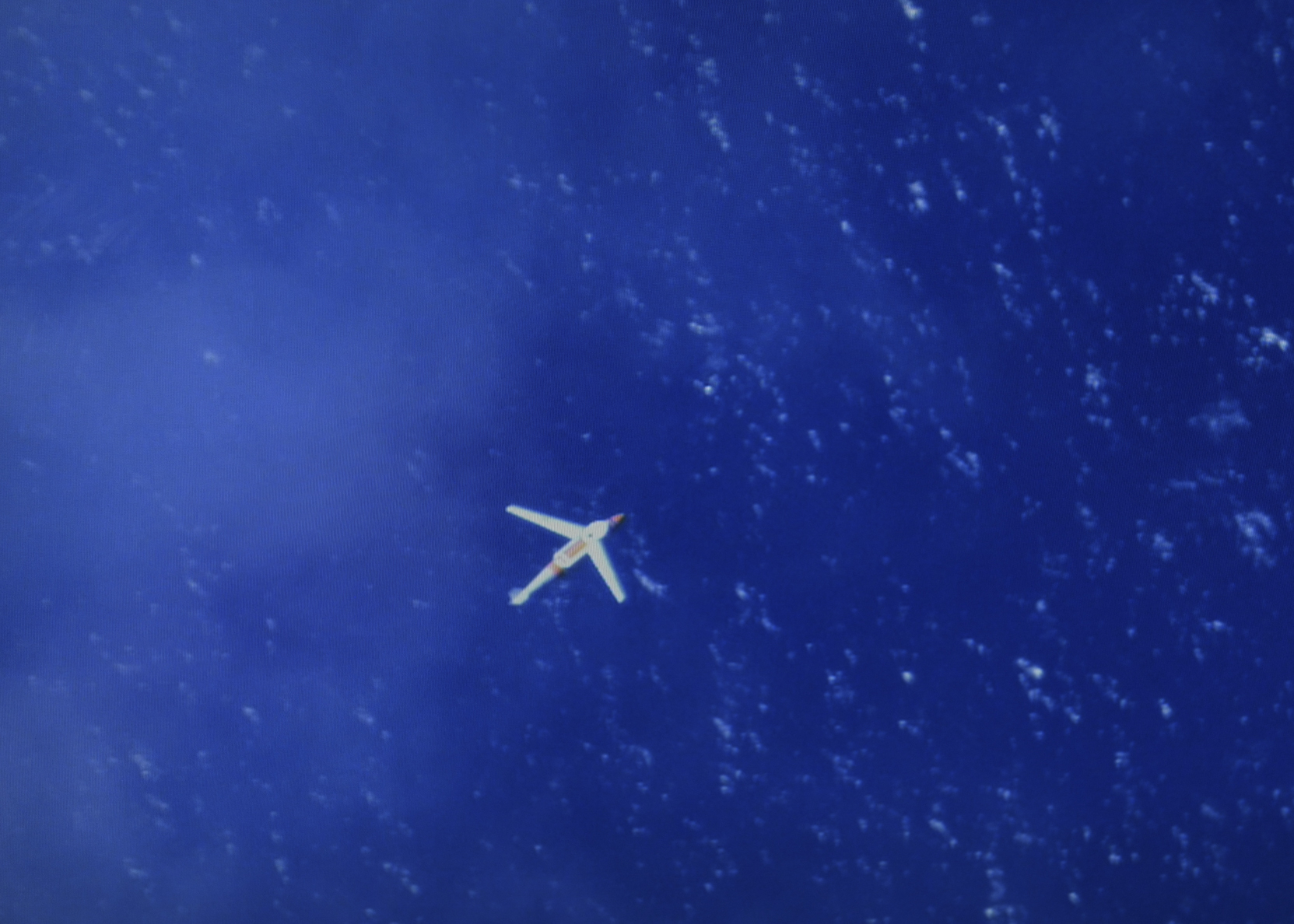
The Air Force has also planned anti-ship “Quicksink” weapons in future loadouts. In July 2024, the Air Force and allied air forces tested sinking a large surface ship at long range, including for the first time using a U.S. Air Force B-2 Spirit stealth bomber. The test of the weapon occurred on 19 July, when a B-2 participated in sinking the ex-USS Tarawa (LHA-10), a retired amphibious assault warship the size of a small aircraft carrier. Quicksink warheads of some 2,000 pounds could give the Air Force bombers the anti-ship capability of a submarine-launched torpedo without exposing a submarine to risk from detection and targeting.
In 2026, the Navy was upgrading the Quickstrike mines to the Mk-71 TDD, a state-of-the-art firing mechanism. The Mk-71 senses magnetic, seismic, and pressure signatures and can be programmed with sophisticated target-processing and counter-countermeasures algorithms. This enables the Navy’s miners to optimize performance against different target classes and to counter future targets. In short, the Quickstrike mines are not simple devices but rival even the Navy’s cruise missiles in complexity and sophistication.
Analysis of the American experience with naval mines reveals that it took about three decades to approve the Mk-71 TDD for fleet operations. It is little surprise that in the competition for resources the Navy mine warfare community is often regarded as the service’s forgotten capability.
Blockading Iran
A blockade of Iran’s Hormuz ports, both inside and outside the Strait, could be accomplished with the use of American mines, assuming that U.S. minefield plans are updated and the mine hardware is ready to use. Stopping Iran’s minelayers, many of which are very small and can be deployed from numerous ports or caves along the Iranian littoral, will not be trivial. The job of keeping these threats in ports will be challenging enough.
As soon as the decision to lay U.S. mines is received, the Navy’s carriers could immediately launch Quickstrike-armed attack aircraft. Quickstrike TDDs can be set to such a sensitivity that they can detect and detonate on a wide range of surface and subsurface vessels, including Iran’s small-vessel signatures. Once U.S.-Iran War hostilities are exhausted, the deployed Quickstrike mines, already pre-set to self-destruct at a predetermined time, will self-clear, eliminating an additional hazard for U.S. and other navies’ mine countermeasure force efforts to ensure safe passage. Strait of Hormuz commercial and naval ship traffic will return to normal transits. Still, when hostilities in the Strait and Persian Gulf and Hormuz finally wind down, the dangerous and difficult task of clearing mines must begin.
As The Commander’s Handbook on the Law of Naval Operations NWP 1-14 (Hague Convention 1907) explains, nations that laid mines must remove them when hostilities end and must notify the positions of mines to the other belligerents. This is an extremely burdensome task. For example, following the cessation of Operation Desert Storm in 1992, it took a dedicated multi-navy coalition mine countermeasure force more than a year to clear the ten mine danger areas in the northern Persian Gulf. U.S. Navy mine counter-measure operations continued into 1997.
Similarly, mine countermeasures vessels participating in various NATO exercises in the Baltic and North Sea have continued to find and destroy World War I- and World War II–era mines. To date, they have discovered between 50,000 and 80,000 mines. In mid-2026, should the United States decide to blockade Iran’s waters with sea mines, the challenges for U.S. miners would be to develop and plant effective minefields quickly and accurately. Estimates of the time it would take mine-sweepers and -hunters to sanitize a Hormuz waterway ran from a month to more than a year.
Into the Fight
Mine warfare is not easy, quick, or career-enhancing. Since 1776, only a handful of Navy flag officers (RDML/RADM) commanded mine warfare forces. Reaching Captain (O-6) was considered stellar performance. Multiple back-to-back mine warfare tours assured sitting in the last pew. As mine warfare historian Tamara Moser Melia recognized, “By the end of World War I, most U.S. naval officers probably agreed with the assessment that mine sweeping [and mine hunting] remained merely unpleasant work for a naval man, an occupation like that of rat-catching.” The sentiment holds true today.
The U.S. Navy’s Quickstrike bottom influence mines will be critical to success. Despite the cost it will take to clear them when the war truly ends, their effects will be decisive in bringing the conflict to a conclusion. It is past time to get them into the fight.
CDR Ronald E. Swart, USN (Ret.) is the Principal Advisor to the Mine Warfare Association (https://minwara.org). He has 32 years of experience in naval minefield planning and mine readiness.
Dr. Scott Truver, also a Principal Advisor at MINWARA, has worked in support of U.S. Navy mine warfare since 1990 and is the co-author of Weapons that Wait: Mine Warfare in the U.S. Navy (2nd ed, Naval Institute Press).
References
Brad Lendon, “How the US Navy could Blockade Iran’s Port and Sweep Mines from the Strait of Hormuz,” CNN World, 13 April 2026, https://www.cnn.com/2026/04/13/middleeast/us-iran-hormuz-blockade-minesweeping-explainer-intl-hnk-ml. Brad Lendon, “The U.S. Says It Has Successfully Practiced Using a Low-Cost Bomb to Sink a Major Surface Ship: China is Taking Note,” Navy Strategy News, 29 July 2024.
Brad Lendon, “The U.S. Says It Has Successfully Practiced Using a Low-Cost Bomb to Sink a Major Surface Ship: China is Taking Note,” Navy Strategy News, 29 July 2024.
Bryan Clark, “’Shoot and Kill’” Orders Made on Mine-Laying Boats in the Strait, Hudson Institution, CNN, April 2026 shttps://www.hudson.org/missile-defense/shoot-kill-orders-made-mine-laying-boats-strait-bryan-clark.
Jessie Yeung, “Day 45 of Middle East conflict––US Navy starts Blockade on Iranian ports,” CNN World, 14 April 2026.
Edwards, “Preparing Today for the Mines of Tomorrow,” Naval War College Review, Vol72, No3, 2019, 12, https://digital-commons.usnwc.edu/nwc-review/vol72/iss3/5/.
Mine Warfare Plan: Meeting the Challenges of an Uncertain World. Washington, DC: Office of the Chief of Naval Operations, OP-00/OP-03, 29 January 1992. Mimeo.
Riley Cedar, “The US has counter-mine ships homeported in the Middle East. Are they effective?” Navy Times, 23 March 2026, https://www.navytimes.com/news/your-navy/2026/03/23/the-us-has-counter-mine-ships-homeported-in-the-middle-east-are-they-effective/.
Commander’s Handbook on the Law of Naval Operations NWP 1-14 (Washington, DC: Office of the Chief of Naval Operations, March 2022, NWP_1-114M.pdf)/.
Tamara Moser Melia, Damn the Torpedoes: A Short History of U.S. Naval Mine Countermeasures, 1777–1991, (Washington, DC: Naval Historical Center, Department of the Navy, 1991).
Tony DiGiulian, Owner, Naval Weapons Systems (NavWeaps, http//www.NavWeaps.com) military database. Accessed 3 June 2026.
“Trump Announces Plan to help ‘Guide’ Ships Out of the Strait of Hormuz, The Maritime Executive, 3 May 2026.
Featured Image: A Mk-63 Quickstrike Mine is mounted on a P-3 Orion aircraft. (US Navy photo)
Discover more from Center for International Maritime Security
Subscribe to get the latest posts sent to your email.
