Australia Should Stop Shadowing Allied Sanctions and Start Building Them With Ukraine
Australia has remained the world’s largest importer of third-party products refined from Russian oil, fueling Russia’s war machine.
Kyiv Post
75
9 min read
0 views
For four years, Australia has done something important on Russia: it has stayed in the fight. Canberra has kept adding names, tightening measures, and aligning itself with the broader coalition backing Ukraine. On Feb. 24, 2026, the government announced its largest sanctions package since the start of the full-scale invasion. Australia has now issued more than 1,800 Russia-related sanctions since February 2022.
Australia has remained the world’s largest importer of third-party products refined from Russian blood oil, fueling Russia’s war machine. Australia has provided the Russian Federation with more tax revenue than it has provided in military and humanitarian support to Ukraine.
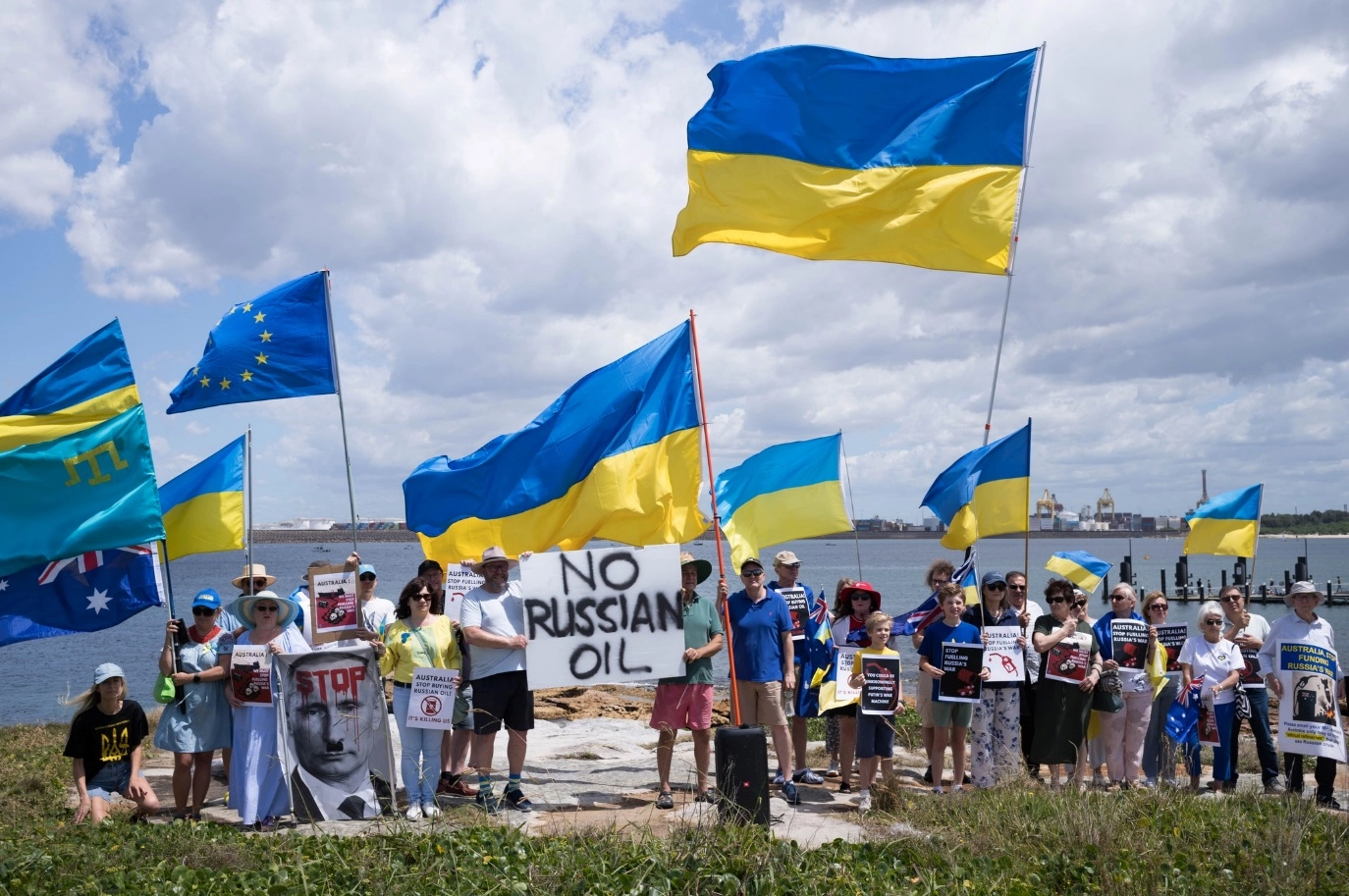
Photo: Nicholas Buenk. Australian Ukrainians in Sydney protested At Kurnell and Port Botany. The tankera Hafnia Lillesand and Proteus Bohemia carried fuels made from russian crude feedstock at Reliance Industries’ Jamnagar Refinery in India.
If Australia wants to matter strategically, not simply morally and symbolically, it must stop treating support to Ukraine and sanctions as something drafted in Washington, Brussels, London or Ottawa and only then echoed in Canberra. It should remain aligned with allies, certainly. However, alignment is not leadership. The next serious step would be for Australia to build a formal, standing sanctions partnership with Ukraine itself. This would not be a one-off consultation, nor a symbolic roundtable, but an institutional mechanism that turns Ukrainian frontline expertise into Australian sanctions design, enforcement, and reform.
Russian authoritarianism demands a permanent state of conflict. A democratic, successful Ukraine is indeed a threat to Putin, but not a military one.
That is just one area where Australia could actually lead.
Ukraine now possesses one of the world’s deepest real-time bodies of knowledge about sanctions evasion: how Russian oil is moved, how procurement networks adapt, how shadow-fleet vessels are concealed, how logistics chains are rerouted, how front companies and intermediaries mutate under pressure. Kyiv is not merely the victim of aggression; it has become a live laboratory of economic warfare. Its state institutions, think tanks, intelligence-linked public tools, and civil-society investigators are generating targeted, actionable sanctions intelligence every day.
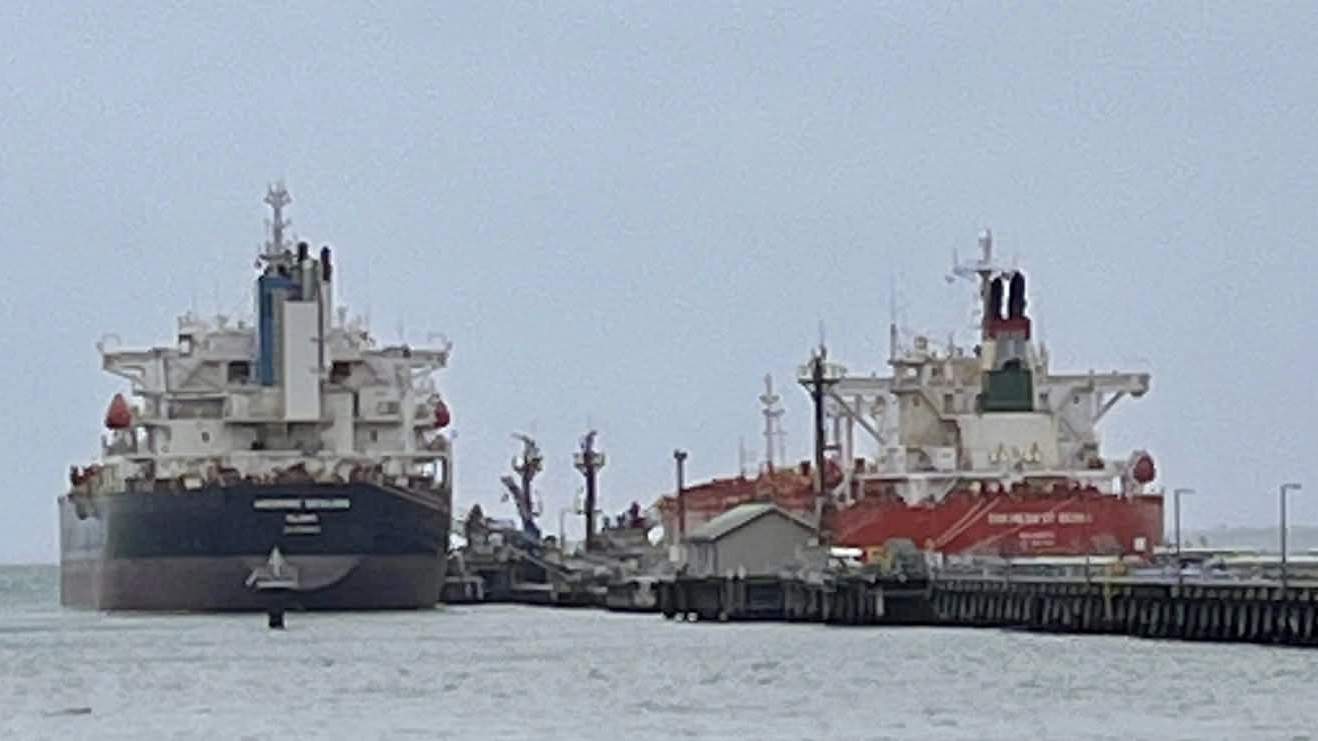
Photo: Cathy Harper Ukrainians in Geelong. Tankers Ardmore Sealion and Komorebi offloading at Geelong .
The KSE Institute sanctions team says it has been providing the Ukrainian government with research-based analytical support since the start of the full-scale war and is part of the Yermak-McFaul sanctions architecture. In late 2025, Denmark backed KSE’s new Center for Geoeconomics and Resilience and Sanctions Hub of Excellence, explicitly to deepen sanctions analysis and coordination with partners.
Australia should be paying close attention to Denmark’s approach.
Australia does not have the economic weight of the United States or the European Union, but it does have room to innovate. It can become the coalition’s best loophole-closer, fastest niche designator, and most serious middle-power enforcer. But to do that, it needs access to the best available evidence and the most current target development. That evidence increasingly sits with Ukrainians.
A formal Australia-Ukraine Sanctions Partnership Task Force would give Canberra a way to use that advantage. On the Ukrainian side, it should draw from the Office of the President, the National Security and Defense Council, the National Bank of Ukraine, and the integrated sanctions ecosystem tied to the War & Sanctions platform and KSE’s analytical work. Ukraine’s own sanctions policy is plainly moving in greater integrated directions. In February 2026, Kyiv announced further sanctions on 91 vessels in Russia’s shadow fleet and, days later, on 225 captains involved in transporting Russian petroleum products in circumvention of Western restrictions. These were not symbolic gestures; they were targeted efforts to hit the operational machinery of sanctions evasion.
This points to the future of sanctions. The next phase is not just about oligarchs and state banks. It is about captains, managers, insurers, brokers, logistics firms, shell entities, crypto facilitators, and third-country intermediaries. It is about the connective tissue of evasion.
Australia should be building its sanctions policy around exactly that logic.
There is already a domestic policy basis for doing so. Australia’s Senate Foreign Affairs, Defence and Trade References Committee is currently inquiring into the Effectiveness of sanctions against the Russian Federation, after the matter was referred in November 2025. More broadly, parliamentary scrutiny has already pushed toward stronger enforcement, limited loophole closure, and deeper engagement with outside expertise. A formal sanctions task force with Ukrainian participation would not be a radical departure from Australian policy development; it would be the logical next step.
Australia has been a follower in sanctions policy and generally for support to Ukraine. It tends to move only after others, mirror broader packages, and announce solidarity. Solidarity is necessary. But by the fourth year of the full-scale war, solidarity without institutional imagination starts to look like passivity and mere symbolic rhetoric.
A standing bilateral mechanism would change that. It could give Australia a secure channel to receive target dossiers from Ukrainian experts, a structured way to triage shadow-fleet and sanctions-evasion cases, close loopholes, and a regular forum to identify where Australian law and enforcement can bite hardest, such as shipping services, financial compliance, trade routing, beneficial ownership, and professional facilitation. Instead of waiting for an ally to publish a list and then deciding whether to echo it, Canberra could begin generating its own cases directly with Ukrainian input.
That would make Australia far more useful to Ukraine and far more serious in the eyes of its allies.
It would also make Australian sanctions smarter. The most effective sanctions are not simply broader; they are more precise, better evidenced, and harder to evade. Ukraine’s sanctions ecosystem can supply precisely that. Australia can add what Ukraine needs from it: legal credibility, clean institutional processes, financial intelligence, Indo-Pacific reach, and the ability to close off loopholes and Australian-linked avenues that Russian networks may still exploit. This is not charity. It is reciprocal strategic cooperation.
The war is forcing a redefinition of alliances. Australia has supported Ukraine through the language of values, international law, and the rules-based order. All of that remains true. But Ukraine is also now a producer of strategic knowledge. It understands modern sanctions evasion in ways that few Western bureaucracies do. To keep treating it only as an aid recipient is to misunderstand what it has become.
The practical design is not hard to imagine. DFAT and the Australian Sanctions Office (ASO) could co-chair a quarterly task force with a Ukrainian sanctions coordinator and corresponding organizations. Working groups could focus on shadow-fleet disruption, dual-use procurement, financial evasion, asset tracing, beneficial ownership and individuals. Ukrainian civil-society organizations and think tanks could submit evidence through a formal pipeline. Australian agencies could then assess that material for designation, investigation, or legislative reform. The task force itself would not impose sanctions – that remains a sovereign government function – but it would give Australia a far better mechanism for deciding whom to sanction, how to enforce, and where to tighten the law.
Collaboration should also target individuals at all levels, facilitating the systemized abduction and forced deportation of Ukrainian children
Russia will not stop until it is forced to stop. There will be no just or lasting peace until Russia assesses that the cost of waging war is far too great.
Australia must be seen to be acting more seriously, if nothing else, for its own immediate regional security.
Australia’s approach thus far has seen it miss major opportunities that would benefit its own self-interest and seen it lag behind. Contrary to wide Australian popular support, Australia’s support for Ukraine has markedly declined.
Across all levels, since 2022, Ukraine has been inviting Australia to be more than just a provider of aid but a beneficiary of direct cooperation.
In visible contrast to Australia, there are numerous successful examples
The so-called “Danish model” of deeper defense-industry cooperation enables Ukrainian defense companies to produce in Denmark, establish joint facilities and exchange technologies. This directly and immediately boosts Denmark’s innovative potential and strengthens its own national defense.
Denmark takes this deeply embedded collaborative approach across all its endeavors, from the delivery of humanitarian aid, to the reconstruction of the Mykolaiv region, to anti-corruption support. It pays dividends. Collaboration gives Denmark access, learning, influence and institutional returns that one-way aid does not.
Poland, Romania and Latvia are highly interactive with Ukrainian Media NGOs and think tanks to build their own strength in strategic communications, media resilience, countering disinformation, FIMI (Foreign Information Manipulation & Interference) and propaganda.
Through many research visits, Taiwan has adopted Ukrainian civil society systems for their own preparedness.
The Senate Inquiry into the effectiveness of Australia’s sanctions against Russia presents exactly the kind of middle-power initiative that can punch above its weight. Deep collaborative engagement with Ukrainian organizations is the kind of initiative that, beyond moral obligation, would demonstrate Australia is serious about treating Ukraine not as a distant cause, but as a strategic partner.
The status quo of “announce, align, repeat” has run its course. Russia’s evasion networks are adapting too fast, and the sanctions debate has become too technically complex for Canberra to remain a periodic consumer of allied decisions. Australia should still work with Europe, the United States, Canada and Japan. But it should stop waiting for them to define the agenda.
The better path is to build with Ukraine, directly.
For Canberra to take greater initiative, this is what leadership looks like: not another press release, but a structural mechanism; not another delayed mirror-listing, but a pipeline; not just “standing with Ukraine,” but building policy cooperatively alongside it.
The views expressed in this opinion article are the author’s and not necessarily those of Kyiv Post.