The joint Belgian-Dutch replacement Mine Countermeasures (rMCM) programme continues to make progress towards demonstrating its full stand-off mine warfare capability before the end of 2026, with recent ship and system deliveries paving the way for a critical phase of operational integration.
Speaking at the recent Navy Leaders Combined Naval Event (CNE) 2026, Commander Pierre Van Engeland, Belgian Navy programme manager for rMCM, said the delivery of the first two MCM motherships and the first toolbox of uncrewed systems have established the foundation for the next phase of testing and familiarisation of the systems.
However, significant work remains to integrate the various platforms, sensors, mission systems and operators that underpin the programme’s stand-off mine warfare concept, he said.
“If I was to sum up the biggest challenge in the programme right now, it’s software integration on board the ship and with the tools and then putting it all together,” Cdr Van Engeland told CNE delegates. “It’s a huge challenge. We’re getting there, but we still need a lot of time to achieve that. We’re working on it in close co-operation with industry, and hopefully by the end of the year we will be able to demonstrate a complete end-to-end operational MCM capability from the ship – that’s the goal.”
The rMCM programme, awarded in 2019 to Belgium Naval & Robotics – a consortium comprising Naval Group and Exail – covers the delivery of 12 dedicated MCM motherships (six for each navy), alongside an extensive suite of around 120 unmanned systems designed to detect, classify, identify and neutralise naval mines beyond the danger zone.
The 12 ships are being designed and built by Kership, a joint venture between Naval Group and commercial shipbuilder Piriou Group, with ship assembly taking place at Piriou’s shipyards in Concarneau, Brittany, and Lanester (near Lorient) and in Romania. Most of the unmanned systems are being produced at Exail’s dedicated MCM factory in Ostend, Belgium.
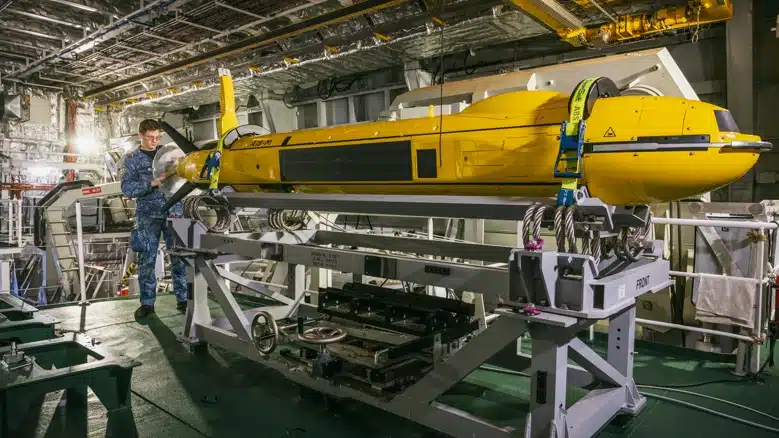
The toolbox comprises Exail’s UMISOFT software suite for mission management and data analysis, and a mix of inspector 125 USVs, A18-M AUVs equipped with the UMISAS 120 synthetic aperture sonar payload, T18-M towed sonars equipped with the UMISAS 240 SAS, mine identification and disposal systems (comprising SeaScan Mk 2 and K-ster C remotely operated vehicles), an influence dredger integrating five CTM magnetic modules and one Patria acoustic module, and Saab Skeldar V-200 uncrewed aerial systems (UAS).
Programme milestones
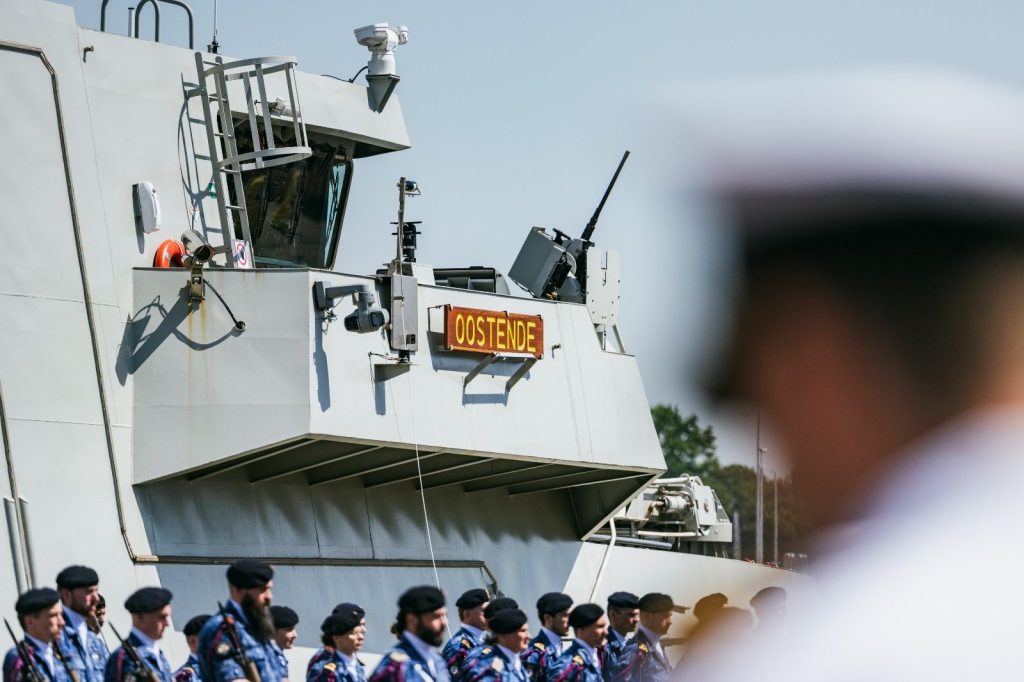
The Belgian Navy took delivery of lead ship Oostende (M940) in November 2025 and christened it on 24 June 2026. The second ship Vlissingen (M840) was handed over to the Royal Netherlands Navy in February 2026. Nine of the remaining ships are currently at various stages of construction: first steel for the penultimate ship was cut in early May 2026, and the 12th and final ship is planned to start construction by the end of this year.
The delivery of the first toolbox of unmanned systems to the Belgian Navy in March 2026 has marked the start of the system integration and commissioning phase aboard Oostende. During this phase, further developmental testing and continuous improvements will be made in partnership with Exail, Cdr Van Engeland said. “We are working very closely with industry during this phase, so it’s a win-win situation, where we are bringing our operational feedback to Exail, and they are there with us to be able to train with the tools,” he said.
Current challenges
Developing a brand-new concept of operations (CONOPS) has brought new opportunities but also challenges, Cdr Van Engeland noted. “When you’re looking at a new concept, there are many new things to learn, so that’s a big opportunity. But the challenge is having to develop and train everything at the same time – and it’s not always easy to know what to prioritise first.”
Cdr Van Engeland said the A18 AUV has demonstrated strong performance during testing and evaluation activities, describing the quality of the first images generated by the synthetic aperture sonar as “pretty amazing”. However, he noted that exploiting this capability presents new challenges – the most significant being data management. “The challenge now is learning how to deal with the huge volume of data produced,” he said.
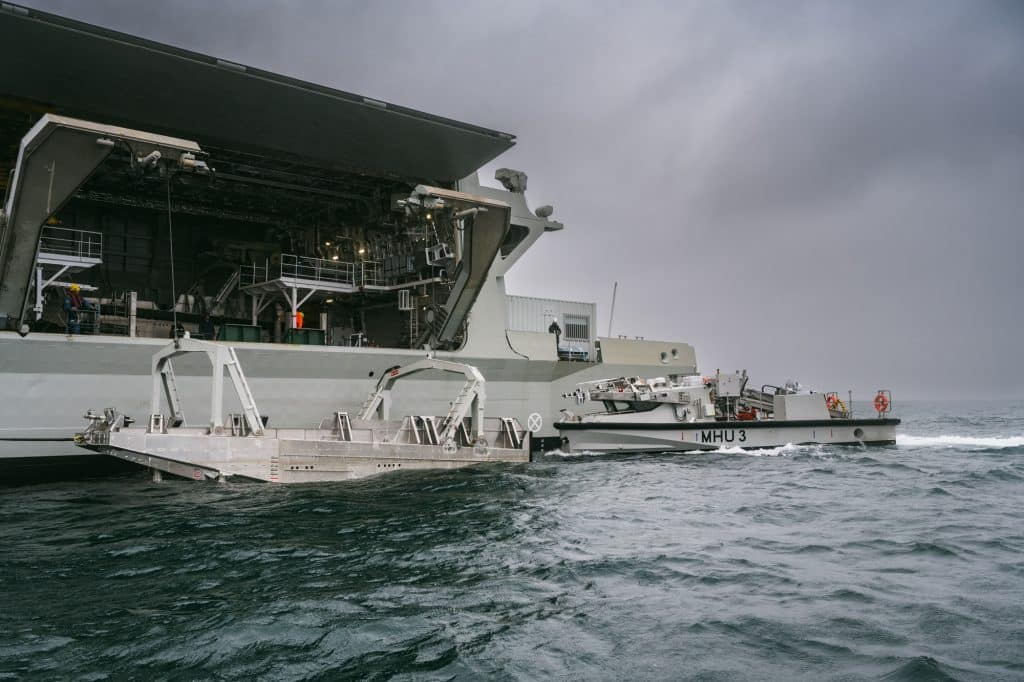
Learning to launch and recover the AUV in higher sea states is also a work in progress. “It works for the moment, but our operators haven’t yet got it working up to Sea State Four as we would like. We’re also not there yet regarding the full automatic launch and recovery of the system,” Cdr Van Engeland said. “So, we’re currently working with a man on board the USV, and we are working together with industry to improve that as fast as possible.”
The two T18 towed sonars which form part of the first toolbox have yet to be delivered but are expected to arrive during June. The T18 offers almost the same capabilities as the A18 – the main difference being that it produces near real-time data transmission through its tow cable connection and will be able to do the same area coverage as the A18 at twice the speed as the antenna is twice the length.
The integration of the Skeldar V-200 UAVs onboard the mothership also remains a work in progress. Cdr Van Engeland said the UAVs are currently restricted to land-based training as they await qualification for automatic take-off and landing from the ship’s decks, with industry trials expected to take place this summer.
“For the moment, we’re conducting ground-based training with the UAV, just to familiarise our operators with using it. The goal is to integrate the UAV on board with the complete toolbox by the end of this year,” Cdr Van Engeland said. “This is quite a challenge, because when the CoNops was written, it was based around MCM tools – but the UAV is not an MCM tool, it’s a helicopter. So, it’s challenging for us to maintain it, to have the proper certification and so on.”