2 hours ago
Laura BickerChina correspondent
It's a turnaround for Beijing, whose official response has been muted so far. Why is China stepping in now?

2 hours ago
Laura BickerChina correspondent

 Getty Images
As the war in the Middle East enters its second month, choking the world's energy supply and sending oil prices soaring, China is trying to step in as a peacemaker.
It comes as President Donald Trump says US military action in Iran could end in "two to three weeks", but there is no clear sense yet of how that will happen or what comes after.
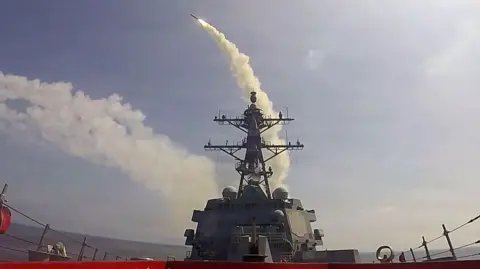
China joins Pakistan, which has emerged as an unlikely mediator in the US-Israel war against Iran. Officials in Beijing and Islamabad have presented a five-point plan with the aim of bringing about a ceasefire and re-opening the vital Strait of Hormuz.
Pakistan, which has been a US ally in the past, seems to have won over Trump to mediate this conflict.
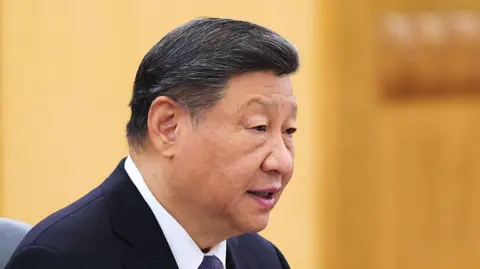
Beijing, however, is entering the fray as a rival to Washington, and ahead of a crucial trade talks between Xi Jinping and Donald Trump next month.
China's backing on this is "very important," says Zhu Yongbiao, a Middle East expert and director of the Centre for Afghanistan Studies at Lanzhou University.
"Morally, politically and diplomatically, China is providing comprehensive support with the hope that Pakistan can play a more distinctive role."
It is also a turnaround for Beijing, whose official response to the war has so far been quite muted. So why is China stepping in now?
 Getty Images
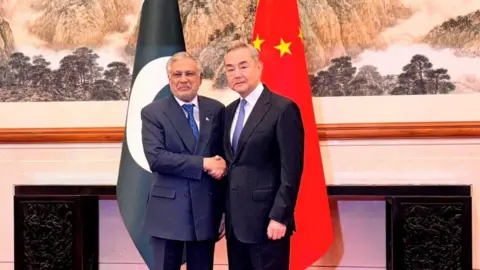
The peace plan was drafted after Pakistan's foreign minister flew to Beijing to ask for Chinese support for the country's efforts to negotiate an end to this conflict.
His efforts appear to have worked. China's Foreign Ministry said the two were making "new efforts towards advocating for peace." The joint statement agreed that dialogue and diplomacy were "the only viable option to resolve conflicts", and it called for waterways, including the blockaded strait, to be protected.
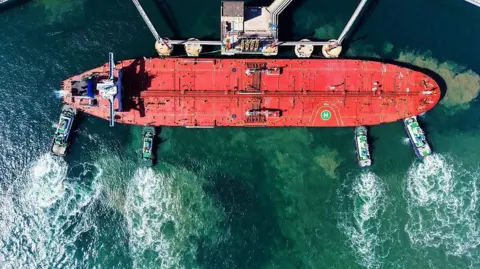
It's not just about oil, although that will be a concern. China, the biggest importer of crude oil in the world, has enough stockpiled to get it through the next few months.
Beijing will likely have decided to play the role of peacemaker because the war in Iran jeopardises something Xi covets: stability. China needs a stable global economy as it is heavily reliant on selling goods around the world as it tries to revive an ailing domestic economy.
"If the rest of the world begins to slow down economically because of an energy shock, that's going to be tough for China's factories and exporters," says Matt Pottinger, Chairman of the Foundation for Defense of Democracy's China Program.
"That's why I think when I see China's foreign minister just this week advising Iran that we need to find a way to end this war, I think there's some sincerity there. I think that Beijing is a little bit worried about where this could lead if it turns into a real energy shock that is protracted."
There are already fears that China's industrial heartland, which serves as the factory of the world, will be impacted in the long term if this crisis continues.
Paying a higher price for oil affects the whole supply chain, from the plastics needed to make toys and games, to the raw materials for modern synthetic fabrics, to the hundreds of components that go into phones, electric cars and semiconductors.
 Reuters
The US trade war with China during Trump's first term led many business owners across the country to look for new markets around the world.
As a result, China's exports to the Middle East grew nearly twice as fast as its exports to the rest of the world last year. The region has become the fastest growing market for electric cars, and China is also the largest investor in desalination in the Middle East, where potable water is scarce.
The Power Construction Corporation of China has projects in Saudi Arabia, the Emirates, Oman and Iraq.
As a result of its economic ties, China has cultivated relationships across the region with both US allies, such as Saudi Arabia, and foes, such as Iran.
Tehran and Beijing have a partnership dating back decades. China is Iran's leading trade partner and it buys around 80% of Iranian oil.
The Chinese government has played the role of peacemaker in the Middle East before, with limited success.
In 2023 it brokered a deal between bitter rivals Saudi Arabia and Iran, which lave long stood on opposing sides in proxy wars in the Middle East. They severed ties in 2016 when Saudi Arabia executed a prominent Shia Muslim scholar, triggering protests in Iran with crowds attacking its embassy in Tehran.
After China took up the mantel as mediator, the two sides agreed to re-establish diplomatic relations. This was in China's interest. Beijing will have hoped that better diplomatic relations between Saudi Arabia and Iran would reduce the likelihood for regional tensions.
A year later, Beijing played host to the leaders of 14 Palestinian factions, including Fatah and Hamas. The talks resulted in a national unity government for the occupied West Bank and Gaza.
The declaration was more an expression of intent rather than a comprehensive agreement, but once again, it highlighted the role China can play in the region, and its interest in stability in the Middle East.
 NurPhoto via Getty Images
China's partnerships across the world come with no security guarantees or military backing.
For Beijing, its economy comes first - and it is this economic interdependence with countries across the region which gives it leverage and helps it project some influence.
"China is cautious about being drawn into broader conflicts," says Zhu. "Its priority, both domestically and in foreign policy, is economic development. There is a broad consensus that China shouldn't recklessly get involved in a war."
But this approach has its limits. China doesn't have the military capabilities in the region to step in even if it wished to do so.
The US has bases in each of the Gulf states. China's closest base is in Djibouti in East Africa and was only established in 2017. It is a logistics hub for anti-piracy operations rather than a base for projecting power.
During the Israel-Iran war in 2025, China stayed on the sidelines and offered minimal support revealing the limitations of its role as a partner.
As for this latest peace plan, both the US and Iran have yet to respond, but pushing forward this initiative allows Xi to play the role of neutral broker and peacemaker - and once again stand in contrast to the leader of the other major superpower, the US.
Beijing's credibility to portray itself as a pragmatic international player comes with plenty of caveats. Its alignment with Russia has consistently sparked questions about its neutrality. Its increasing control of Hong Kong and its repeated threats to take self-governed Taiwan by force if required are still huge concerns.
And China's authoritarian leaders avoid any discussion about human rights, and never condemn regimes for rights abuses or misuse of power. All of this makes it President Xi an unlikely spokesperson for a global rules-based order.
But China is a powerful global player driven by strategic interests. It has shown it has some influence in the Middle East, and it certainly has ambitions to gain more leverage in the future.

European stock markets opened higher after the US president said the conflict would "end very soon".

Prime office supply in mainland Chinese cities and Hong Kong is estimated to peak this year, while demand remains hampered by an economic slowdown and global uncertainties, according to Cushman & Wakefield. At the end of 2025, premium office inventory in 21 major cities in Greater China – including

Against a backdrop of war and global uncertainty, Chinese Premier Li Qiang delivered a clear message at the recent China Development Forum: China is committed to being a “harbour of stability” for the world. The forum, which drew CEOs from global companies such as Siemens, Nestlé and Apple, signalle

Stanford said the papers, which mentioned the Tiananmen Massacre, would be banned if returned to Beijing.