9 hours ago
Paul Brown, Barbara Metzler and Adam DurbinBBC Verify
BBC Verify examines recent damage to three key Russian oil export facilities near the Baltic Sea.

9 hours ago
Paul Brown, Barbara Metzler and Adam DurbinBBC Verify

 Vantor
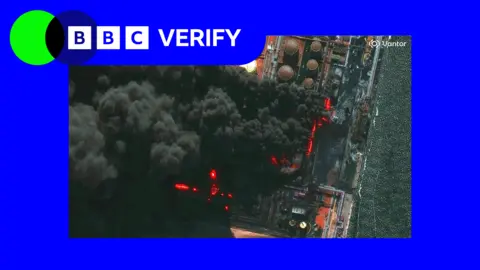
Satellite imagery and verified videos show Ukraine has repeatedly struck key Russian oil export infrastructure near the Baltic Sea in the past week, leaving some facilities burning for several days.
BBC Verify has confirmed at least three oil sites in Russia's Leningrad region were attacked near the city of St Petersburg, about 500 miles (800km) north of the Ukrainian border, since 23 March.
This includes several separate strikes on the key Baltic Sea ports of Ust-Luga and Primorsk as well as an attack on the nearby inland Kirishi oil refinery.
According to analysis by the Finland-based Centre for Research on Energy and Clean Air (Crea) 22% of Russia's total oil exports in 2025 departed from Primorsk and 20% from Ust-Luga.
 Vantor
Recent data shows no ships were loaded with oil in any of Russia's three Baltic ports on 26 and 27 March, which Crea said is the first period of two consecutive days with no such activity since Moscow launched its full-scale invasion of Ukraine in 2022.
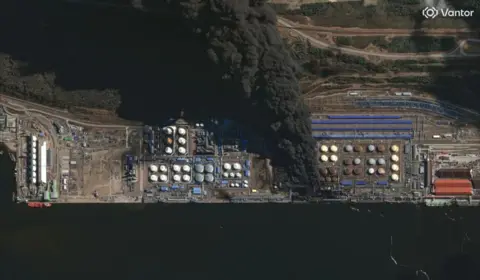
Satellite images show enormous plumes of smoke rising from burning oil facilities in Primorsk on 24 March, as well as fires at Ust-Luga and extensive damage to Kirishi on 27 March.
BBC Verify's analysis of the pictures indicates:
 Telegram/Astrapress
Nasa's satellite resource FIRMS, used to detect heat signatures on the Earth's surface, indicates Primorsk was still burning as of 02:54 BST on Monday.
A heat signature was also detected by FIRMS at Ust-Luga at 12:28 on Monday. Leningrad region's governor, Alexander Drozdenko, had said the fire had been contained on Sunday. He did not report any casualties.
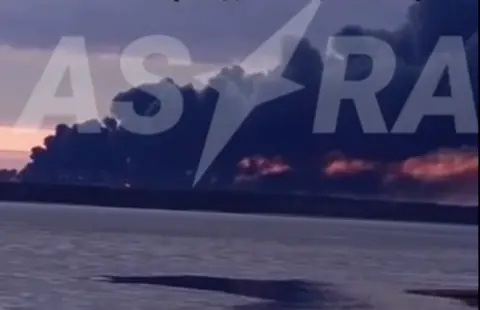
BBC Verify has also confirmed several videos showing the aftermath of attacks on all three facilities in the past week, including clips showing massive smoke plumes rising into the sky from Primorsk.
The commander of Ukrainian military drone forces, Robert Brovdi, has said that an operation targeting these three Baltic oil export facilities was carried out between 23 and 28 March.
Brovdi added the strikes were aimed at "demilitarising Russia's oil arteries, refining capacity and crude export infrastructure".
Ukraine's military has said the Kirishi refinery is among the three largest oil‑processing plants in Russia, including the production of "fuels that support the armed forces of the aggressor state".
At least 40% of Russia's oil export capacity was halted on 25 March following the first attacks, according to calculations by the Reuters news agency based on market data.
According to Crea's analysis, Russia earned about £7.1bn from oil exports in the final three weeks of March, as prices rose sharply due to disruption caused by the US-Israel war with Iran.
Ukrainian President Volodymyr Zelensky said on Monday that allies have asked Kyiv to reduce attacks on Russia's energy sector because of the global energy crisis. He added they would only end if Russia stopped targeting Ukraine's energy system.
Alexander Lord, an analyst at UK-based intelligence company Sybelline, said it's "likely that Kyiv is attempting to offset the revenue windfall that Russian oil and gas exporters are otherwise currently enjoying".
But Lord added the longer the war continues, the more likely it becomes that the "US will attempt to pressure Ukraine to stop these targeted strikes, as part of wider efforts to suppress global oil prices".
Additional reporting by Daniele Palumbo and Yaroslava Kiryukhina

The National Police and the Security Service of Ukraine have thwarted a series of contract killings organized by Russian agents.

Hungarian Foreign Minister Péter Szijjártó has commented on the leak of audio recordings of his conversations with Russian Foreign Minister Sergei Lavrov and once again criticised the European Union's sanctions policy against Russia.
Ukraine’s refusal to permit European specialists to inspect the Druzhba oil pipeline, through which Russian oil flows to Hungary and Slovakia, has created tension with the EU and deepened divisions within the bloc, Euractiv reported on March 31.

As of March 31 morning, users in five regions are without power due to new Russian attacks on the power grid. Electricity consumption is increasing due to cloudy weather.