10 hours ago
Soutik BiswasIndia correspondent
The story of the rise and decline of India’s communists - from ruling states to struggling for relevance.

10 hours ago
Soutik BiswasIndia correspondent

 AFP via Getty Images
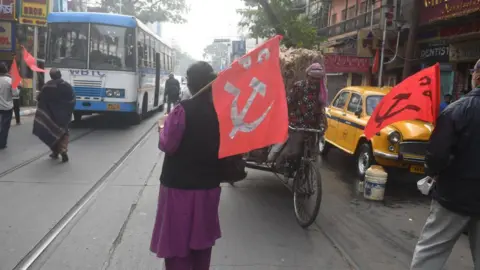
For the first time since 1957, India no longer has a single communist-led state government.
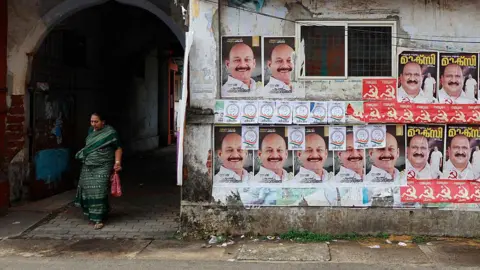
The defeat of the Communist Party of India (Marxist)-led Left Democratic Front (LDF) in Kerala this month, after a decade in power, marked the end - at least for now - of one of the world's most enduring experiments in democratic communism.
At their peak, India's communist parties ruled states stretching from West Bengal to Kerala and Tripura. They impacted the lives of more than 100 million people through trade unions, peasant organisations, student wings and disciplined cadre networks.
In West Bengal, the Left Front governed continuously from 1977 to 2011 - one of the world's longest-running elected communist administrations. In Tripura, the Left ruled for 35 years in all, including an uninterrupted 25-year stretch before its defeat by Prime Minister Narendra Modi's Bharatiya Janata Party (BJP) in 2018.
Kerala followed a different trajectory. Since 1957 - when the state voted for one of the world's first elected communist governments under EMS Namboodiripad - power has alternated between the Left and the Congress, making the communists a durable force but never a permanently dominant one.
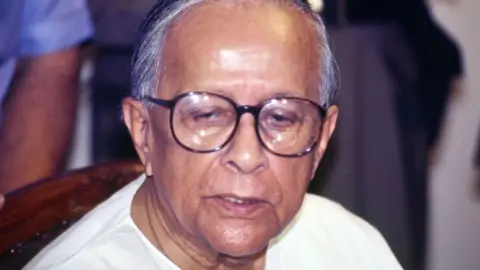
In 1996, Jyoti Basu, a founding member of CPI (M) and then West Bengal's chief minister, came within touching distance of becoming India's prime minister as head of a coalition government. But his party rejected the offer - a decision Basu would later famously describe as a "historic blunder".
The communists shaped coalition politics in Delhi so deeply that in 2008 they withdrew support from former prime minister Manmohan Singh's government over the landmark civil nuclear deal with the US. At the time, the Left parties held 62 seats in the lower house of parliament, enough to push Singh into a confidence vote before he finally secured the agreement.
 NurPhoto via Getty Images
Their reach extended far beyond parliament. Despite economic stagnation in West Bengal and concerns over declining educational standards under Left rule, the communists continued to wield outsized influence over economic thinking and intellectual and cultural life well beyond their electoral strongholds.
Many believe that most of that influence has now faded.
The Left today survives unevenly. In Kerala, despite its latest setback, the Left remains politically consequential. In Tamil Nadu, it survives largely through alliances. In Bihar, the CPI (Marxist-Leninist) has emerged as an energetic grassroots force in some pockets. Left-backed student groups continue to fare well in leading universities.
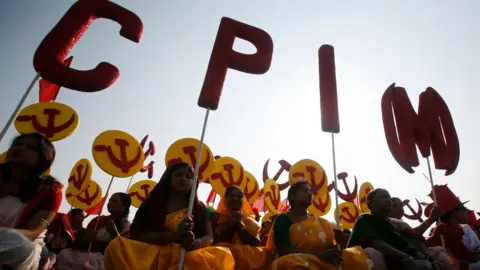
But in West Bengal and Tripura - once the great bastions of Left power - the communists have been reduced to a shadow of their former self. Nationally, the CPI (M)'s share of the popular vote has fallen from more than 6% at its peak in the 1980s to below 2% in recent general elections.
The decline reflects the fading of an older political language: class struggle and collective mobilisation have steadily given way to identity politics, nationalism, populist leaders and welfare delivery.
Mohammed Salim, CPI (M)'s West Bengal secretary, sees a larger historical tide at work. Since the 1990s, he argues, the rise of Hindu nationalism and market liberalisation produced a "religious, political and economic onslaught" that squeezed the Left from all sides.
"The middle class was shown this green pasture," he says. "Development, modernisation, infrastructure - you will get a slice of it. Aspiration was generated."
 Sondeep Shankar/Getty Images
The communists, he argues, struggled to counter a politics increasingly organised around caste and religion rather than class. "Politics of division weakened class unity," says Salim.
Yet experts argue the Left cannot explain away its decline simply through the rise of Hindu nationalism, caste politics and aspirational politics.
Unlike China or Vietnam, communist parties in India governed only states within a "federal political economy", says Sanjay Ruparelia, a professor of politics at Toronto Metropolitan University.
That left them under growing pressure to attract private investment and deliver growth. In West Bengal, the contradiction exploded spectacularly: the party that had risen through land reforms was suddenly accused of dispossessing peasants in the name of industry.
 REUTERS
Kerala stood apart, earning international attention for decentralised planning, high social indicators, literacy, poverty reduction and a strong public health system.
But the model had underlying strains. "Kerala continued to rely heavily on remittances from abroad, which have wavered, creating mounting fiscal pressures and inadequate employment generation, especially among youth," says Ruparelia.
More strikingly, Kerala's communists themselves drifted towards the economic model they once opposed.
A 2022 CPI (M) policy document embraced private investment, public-private partnerships, private universities and globally integrated technological services.
For political scientists such as Ruparelia, this evolution underlined a larger reality: India's communist parties were often "better understood as social democratic than communist".
Rather than pursuing revolution, they largely functioned as parliamentary parties centred on welfare, labour rights and redistribution.
"India was unusual in having parties from the communist tradition succeed in democratic elections," he says.
But, argues MA Baby, general secretary of the CPI (M), state governments always operated within tight constraints.
"They have limited financial and administrative powers. The real power lies in Delhi," he says.
"We used state governments to show that even within the capitalist socio-economic structure, pro-people policies and alternatives are possible despite limited powers."
But the social base sustaining that model has steadily eroded. Organised labour was always a minority in India's vast informal economy. Welfare politics increasingly shifted from class mobilisation to direct cash transfers and identity-based coalitions.
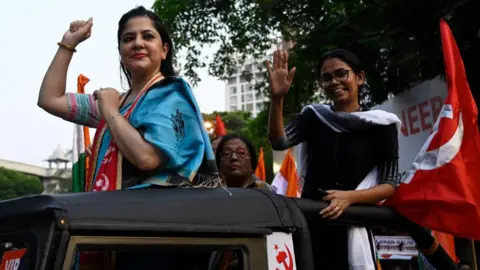
When farmers' protests erupted in 2020 against Prime MInister Narendra Modi's farm laws, they exposed how much rural politics had changed.
The Left remained part of the movement - "the voice of conscience", as analyst Shikha Mukherjee puts it - but no longer its leader. Regional parties and independent farm unions had taken over that space.
 Hindustan Times via Getty Images
"The Left has lost its place as the principal voice of rights and entitlements. It has struggled to adapt to the modern economy, and ideological confusion now lies at the heart of the movement," says Mukherjee.
India today is marked by soaring inequality, chronic youth unemployment and deepening economic insecurity - conditions in which Marxist politics might once have been expected to flourish. As Ruparelia notes, "the objective conditions, as leftists are wont to say, should benefit them".
But where are the communists, asks Mukherjee. "The Left should have been out on the streets. Where are they?"
The paradox is not uniquely Indian.
After the 2008 financial crisis, Europe too saw the emergence of new left-wing parties.
But many struggled against nationalist populists who mobilised workers through "immigration politics and ethnonationalism rather than class solidarity", says Ruparelia. India's Left, Mukherjee argues, has faced a similar challenge with the BJP.
Still, writing obituaries for political movements is premature.
 NurPhoto via Getty Images
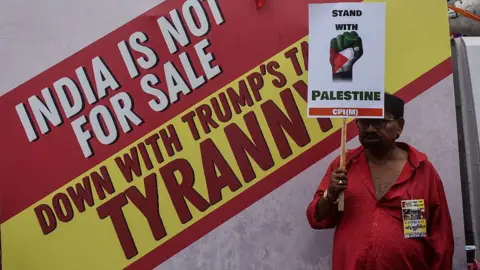
Indian communism has survived splits, state repression and electoral collapse. Its organisational networks - though diminished - still run through parts of the country.
Whether the Left can transform that residual presence into political renewal is another question.
"The CPI (M) needs to reinvent itself - to work within the economic system liberalisation has created, not merely oppose it," says Mukherjee.
In West Bengal, Salim insists the party is again "regrouping, repositioning and rejuvenating".
Keen to shed its image as ageing and resistant to change, the party has been pushing a younger generation of leaders to the forefront.
"Communists must constantly rejuvenate themselves. The only constant is change itself," says Baby.
But the scale of the Left's decline remains stark. In the Bengal election, the CPI (M) won just one seat in the 294-member assembly and secured little more than 4% of the vote.
Kerala, however, tells a different story: even in defeat, the LDF retained roughly a third of the vote, underlining that the communists remain a significant political force there. In Tripura, a return to office still appears distant.
Yet party leaders insist the Left's electoral decline does not fully capture its social and political relevance.
"Are we hopeful? Of course," says Baby.
"In fact, we ask: without us, what future is there? Seats matter, but our place in the hearts of the people matters more."

Foreign spies in China have disguised themselves as wedding photographers near naval ports, or have collected mapping data using advanced radar and GPS optical lenses mounted on cars under the cover of autonomous driving research, according to China’s top body protecting state secrets. The National

Chinese aircraft carrier Liaoning and its strike group are holding a live-fire exercise in the Pacific east of the Philippines, following one of its longest deployments in the South China Sea. The People’s Liberation Army (PLA) Kuznetsov-class carrier, along with at least four escorts, was spotted o

The US military scaled back and kept a low profile for its transits through the Taiwan Strait last year in contrast with increased passage by its allies, according to a report released by a leading Chinese think tank. In 2025, the remaining Five Eyes countries – Australia, Canada, Britain and New Ze

The YouTuber allegedly made false claims that fuelled a career-ending scandal for Kim Soo-hyun.