
From March 14 to 16, US and Israeli operations continued targeting key elements of the Islamic Republic’s military capabilities, including missile infrastructure, naval command sites, and facilities tied to Iran’s military space program.
As the conflict intensifies, messaging from Israeli leaders increasingly seeks to reach Iranian citizens directly, as sources point to emerging fractures inside the regime’s political and security establishment. Within Iran, authorities appear to be preparing for possible unrest through expanded checkpoints, arrests, and heightened surveillance, even as economic disruptions and banking outages add further pressure ahead of the Nowruz holiday.
Military overview
US Central Command (CENTCOM) released a video update on March 16, highlighting American strikes against the regime’s missile, drone, and naval threats. It also noted that the US has also struck the manufacturing capabilities of the Islamic Republic. CENTCOM noted that Iranian forces have retaliated by firing missiles and drones at civilian areas in the region hundreds of times, including more than 300 incidents involving cluster munitions.
IDF Persian said on March 16 that Israeli forces carried out a precision strike in eastern Tehran targeting the main headquarters of the Islamic Revolutionary Guard Corps (IRGC) Navy, describing the force as responsible for disrupting international shipping and transferring weapons and funding to militant groups by sea. The statement said that the attack aimed to damage the unit’s command infrastructure and disrupt its ability to plan and coordinate operations linked to attacks against Israel and threats to maritime trade routes.
Another post said that an Israeli strike in central Tehran destroyed a facility linked to Iran’s military space program that was allegedly used to develop capabilities for targeting satellites. The site was described as supporting projects tied to offensive space technologies, including work associated with the IRGC’s “Chamran-1” satellite launched in September 2024, which the post said could threaten Israel’s and other countries’ space assets.
Meanwhile, Jerusalem’s direct messaging to Iranians persists. In a video address to the Iranian people on March 16, Israeli Prime Minister Benjamin Netanyahu congratulated Iranians on the upcoming Persian New Year, Nowruz, which begins on March 20, and delivered a message of hope. He said the holiday carries a “special meaning” this year, adding that “light will triumph over darkness.”
The latest on the regime’s stability
Citing an anonymous senior Israeli official, The Times of Israel reported on March 15 that there are “signs of cracks” within the Islamic Republic, adding that Jerusalem is facilitating the conditions to empower the Iranian people to overthrow the regime. “It may take time, but this is not an endless war, and we are far ahead of schedule,” the official remarked.
In line with these claims, the IRGC and the administration of Iranian President Masoud Pezeshkian are reportedly at odds over Iran’s postwar outlook, according to IranWire. In a tense meeting, Pezeshkian supposedly warned that the government would face severe economic strain and renewed public dissatisfaction once the fighting subsides, urging the Guards to help prepare for recovery. An IRGC representative reportedly dismissed the concern, arguing that the war has strengthened public unity and a continued emergency environment would deter unrest. If the report is accurate, the exchange would indicate a sharp divide between the government’s economic worries and the Guards’ hardline wartime posture.
Unconfirmed reports also allege rising desertions within the IRGC and the Iranian police. The defections are attributed to breakdowns in communication with command centers in Tehran, frustration that field personnel are exposed while senior commanders remain sheltered, and worsening economic pressure, as cash shortages leave some security members struggling to cover basic expenses.
The latest on internal repression: the regime braces for unrest
Reports from inside Iran indicate a sharp increase in Basij and other security forces establishing checkpoints and armed plainclothes patrols across multiple Iranian cities as part of a broader effort to control urban spaces and identify dissent. Incidents have been reported in Tehran, Karaj, Tabriz, Isfahan, Ahvaz, Shiraz, Rasht, Khorramabad, Zahedan, and cities across Kurdistan and East and West Azerbaijan provinces. At these checkpoints, personnel have reportedly detained and interrogated civilians, searched mobile phones, confiscated devices, and, in some instances, opened judicial cases based on information found on personal phones.
Iran International reported on March 16 that several security checkpoints across Tehran were allegedly hit in US-Israeli airstrikes, including locations around Enghelab Square near South Kargar, the Molavi–Sahebjam district, Azadi Square, Hejazi Highway, Mortezagerd, and the Azadegan Highway. The outlet said that some of the positions had been placed under major road structures or inside covered urban areas, a tactic authorities reportedly adopted to reduce exposure to aerial strikes as attacks increasingly target security patrols and checkpoints across the capital.
On March 16, the Israeli Mossad’s Persian-language account posted, “Your final battle will begin soon. We are with you in the sky on earth and in our hearts.”
That same day, the IRGC-affiliated Fars News warned that foreign intelligence services are allegedly planning to trigger a new phase of unrest inside Iran. It claimed Israeli and US intelligence are seeking to stage killings and activate networks to spark instability.
Regime media reported that armed assailants opened fire on a police patrol in Taftan county on March 16, killing five police personnel and one civilian. Taftan is located in Sistan and Baluchistan province in southeastern Iran, a region where Baluch separatist groups have carried out repeated attacks against Iranian security forces over the past decade.
A day prior, Iran’s national police chief Ahmadreza Radan claimed that authorities arrested 500 people accused of sending information to “the enemy and anti-Iranian media,” describing the detainees as spies. Radan claimed roughly half of the cases involved serious offenses, alleging that the suspects provided targeting information, maintained contact with opposition groups, and sought to disrupt public order, though he offered no evidence and did not specify when the arrests occurred.
The prosecutor of West Azerbaijan province said on March 15 that authorities arrested 20 individuals in Urmia accused of being “agents linked to the Zionist regime.” The statement added that IRGC Intelligence Organization forces in West Azerbaijan, working with the Basij and using cyber-monitoring and intelligence operations, identified and dismantled several alleged Israel-linked networks accused of sending information about military, police, and security facilities. Although authorities provided few details about the case, West Azerbaijan province, similar to neighboring Kurdistan province, has long been a hotspot of Kurdish separatist activity.
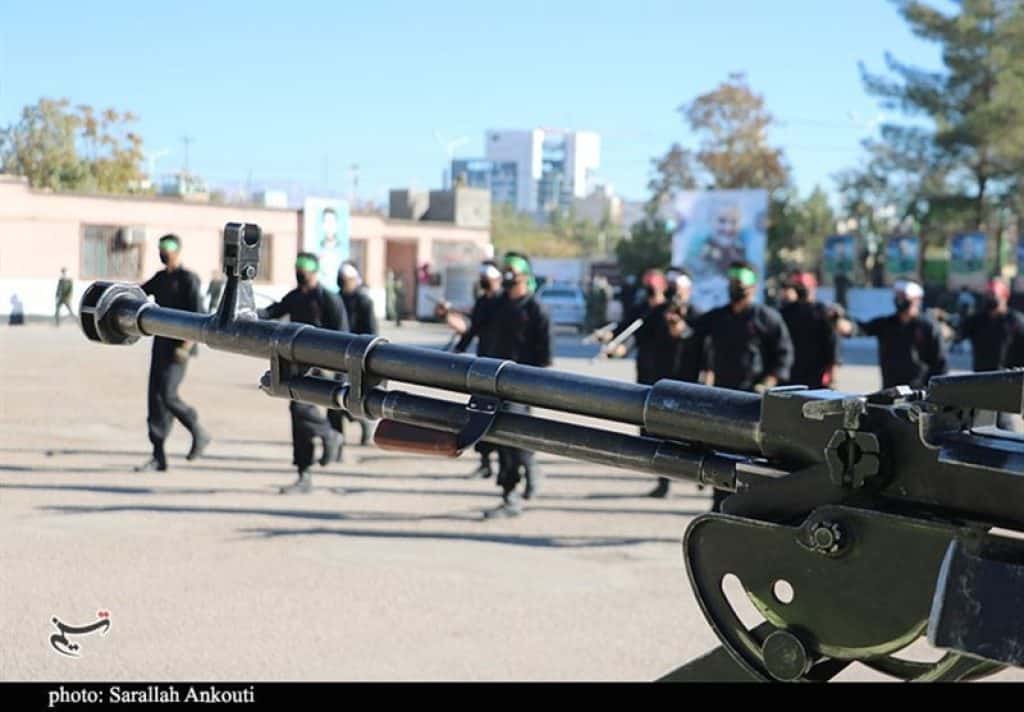
A video sent to Iran International on March 15 shows a truck carrying a DShK heavy machine gun stationed in the Shiraz-Sepidan police station, equipment the regime has previously used to kill unarmed protestors.
Footage circulating online from Tehran claims that the regime has posted flyers in residential buildings, warning residents of heightened security monitoring. The notices urge people to report suspicious activity, avoid sharing images or information online, and refrain from actions that could be interpreted as cooperation with hostile media or foreign actors. The reported messages reflect broader efforts by the regime to tighten social control and surveillance in neighborhoods.
Iran’s banking system disrupted
Widespread disruptions have affected services at two of Iran’s largest state banks: Bank Melli and Bank Sepah. Customers across cities, including Tehran, Karaj, and Fardis, have reported being unable to check balances, transfer funds, or access other online services, while many branches have also halted routine transactions.
The outages appear particularly severe at Bank Sepah, where many ATMs have stopped dispensing cash, and customers in some branches cannot withdraw or deposit funds. Long lines have formed outside certain Bank Melli branches as people attempt to access in-person services, though many operations remain unavailable, and support hotlines have reportedly gone unanswered. Tasnim News Agency described the outages as a possible cyberattack and blamed an “enemy conspiracy,” while also suggesting that earlier missile damage to a Bank Sepah branch may have contributed to the problems. The financial disruptions come at a sensitive moment just ahead of the Iranian New Year.
Janatan Sayeh is a research analyst at the Foundation for Defense of Democracies focused on Iranian domestic affairs and the Islamic Republic’s regional malign influence.
Tags: basij, Iran, IRGC, Israel Iran, Operation Epic Fury, Operation Lion’s Roar, US-Iran


