Italy is voting on whether to change its constitution. What does this mean for Meloni?
9 hours ago
Sarah RainsfordSouthern and Eastern Europe correspondent, Rome
The dry subject matter of this weekend's vote seems obscure but for many it is a vote on the PM.

9 hours ago
Sarah RainsfordSouthern and Eastern Europe correspondent, Rome

 Getty Images
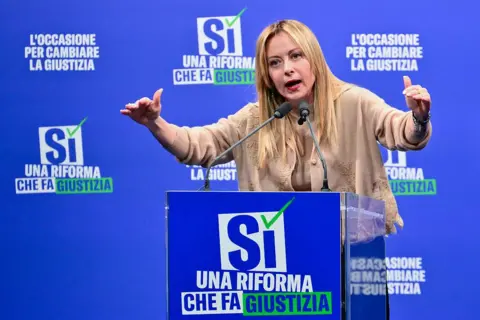
In her push for a "yes" vote in this weekend's constitutional referendum, Italy's prime minister has been reaching for new audiences.
On Thursday, Giorgia Meloni sat at the mic between a popular rapper and a personal trainer-turned-podcaster to urge Italians to vote for a judicial system she promised would be "more just" for all.
Opposition parties have been busy too, styling the "historic" reform proposed by the right-wing government as a threat to democracy, and turning it into a protest vote against Meloni's rule.
In power for three-and-a-half years, close to a record in a land of shaky coalitions, Meloni prides herself on bringing stability to Italy. But as this referendum has become increasingly personalised, she could be facing her first significant defeat.
"She wants to win. If she loses, there will be an impact and she understands that," political scientist Roberto D'Alimonte of Luiss University explains.
"She needs to mobilise her voters to have a better chance to win this race. But it's going to be touch and go."
 Getty Images
That's why the prime minister joined rapper Fedez and Mr Marra on their podcast, Pulp.
Swapping her usual one-tone trouser suit for a woolly jumper with sparkles, Meloni fielded questions for an hour from the tattoo-covered rapper and his popular co-host.
The engagement was meant to encourage younger voters to the polls.
There is no minimum turnout for this kind of referendum - the camp with the most ballots over two days of voting wins. The "no" campaign already has the backing of trade unions.
Recent polls suggested that low participation would favour those against the reform.
So on air Meloni set out her case for "yes" with trademark gusto.
She said changes to how Italy's judges and prosecutors work would make the system "more meritocratic, more responsible, more efficient".
She also argued her opponents were only turning all this into a referendum on her rule because they couldn't fault the reform itself.
In any case, Meloni made clear, she wouldn't be stepping down.
"If you vote 'no' today just to send Meloni home, you'll find yourself keeping both Meloni and a justice system that doesn't work," the prime minister said.
"That doesn't seem like a good deal to me."
So is Italian justice really "broken"?
The system is certainly chronically overloaded, with some of the longest-running trials in the EU.
But the reform won't address that.
The referendum looks at separating the career paths of judges and prosecutors, as well as creating distinct bodies to govern them. It also proposes a new disciplinary court for both.
The potential impact depends entirely on who you ask: many Italians struggle to understand this referendum at all.
The proposal is a project of the late Silvio Berlusconi's party, Forza Italia, part of the current coalition.
Italy's oligarch prime minister of many years was forever in and out of court and railed against the judiciary as a supposed "communist" block on his power.
Meloni herself has also clashed publicly with the courts, claiming that "powerful factions" routinely derail her signature policies, especially on migration.
In Milan recently she claimed - with no evidence - that rejecting the referendum would mean "even more… immigrants, rapists, paedophiles, drug dealers being freed and putting your security at risk."
Such rhetoric is one reason why opposition parties are so wary of this reform.
They fear Meloni's real aim is to subjugate the judiciary to her political control.
She and her team deny that.
But at a time of global uncertainty and rising prices caused by an unpopular US war, they also know voters may use the referendum to vent their frustration.
"The geopolitical situation is very tough, of course. People are scared. I completely feel that. But we need to stay focused on the purpose of the referendum," Andrea di Giuseppe, a member of Meloni's Fratelli d'Italia party, argues.
He suggested that an assessment of Meloni's own record could wait for the general election next year.
"If you are not happy about this government, then in 2027 [you can] just kick it off the bus, change to another government. Now, the matter of the referendum is what counts."
There are some, even on the left wing of politics, who support this reform and see the close ties between judges and prosecutors as too cosy.
"It's like, I help you for this case, so you help me. It's like a little parliament where they all act together. It's not normal," says Alessandro Sterpa, a constitutional law professor at Tuscia University.
Not usually a Meloni supporter, he points to widespread complaints in the past about the influence of political factions, the so-called "correnti", within the judiciary.
He also sees nothing in the proposed reform that would increase the degree of government control.
On the other hand, this would be the first time a hard right government has changed Italy's constitution, written in the 1940s after the defeat of fascism.
"For a long time, the left wing wrote books in the university that only the left can defend the constitution. But we cannot say these kinds of things now," Sterpa argues.
"My grandparents fought against fascism, with arms. Now I am for the reform because it's useful for the country."
The final rally of the "no" campaign was on Rome's majestic Piazza del Popolo, where some spelled out "Vote No" in white tape on the cobblestones.
An inflatable unicorn with rainbow-coloured tail wandered through the crowd with a sign reading "Leave the Constitution in Peace" round its neck.
From the stage came passionate calls to "defend democracy".
"The constitution gave us the guarantee of this balance of powers after fascism. We needed that not to fall again in that kind of state," argues Andrea Malpassi from the CGIL trade union, firmly for the "no" vote.
He's deeply wary of any constitutional tinkering by a prime minister who began her own political life as an admirer of Mussolini, the dictator.
"In the last few years we have had a lot of inquiries into what… ministers of this government did," Malpassi says.
"We don't want that not to be possible in the future."
If Meloni wins this vote she has grand political ambitions, including increasing the powers of her own office in a future referendum.
But this test comes at a difficult time.
"Italians don't like to get involved in these American wars, and the rise in gas prices damages the popularity of the government. The context is very negative for Meloni at this point," Prof D'Alimonte agrees.
She would survive a "no" vote. But the much-vaunted stability she has brought to Italy would be shaken at a particularly vulnerable time.
"She will not resign," the professor says. "But she will be politically weakened, there is no question about that."
Additional reporting by Giulia Tommasi.

Over the past 24 hours, one person was killed, and three others were wounded in the Kherson region as a result of shelling by Russian forces.

One person was killed, and six others were wounded in the Donetsk region over the past 24 hours as a result of Russian shelling.

Over the past 24 hours, 12 settlements in the Kharkiv region came under enemy attack. Two people were injured as a result of the shelling.

Over the past 24 hours, 148 combat engagements took place between the Ukrainian Defense Forces and Russian troops, with the enemy attacking the most in the Pokrovsk, Kostiantynivka, and Huliaipole sectors.