Kim Jong Un consolidates power in North Korea’s sweeping political overhaul
North Korea completed preparations for Kim Jong Un’s fourth term as the country’s supreme leader in late February and March 2026, holding three major political events in rapid succession that replaced more than half of the officials in key ruling bodies and hardened the regime’s st
Daily NK
75
5 min read
0 views

North Korea completed preparations for Kim Jong Un’s fourth term as the country’s supreme leader in late February and March 2026, holding three major political events in rapid succession that replaced more than half of the officials in key ruling bodies and hardened the regime’s stance toward South Korea.
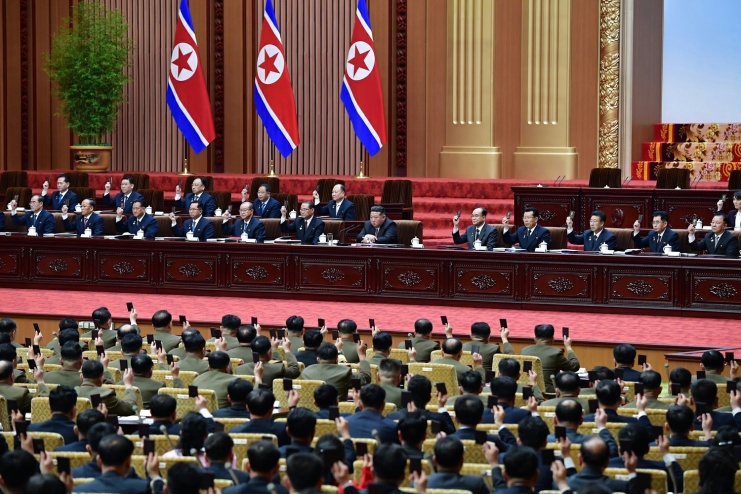
The Ninth Congress of the Workers’ Party of Korea (Feb. 19–25), elections for the 15th Supreme People’s Assembly (March 15), and the assembly’s first session (March 22–23) together secured Kim’s reappointment as general secretary of the party and president of the State Affairs Commission. The events also deepened the personality cult around his predecessors while ousting elder statesmen including Choe Ryong Hae from positions of influence.
The reshuffle marks Kim’s 15th year in power and signals a deliberate departure from the model set by Kim Il Sung and Kim Jong Il. With North Korea’s nuclear arsenal maturing and thousands of troops deployed to support Russia’s war in Ukraine, Kim appears confident enough to chart his own course. That course rests on five pillars: nuclear weapons, self-reliance, ideological reinforcement, hostility toward South Korea, and diplomacy aligned with bloc membership or national interest.
Assembly session hardens policy, sharpens social controls
The 15th Supreme People’s Assembly’s first session ratified the decisions of the Ninth Party Congress and adopted amendments to the constitution, the budget and a range of policies. The centerpiece was Kim’s policy speech, titled “On the Tasks Facing the Government of the Republic at the Present Stage of Socialist Construction.”
Kim used the address to assert the legitimacy of North Korea’s nuclear program and self-reliance drive, and to declare his intention to keep advancing what he describes as autonomy, independence and self-defense built on nuclear weapons. His remarks also invoked the “three revolutions — ideological, technological and cultural” of the 1970s and called for “strict administrative and legal measures” to prevent what he termed alien and unsound elements from infecting the socialist way of life. He announced plans to introduce a new police system and expand the role of neighborhood watch units and local government offices.
Those moves point to growing unease within the leadership over shifts in public sentiment. The appointment of propaganda chief Ri Il Hwan to the Party Presidium and of top military commissar Jong Kyong Thaek as vice chairman of the Central Military Commission and head of the Military Political Leadership Department during the party congress reinforced that picture. So did the elevation of intelligence chief Ri Chang Dae, Public Security Minister Pang Tu Sop and chief prosecutor Kim Chol Won to the State Affairs Commission during the assembly session.
On South Korea, Kim’s language was categorical. At the party congress he declared that North Korea “has nothing to discuss with the ROK, the most hostile entity, and will exclude the ROK from the category of compatriots forever,” warning that any South Korean attempt to change the status quo would bring about its own destruction. In his assembly speech he went further, saying North Korea would “categorically reject, ignore and treat the ROK with the most explicit words and actions” and make it “pay the price for its acts of provocation without the slightest consideration, hesitation or mercy.”
By contrast, Kim’s remarks on the United States were limited to general criticism of recent U.S. policy, including its bombing campaign against Iran. The asymmetry suggests Kim is applying his “two hostile states” policy selectively — freezing out Seoul while keeping a channel open for potential engagement with President Donald Trump.
On diplomacy, Kim stressed personal oversight of foreign affairs and formalized a troika to manage key relationships: his sister Kim Yo Jong for South Korean and external affairs, Kim Song Nam to oversee China and the socialist bloc as head of the party’s international department, and Foreign Minister Choe Son Hui for the United States and Russia. His chief aide Jo Yong Won was named first vice chair of the State Affairs Commission and chairman of the Standing Committee of the Supreme People’s Assembly, consolidating a tight inner circle.
Whether the “two hostile states” framing has been formally written into the constitution has not been disclosed. Kim’s phrasing — “officially regarding South Korea as the most hostile state” — and his inflexible tone suggest it has, though the leadership appears to be managing the optics carefully to soften the domestic and international impact of abandoning the “one Korean nation” doctrine championed by his predecessors.
Taken together, the three events confirm that Kim will pursue stability through defense and experimentation through offense, guided by the five pillars above. That strategy may include nuclear or missile tests, high-profile executions intended as warnings, and deliberate provocations along the border.


