
At least 2,000 U.S. Marines constituting the 31st Marine Expeditionary Unit (MEU), headquartered in Okinawa, have been dispatched towards the Middle East as U.S. Strikes on Iran enter their third week.
These 2,000+ Marines and their associated equipment are currently located aboard the USS Tripoli (LHA-7) and the USS New Orleans (LPD-18). Prior to receiving orders to depart for the Middle East, the Tripoli, her marines, and her escorts were taking part in exercises in the Pacific Ocean near the Philippines, and had returned to their typical basing in Japan before moving out again.
Orders for the Tripoli’s Amphibious Ready Group (ARG) to make for the Middle East was initially reported by The Wall Street Journal, citing unnamed Pentagon officials. Currently, the Tripoli ARG consists of the Ticonderoga-class guided missile cruiser the USS Robert Smalls (CG-62) and the Arleigh Burke-class guided missile destroyer USS Rafael Peralta (DDG-115), along with the USS Tripoli herself and the USS New Orleans.
The transfer of the the Tripoli ARG marks the most major assets that have been moved out of INDOPACOM’s inventory thus far, as the Tripoli had been assigned to 7th Fleet’s area of responsibility as a part of the U.S. military’s contingent in Japan. It has been noted that primarily air-defense assets had been previously commandeered from INDOPACOM, with both THAAD and Patriot battery components (primarily Transport Erector Launchers and missiles) being reportedly moved to the Middle East from Korea.
Capability and Intentions
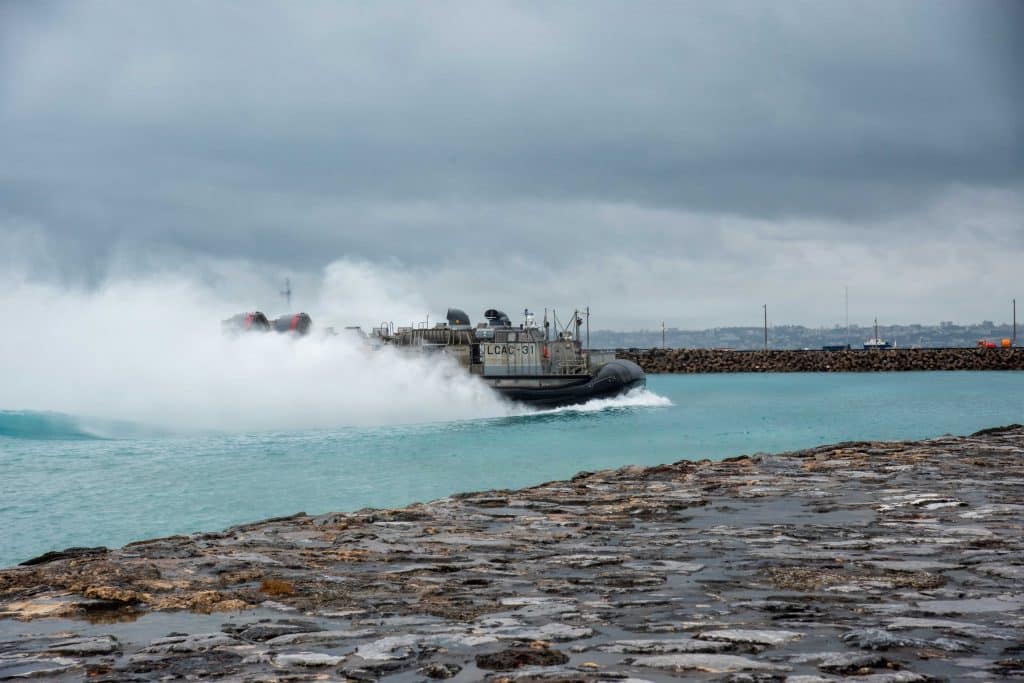
An ARG’s primary goal is to land and support marines in coastal and littoral environments, with Marine landings being facilitated by over thirty aircraft in the group’s air wing, along with any sea-based landing craft. The ARG’s allotment of aircraft used to support Marines consists of: F-35 Lightning II Fighter Jets, MV-22B Tilt-rotor transports, AH-1Z Viper Attack Helicopters, UH-1Y Venom Attack/Utility Helicopters, MH-60S Utility/Search and Rescue Helicopters, and CH-53E/K Stallion Transport Helicopters.
With the Tripoli herself spotted on satellite imagery (posted to X by @MT_Anderson) speeding towards the Middle East, the goals for the deployment of the Marines, their vessels, and their equipment remains unclear. The arrival of an ARG with the above mentioned prowess regarding the insertion of U.S troops, has potentially signaled further U.S involvement by attempting to capture or hold some amount of hostile territory.
Potential targets for the ARG include Marine deployments on outlying Iranian islands in the straits, serving as a jumping off point to help interdict any Iranian mining or interdiction efforts in the Strait of Hormuz trying to clamp down on the passage of commercial shipping, as the price of oil has climbed by significant margins. However, the Pentagon has not confirmed the intentions behind the Tripoli ARG’s new tasking, with no forthcoming statements from any officials as of yet.
Given the ARG’s current location, Naval News estimates it will take the group 10 to 15 days to reach the Strait of Hormuz area.