
A large uncrewed underwater vehicle (LUUV) demonstrator built by Saab for the Swedish Defence Materiel Administration (FMV) is on track to start sea trials in mid-year, the company has confirmed.
FMV awarded Saab a SEK 60 million ($6.9 million) contract in August 2025 for the design, construction and testing of the LUUV testbed. The vehicle, known by the proprietary name Autonomous Ocean Drone (AOD), will integrate Saab’s own Autonomous Ocean Core autonomy engine.
According to FMV, the demonstrator is intended to explore the potential application of a LUUV to a range of undersea missions, including protection of critical underwater infrastructure and intelligence, surveillance and reconnaissance (ISR). It will serve as a testbed to push the technical boundaries of autonomous underwater vehicles (AUVs), and also inform the utility of a LUUV-type vehicle launched and recovered from submarines.
“This is a demonstrator [supporting] two trials in one,” Rear Admiral Fredrik Lindén, FMV’s Director Naval Systems, told Naval News. “Can we pick up the production pace and get it in the water in the right time? And then once it’s in the water, what can we learn from it, and how do we adapt that for subsequent batches?”
“[It] will also allow us to start testing and trying out what the future organic LUUV will look like for the A26 submarines,” he added. The A26 design incorporates a multi-mission portal sized to accommodate larger AUVs.
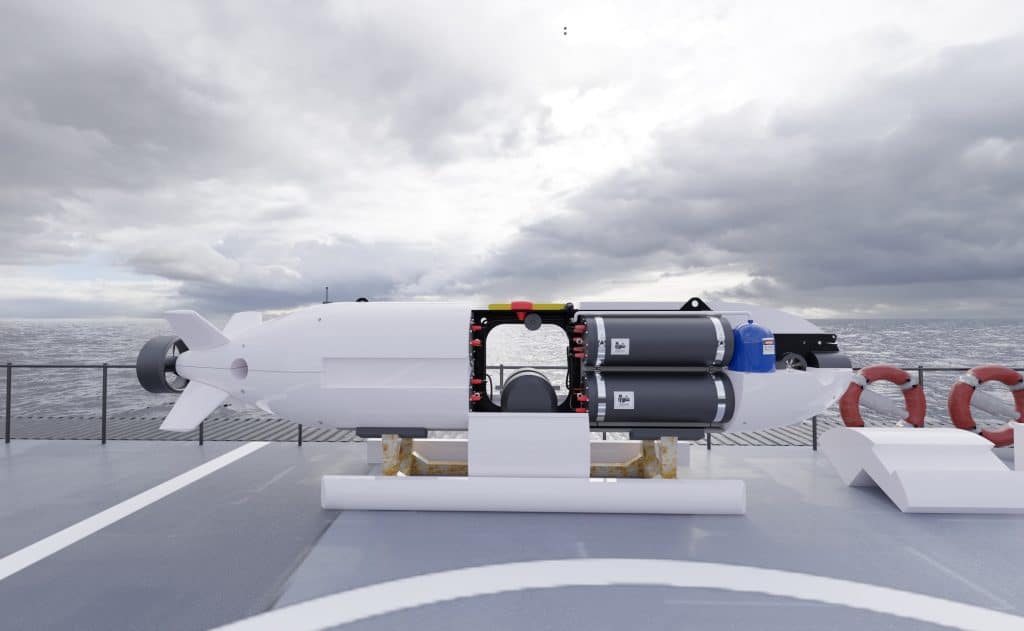
Saab’s baseline ISR-configured AOD is 7 metres in length, has a diameter of 1.4 metres and has a weight of 6.5 tonnes. Powered by Lithium-Ion batteries, the vehicle has a range in excess of 600 nautical miles at a patrol speed of around 4 knots.
Peter Karlström, Saab’s product manager for AOD and Artificial Intelligence (AI) and software solutions, said that the demonstrator being built for FMV will serve as a valuable tool to further mature autonomy, explore use cases, and refine concepts of operation. “There is a need for more autonomous assets as a way to [bridge] the capability gap, and we see that the Technical Readiness Level is there now regarding batteries and autonomy,” he said. “We have a good pedigree within Saab from our torpedoes and smaller AUVs, and we are also bringing our structures, signatures and control systems expertise from large submarine manufacturing.
“This is still a demonstrator platform, but we believe it will show the capabilities and bring us closer to a product. The plan, between ourselves and the navy, is to continuously develop more and more capable software, and do more autonomous operations. That roadmap is ongoing, and hopefully at some stage in the next couple of years we will actually start doing operations with the navy in an exercise context to develop concepts of operations and operating procedures.”
Saab has developed Autonomous Ocean Core control system to provide autonomy capabilities to small and medium sized naval platforms in military and civilian missions. It has been designed as a vessel-agnostic control system with an open architecture that can easily integrate with driveline, propulsion, and vessel automation systems. The AOD/LUUV marks the first time it has been used for an underwater application.
“[Autonomous Ocean Core] is the autopilot and the AI that drives the drone,” Karlström said. “It is a common software which we …are currently using it on our CB 90 and other test platforms. This enables us to view our autonomy stack more like applications as you would find in the app store. It’s built on an open architecture, so you have known interfaces and you can add on capabilities as they develop.”
Another key feature of the AOD is the internal payload bay. “This will allow the vehicle to carry different payloads that you want to place on the seabed,” said Karlström. “In the future we can start looking even at carrying different effectors.
“We have reserved an empty space [in the vehicle] and we have some capacity in our weight compensation system to account for payload deployment.”
The ISR sensor payload/mission fit will include a multi-aperture sidescan sonar, an intercept sonar, a forward looking sonar, a flank array sonar, a multibeam echo sounder and a Doppler Velocity Log/Inertial Measurement Unit. The sensor suite has been selected, but Saab is not disclosing vendors at this stage.
No formal date has been set for the launch of an AOD product line. According to Karlström, the timeframe will be conditioned by the LUUV demonstration, and the needs of the market . “But somewhere along the line there will be the start of a product line,” he confirmed.


