South Korea Unveils Historic Plan to Build First Nuclear-Powered Submarine

On Tuesday, May 26, South Korea’s Ministry of National Defense announced the “Basic Plan for the Development of the Republic of Korea Nuclear-Powered Submarine.” Republic of Korea Ministry of National Defense Press Release Translated by Naval News The “Basic Plan for the Development of the Rep

Naval News
75
5 min read
0 views
South Korea Unveils Historic Plan to Build First Nuclear-Powered Submarine

On Tuesday, May 26, South Korea’s Ministry of National Defense announced the “Basic Plan for the Development of the Republic of Korea Nuclear-Powered Submarine.”

Republic of Korea Ministry of National Defense Press Release Translated by Naval News

The “Basic Plan for the Development of the Republic of Korea Nuclear-Powered Submarine” is the first document to present, both domestically and internationally, the direction for the Republic of Korea to systematically develop a nuclear-powered submarine. Its main contents are as follows.

Nuclear-powered submarines possess dramatically enhanced operational capabilities compared to existing diesel-powered submarines, including long-duration submerged endurance and high mobility. They will therefore play a key role in responding to North Korea’s submarine-based nuclear and missile threats.

The development of nuclear-powered submarines is not merely a warship construction project, but a national strategic project that requires the concentration of national capabilities based on the Republic of Korea’s technologies in the nuclear and shipbuilding sectors. The project will be developed systematically and in phases while observing the following five principles.
  • First, the nuclear fuel for the nuclear-powered submarine reactor will use low-enriched uranium, and the reactor will be developed to enable long-cycle operation* in order to minimize nuclear fuel replacement.
    • Second, in order to secure autonomy and stability in force acquisition, sustainment, and maintenance, the nuclear-powered submarine will be developed and built within the Republic of Korea.
      • Third, the platform and propulsion system of the nuclear-powered submarine will be developed by actively utilizing world-class technologies accumulated over a long period in the Republic of Korea’s civilian nuclear and shipbuilding sectors, so that a high level of reliability and safety can be ensured.
        • Fourth, the entire process, from the design, construction, operation, maintenance, nuclear fuel management, and dismantlement of the nuclear-powered submarine, will be developed and managed from a total life-cycle perspective in order to secure sustainable operation.
          • Fifth, the development will be pursued so that the first nuclear-powered submarine can be launched in the mid-2030s, and commissioned into service after the late 2030s.
          • South Korea Nuclear Submarine
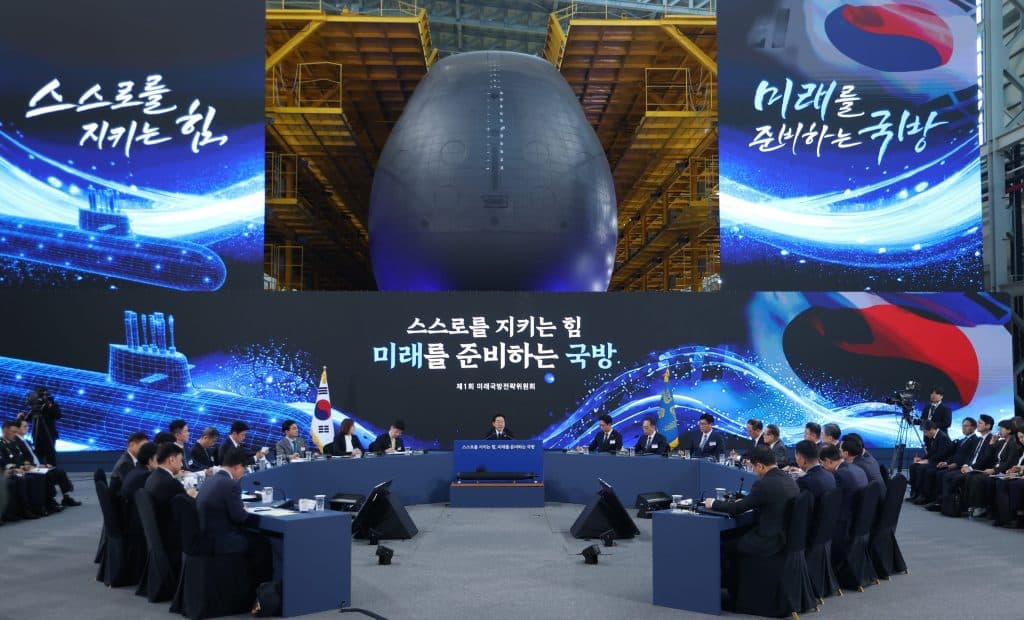
            South Korea aims for Mid-2030s launch of first nuclear-powered submarine. The announcement came during the first future defense strategy committee. (Screenshot from official video).

            In addition, based on the trust of the international community, the Republic of Korea will transparently and firmly fulfill its non-proliferation obligations, and makes the following three commitments.

            • First, the Republic of Korea maintains a firm position that it does not possess nuclear weapons in any form and will not develop nuclear weapons.
              • Second, the Republic of Korea will faithfully fulfill its non-proliferation obligations throughout the entire process of securing and managing low-enriched uranium, the nuclear fuel required for the propulsion system of nuclear-powered submarines, in close communication with the United States.
                • Third, the Republic of Korea will establish, jointly with the IAEA, a safeguards system applicable to nuclear-powered submarines and will fulfill a high level of non-proliferation obligations.
                • Furthermore, the Republic of Korea will firmly maintain nuclear safety and security throughout the implementation of the nuclear-powered submarine project, and will safely and systematically manage all radioactive waste generated from nuclear-powered submarines in accordance with relevant laws and regulations.

                  The development of nuclear-powered submarines is a national industrial development project spanning more than 40 years, including 10 years of construction and more than 30 years of operation, that connects the shipbuilding, nuclear, and defense industries, and will contribute to the development of industry.

                  • The technologies and infrastructure accumulated through the construction of nuclear-powered submarines will spread across related industries and become a key driving force leading the advancement of the national industrial structure.
                    • The development of nuclear-powered submarines is expected to create more than 40,000 stable and high-quality jobs, and to play a role in fundamentally strengthening regional industrial competitiveness and growth potential.
                    • Going forward, the government will name the nuclear-powered submarine project the “Jangbogo-N Project” and promote it as a core national-level force acquisition project.

                      This name carries the meaning of inheriting the spirit of the Republic of Korea’s first submarine, ROKS Jangbogo(SS-061), while building a next-generation model, applying nuclear-powered propulsion, and integrating advanced new technologies.

                      The Ministry of National Defense will continue to concentrate all national capabilities of the Republic of Korea so that the nuclear-powered submarine project can become a historic milestone that opens a new horizon for the Republic of Korea’s maritime security.

                      -End-

                      Naval News Comment

                      By adopting low-enriched uranium, generally understood as uranium enriched to less than 20%, South Korea appears to be signaling its commitment to international non-proliferation obligations, while reducing some of the political and non-proliferation sensitivities surrounding nuclear fuel supply.

                      Another notable point is the plan’s emphasis on domestic development and construction, as well as the use of South Korea’s accumulated civilian nuclear and shipbuilding technologies. This appears to alleviate concerns that the program could rely heavily on foreign technology, instead pointing to Seoul’s intention to establish a more self-reliant framework for development, production, sustainment, nuclear fuel management, decommissioning and radioactive waste management.

                      Coming on the same day as President Lee Jae-myung’s call to accelerate the introduction of nuclear-powered submarines and swiftly pursue the transition of wartime operational control, the announcement appears to fit within Seoul’s broader push for greater defense autonomy. It also reflects South Korea’s ambition to become a stronger maritime power based on its own industrial and technological capabilities.

                      Original Source

                      Naval News

                      Share this article

                      Related Articles

                      🔬
                      🔬Weapons & Technology
                      Defence Blog

                      French startup flies cargo drone with an inflatable wing

                      A French startup’s experimental cargo drone lifted off the ground for the first time in Le Havre, confirming that a pressurized textile wing, an inflatable structure replacing the conventional rigid skin and internal ribs of a standard aircraft, generates enough aerodynamic lift to fly a real

                      大约 12 小时前1 min
                      🔬
                      🔬Weapons & Technology
                      Defence Blog

                      Israeli satellite now tracks moving targets day and night

                      An Israeli satellite company announced on May 26 that its RUNNER satellite can now detect and track moving objects from orbit around the clock, including at night, a capability the company describes as the first of its kind in persistent space-based surveillance. ImageSat International said the new

                      大约 12 小时前1 min
                      🔬
                      🔬Weapons & Technology
                      Defence Blog

                      Ukraine tested VR therapy in war and the results are in

                      More than a thousand patients in war-torn Ukraine completed nearly nine thousand sessions of mixed reality therapy across 47 organizations over six months, a new study released May 26 shows, providing the most detailed real-world evidence yet that immersive headset-based mental health tools can func

                      大约 13 小时前1 min
                      🔬
                      🔬Weapons & Technology
                      Defence Blog

                      South Korea builds its own engine for drone combat jets

                      South Korea’s Hanwha Aerospace launched a joint program with the Korea AeroSpace Administration to develop a 4,500-pound-class turbofan engine for unmanned combat aircraft, targeting completion by 2029 and backed by a total investment plan of approximately $500 million across the company&#8217

                      大约 13 小时前1 min