Unanswered questions remain after Australia's most wanted fugitive killed in standoff
14 hours ago
Helen LivingstoneSydney
Double-murderer Dezi Freeman evaded capture for seven months in the bush but police believe he had help.

14 hours ago
Helen LivingstoneSydney
Just weeks ago, from the foothills of the mountains Dezi Freeman had disappeared into months before, police told the world they "strongly" believed Australia's most wanted man was dead.
The well-known conspiracy theorist and self-described "sovereign citizen" had escaped into dense bushland near the small Victorian town of Porepunkah in August, immediately after shooting and killing two police officers who had come to search his home in relation to historical child sex abuse offences.
But on Monday morning, Australia woke to the news that Freeman had been found alive after one of the largest manhunts in Australian history - only to have been killed in a standoff at a remote farm where he had set up camp.
His death has brought a semblance of closure to some of those affected, surfaced complicated feelings in others, and raised many questions.
Not least among them: where had Freeman spent the past seven months - and did he have help?
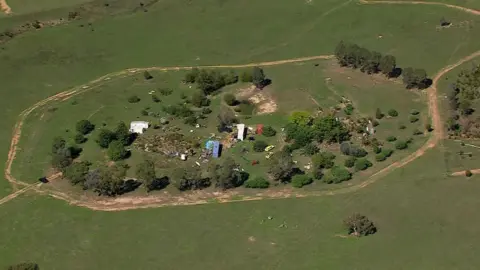
Police had spent at least 24 hours staking out the ramshackle campsite on a property in Thologolong, a town near the Victorian/New South Wales border, before calling on Freeman - real name Desmond Filby - to surrender.

 Australian Broadcasting Corporation
"We gave him every opportunity to come out peacefully and safely. He didn't take that option," Victoria Chief Commissioner of Police Mike Bush said.
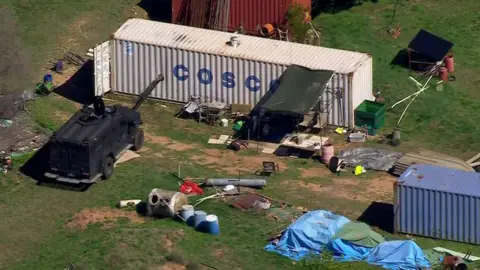
After three hours, Freeman came out of one of the three old shipping containers at the camp at around 8:30 local time (22:30 Sunday BST), bearing a gun stolen from the slain officers. He was shot by multiple police snipers simultaneously, local media have reported, citing police sources.
It was a shock for locals – including the elderly farmer who owns the land, according to his family.
Richard Sutherland has been in Tasmania for months, his brother and neighbour Neil Sutherland has said, and he certainly did not know Freeman or sympathise with his beliefs.
Appearing in Thologolong and its surrounds recently, however, were a handful of road signs graffitied with Freeman's name – something Janice Newnham told the BBC she'd thought was "somebody's April Fool's Day joke".
The local cattle farmer is still sceptical that locals in the town of 22 could have known where Freeman was hiding.
"The main form of social activity is going to the pub or going to the shop or going to the local football - everyone seems to know what everyone else is doing," she says.
When Freeman first vanished, there was huge focus on his skills as a bushman. Friends and locals said he knew the mountains like the back of his hand and was capable of surviving off grid.
This was one of the reasons police struggled to find him after the shooting, says Dr Vincent Hurley, a former police hostage negotiator who now lectures on policing at Macquarie University.
"If that crime was to occur in the city, he would leave his electronic footprint all over," Hurley explains, because mobile phones, car and bus journeys, and ATMs can all be easily tracked, including by using newer technologies such as facial recognition.
But "there was no easy way to actually try and track him down because they literally just had to go searching through the bush", says Hurley.
"And that's pretty, pretty rare."
The most recent similar case, he says, was Malcolm Naden, who was captured in New South Wales in 2012 after nearly seven years on the run.
But while Naden left in his wake a string of burgled properties and makeshift camps – including at a zoo – there was no trace of Freeman.
Police are convinced he had help staying off their radar.
"We're keen to learn who, if any - but we suspect some - assisted him in getting away from Porepunkah… if anyone was complicit, they will be held accountable," Bush told reporters.
While it is theoretically possible to walk the 150km (93 miles) from Porepunkah to Thologolong, police think it unlikely. The mountainous terrain is rugged and covered by thick bush. With temperatures ranging from below freezing in August to 40C in the summer months, it would also have been tough without shelter.
Police sources have told local media Freeman's arrival appears to have been recent.
Fierce bushfires swept through the area in January, coming within a kilometre of the property where Freeman was hiding.
The whole area had been evacuated and was swarming with emergency services while helicopters were flying overhead, Newnham says.
"They were 40 degree days in the bushfire as well," she adds, "so it would have been very hot inside the container."
And pictures from the camp, published by local media, held signs that he hadn't spent his time there alone.
According to the Sydney Morning Herald, which cited unidentified police sources in its reporting, there were spinning air ducts recently fitted to the shipping container, a job likely to require more than one person. There were also three camp chairs pictured beside an open box of beer.
 Australian Broadcasting Corporation
Freeman's family have condemned his actions and have been closely watched by police during the manhunt; his wife was reportedly shocked by Monday's news, having thought he was already dead.
Hurley is convinced that whoever helped him shared his sovereign citizen beliefs, including that they are not subject to government authority.
"No reasonable person down there [in Porepunkah] would have supported him, only because of the horrendous nature of the crime. And... he's a bit of a loner. So it would have been someone who shared his sympathies."
He is also convinced that the tip-off which led police to the hideout would not have come from his peers in the sovereign citizen movement. "They hate the police and they're not going to assist them."
Ultimately, Hurley says he believe Freeman was never going to surrender: "Being captured alive, that would be the ultimate humiliation and betrayal to him as a person. For the duration of the time he was at large, he was symbolically giving the middle finger to the police all over Australia."
In an interview with Nova radio this week, Bush hinted some of these questions may long go unanswered.
It's still early days in terms of the investigation into who may have aided Freeman, he said.
He admitted police had "obtained information" about where Freeman was hiding, but emphasised that "we can't go into how".
No one had claimed the A$1m (£525,000; $709,000) reward for information about the fugitive, Bush said, before stressing that anything in relation to the money and how police had found Freeman was "absolutely confidential".
He added: "I'm quite sure we'll never be sharing those details."

A team of researchers in China has unveiled what they describe as the world’s first open-source flight control system designed specifically for bamboo-frame drones, helping the push for low-cost, eco-friendly unmanned aerial vehicles (UAVs). The system, developed by researchers at Northwestern Polyt

From glimmering floral-patterned glassware to the vivid colours of intricately designed Persian carpets, artefacts from Iran have captivated visitors to a museum in northern China, where they have avoided the risks of damage in the war waged by the US and Israel. The relics, on display at the Inner

There was a surprise guest speaker at Nvidia’s widely watched GPU Technology Conference (GTC) in San Jose, California, last month: Yang Zhilin, the founder of Beijing-based Moonshot AI, the developer behind the Kimi family of foundational artificial intelligence models. Amid heated rhetoric about US

A new exhibition charts Bombay's passage through the centuries via paintings, photographs and prints.