
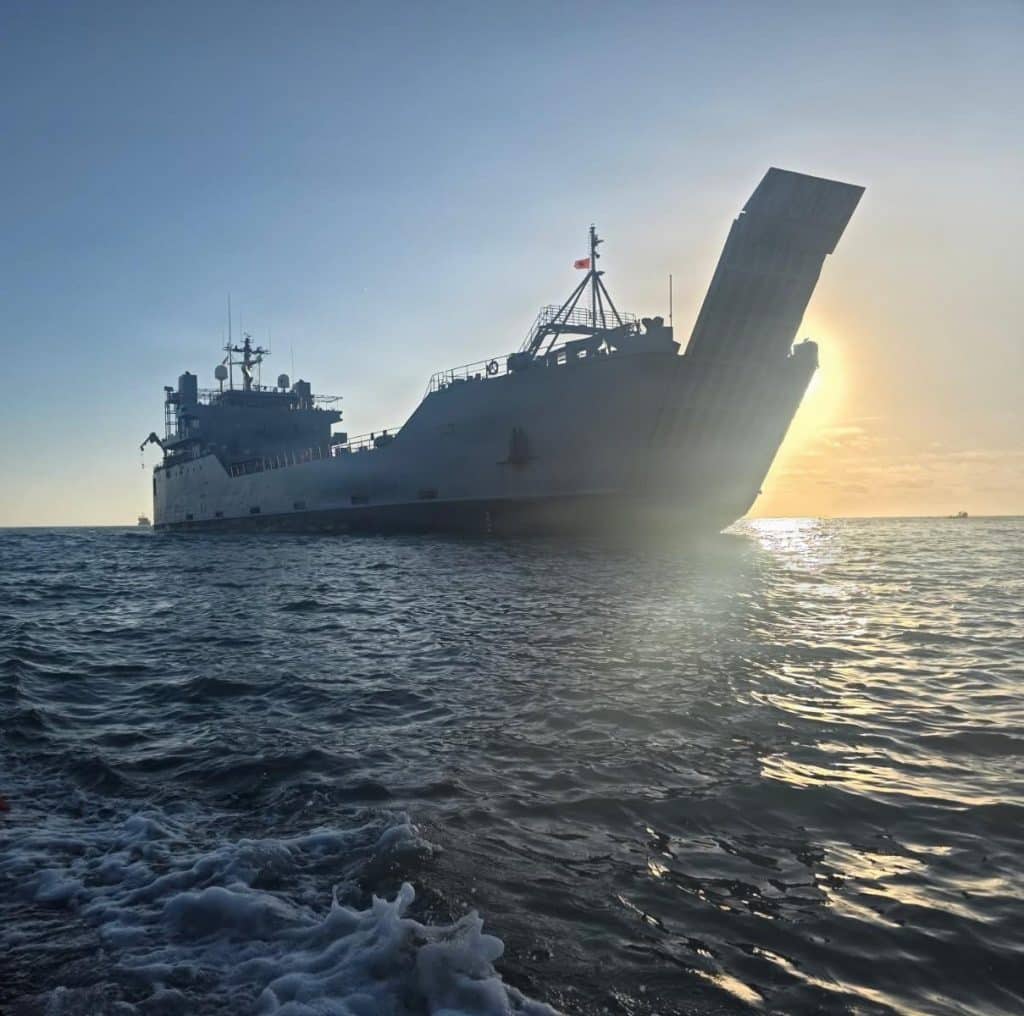
A U.S. Army landing craft launched several low-observable micro high-altitude balloons during an exercise off the coast of Morocco last month, trialing a new launched effect and satellite communications capability developed by Mach Industries to enable long-range communications and precision strikes with one-way attack drones.
The exercise, African Lion 26, tested new technologies developed for U.S. Special Operations Command (USSOCOM) to expand the intelligence, surveillance, and reconnaissance capabilities at individual unit levels. The balloons were equipped with drones, communication relay nodes, and satellite communications equipment.
“Operating in the stratosphere at an altitude of 60,000 feet or more, these systems provide persistent local situational awareness, communication extension, and the deployment of Launched Effects (LE) using specialized payload sensors,” a U.S. Army press release detailed.
A total of six balloons were launched with support from the Capability Program Executive, Intelligence & Spectrum Warfare, a U.S. Army office dedicated to rapidly fielding affordable capabilities with over 80 active programs.
High-altitude balloons gained notoriety after 2023 when a Chinese balloon overflew the contiguous United States. The balloon crossed over several military installations over the course of a week before being shot down by a U.S. Air Force F-22 off the coast of South Carolina.
Since the 2023 incident, the Pentagon has stepped up its effort to field high-altitude balloons, testing several configurations and variants in the Indo-Pacific, including one large test during the Valiant Shield 2024 field training exercise supporting live-fire exercises in a maritime surveillance mission. The balloons supported the exercise’s capstone SINKEX, which Naval News previously covered here.
The balloons used in tests during African Lion differed from the larger, more robust balloons frequently deployed for trans-oceanic missions. They are capable of being deployed in the field by small teams, giving wider reach and force employment options for ground troops in contested environments, including “exquisite kinetic effects”, according to the U.S. Army. During the exercise, the balloons dropped one-way attack munitions that hit their targets with good effect.
“They were able to hit all the targets as intended.”
Chief Warrant Officer 3 Zachary Pickard, Aviation Mission Survivability OfficerGround elements would be hard-pressed to establish secure, reliable communications in the vast distances of the Pacific or Middle East, as seen previously during Operation Epic Fury.
The mission set demanded from Army units in contested environments is rapidly evolving to meet the new operational demands realized in the wake of operations in the Middle East, and establishing a new range of sensors and payload options like drones for high-altitude balloons fills the shortcomings of several fielded communication systems in the Army toolkit today.
“[It’s a] value added system that provides Intelligence, Surveillance, Reconnaissance (ISR) and strike options at the [Special Operations Forces] level.”
Special Forces Group operating high-altitude balloons during African Lion 26