
Who is running the UK Ministry of Defence?
The opening pitch of the UK Ministry of Defence's most senior civil servant to the parliamentary defence committee failed to go to plan.
Army Technology
75
5 min read
0 views

Flanked by key UK Ministry of Defence (MoD) lieutenants, the new Permanent Secretary, Jeremy Pocklington, prepared to present the UK parliament’s esteemed Defence Committee with a scoop hot off the press.
The announcement was of defence financing, the multilateral defence mechanism (MDM), and an aspiration to create a partnership with European countries Finland and the Netherlands on joint procurement, to go live by 2027.
Access deeper industry intelligence
Experience unmatched clarity with a single platform that combines unique data, AI, and human expertise.
Find out more
Only, the release of the planned new funding mechanism, published on 17 March on the morning of the evidence session, was not made by the MoD: it came from the Treasury.
“I have a press release from the Treasury that has been released this morning, I don’t propose to read it out,” Pocklington said, before detailing its most salient aspects.
It smacked of grandstanding, broadcast on Parliament TV with the UK Defence Committee.
In return, the Defence Committee was not impressed to have been blindsided by the announcement, having had no prior awareness of its impending publication.
“It is a slight discourtesy to us as a committee to not let us know this was coming before you [Pocklington] appeared in front of us; it’s not a good look frankly,” noted Jesse Norman, Conservative MP for Hereford and South Hertfordshire.
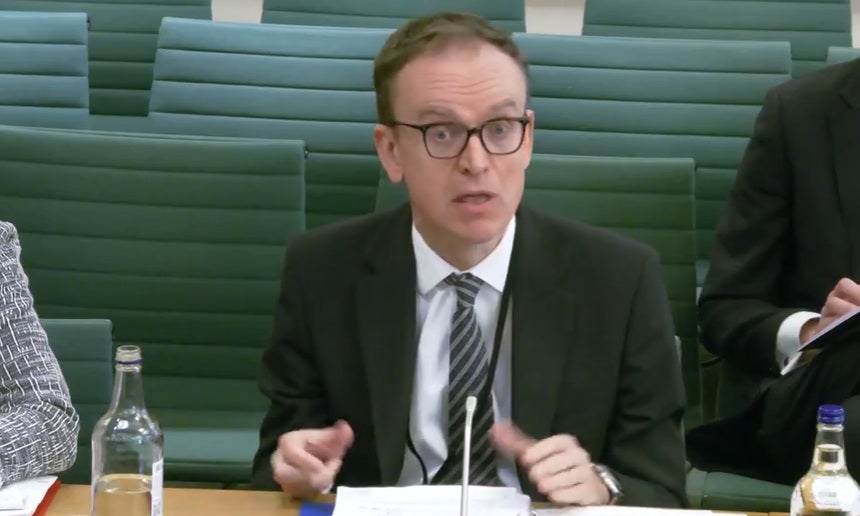
Pocklington said he “apologised”, stating that he had not been aware of the “precise timing” of the Treasury release.
This, from an MoD Permanent Secretary who had spent the best part of two decades at the Treasury, amassing experience in later years as Permanent Secretary at the Department for Levelling Up, Housing, and Communities from 2020-2023, and the Department for Energy Security and Net Zero from 2023-2025, and self-described as the “most experienced” Permanent Secretary in the business.
Indeed, prior to the chastisement from Norman, Pocklington’s career path itself had been the subject of questioning by the committee. A career civil servant, Pocklington joined the Treasury in 1997 straight from the University of Oxford.
“You don’t have any experience in defence, and in the Ministry of Defence per se,” said Tanmanjeet Singh Dhesi, Labour MP for Slough and committee chair. “How do you think you’ll be able to manage this huge role, without that relevant experience in defence?”
Pocklington’s retorted, stating he had “deep experience running government departments” including “in complex projects” such as his time in energy and net zero.
“I think deep Treasury experience is very valuable as well,” he said.
Confusion reigns over new funding structure
Still, to the first order of business, and the discussion of the new funding announcement, as committee members hastily scrolled on their phones to find the Treasury press release.
Would the planned new joint funding mechanism provide both investment into UK defence SMEs, as well as provide finances for joint procurement, the Committee wondered.
“It isn’t exactly clear whether this is a demand side intervention or a supply side intervention,” Norman queried. “Is its purpose to buy more kit, or is its purpose to support the institutions to deliver kit to demands made by the MoD?”
A three-second pause ensued, before the new National Armaments Director, Rupert Pearce, stepped into the breach, exchanging a look with Pocklington in what was a spiky opening 10 minutes of evidence.
“As far as I believe [sic], it’s both. I believe so… but from what I have seen in the announcement, this is an evolving…” Pearce said, tailing off.
“You haven’t been consulted either?” Norman asked, incredulously, adding that MDM was the “new vehicle” through which to engage in multilateral defence procurement. “It seems odd you haven’t been more consulted on the aggregate demand that this was going to generate”.
In response, Pocklington provided an answer, of sorts.
“We have been working closely with the Treasury as you would expect, the timing… it is obviously a Treasury announcement today, but our teams work very closely and are in regular dialogue on this issue,” he intoned.
Pearce, adding, said it was too early to provide specifics figure on the Treasury defence funding announcement.
“It sounds like whistling in the wind by the Treasury frankly. It doesn’t feel like a real thing because you haven’t been adequately consulted and there is no scale on it,” Norman replied.
Continuing, Alex Baker, Labour MP for Aldershot, took issue with the creation of a new joint defence procurement plan in spite of structures like Nato’s NSPA and the European OCCAR fulfilling much the same functionality.
“Do [sic] the Treasury know about the fact that we pay for these solutions that we are not using, yet we are putting all this money into setting up a new mechanism?” Baker asked. “I think that is a bit of an insult to Nato.”
No answer was forthcoming on that particular point, as conversation drifted to the UK’s use of the NSPA and OCCAR, rather than explaining the apparent duplication of effort and funding.
Instead, the opening 10 minutes of this week’s Defence Committee session left more answers than questions, and a worrying performance from the new team charged with enacting long-overdue defence reform.


