
More than €340 billion in bilateral allocations – that’s how much governments across the West and beyond have committed to supporting Ukraine since Russia’s full-scale invasion in 2022, according to the Ukraine Support Tracker by the Kiel Institute for the World Economy.
The US accounts for the largest share, with roughly €115 billion in combined military, financial, and humanitarian aid. The EU institutions follow with around €84 billion, while countries such as Germany (€25 billion) and the UK (€19 billion) have also made substantial contributions.
JOIN US ON TELEGRAM
Follow our coverage of the war on the @Kyivpost_official.
Beyond the largest economies, a second tier of countries, including Japan and Canada, each contributing over €10 billion, have added significant support, while smaller states such as Denmark, the Netherlands, and Sweden have committed between €9 billion and €11 billion, often with a strong military component.
Taken together, the figures suggest a broad and coordinated international effort. Yet, as a Thatcherite would argue, since there is no such thing as public money, what is the actual taxpayer contribution in each country?
The Nordic trio in the spotlight
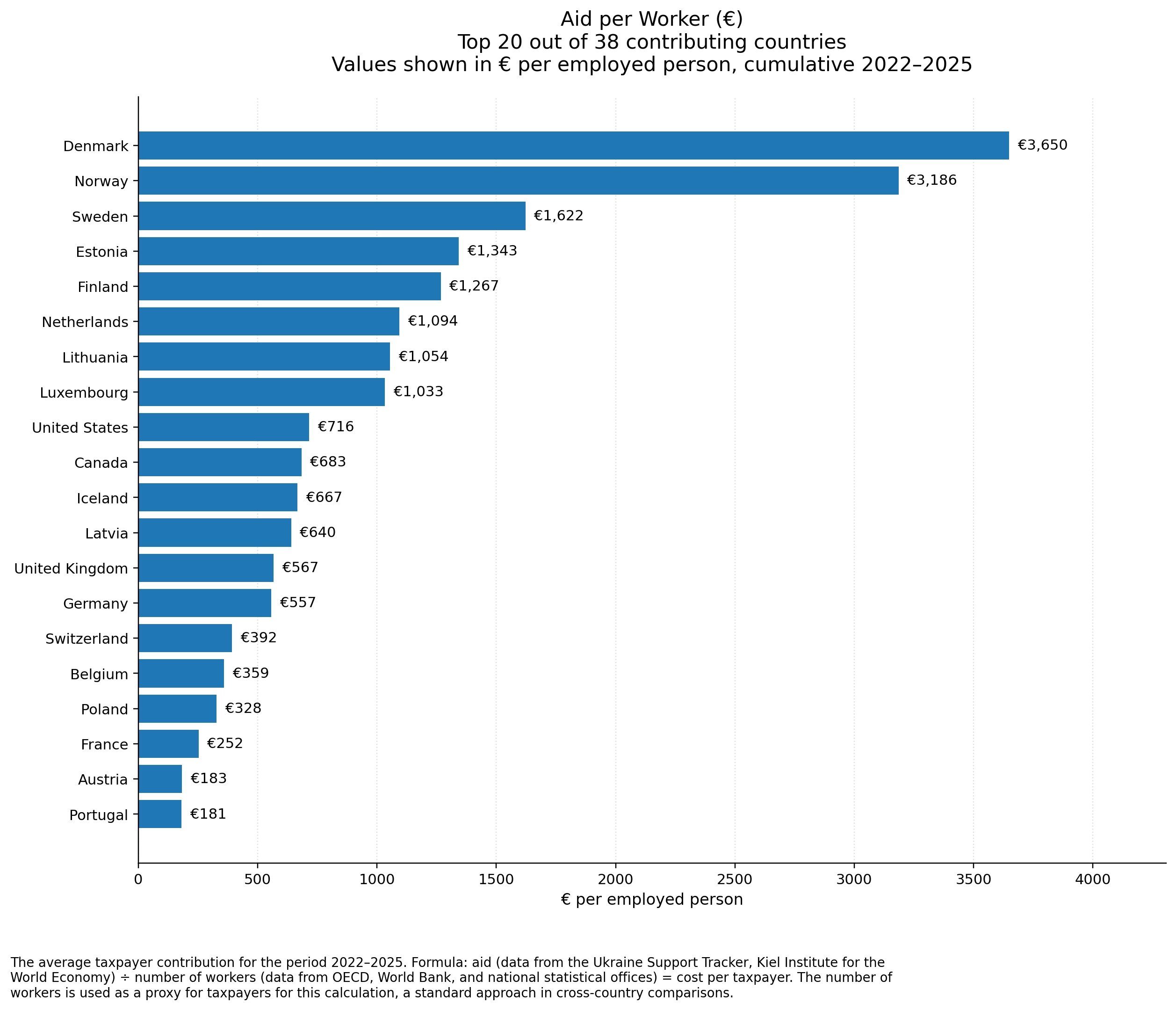
When translated into the average taxpayer contribution to Ukraine aid over the period of 2022–2025, in most major economies, support for Ukraine amounts to an estimate of around €600–€700 per worker (note: estimates may vary slightly as data are updated).
Countries where the average taxpayer contribution to Ukraine aid is the highest include Denmark (€3,650), followed by Norway (€3,186) then Sweden (€1,622).
Several countries exceed the €1,000 threshold. These include Estonia (€1,343), Finland (€1,267), the Netherlands (€1,094), Lithuania (€1,054) and Luxembourg (€1,033).
The US, despite putting an end to non-refundable aid in 2025, continues to stand at €716 for the cumulative period, with Canada (€683), Iceland (€667), Latvia (€640), the UK (€567), and Germany (€557) falling within a similar range.
The next cluster includes Switzerland (€392), Belgium (€359) and Poland (€328).
Meanwhile, the average taxpayer contribution to Ukraine aid over the period of 2022–2025 is the lowest in France (€252), Austria (€183), and Portugal (€181), with large economies like Spain and Italy not even making it to the top tier (their taxpayers’ contribution stands at €104 and €112 respectively).
But that’s not the whole story
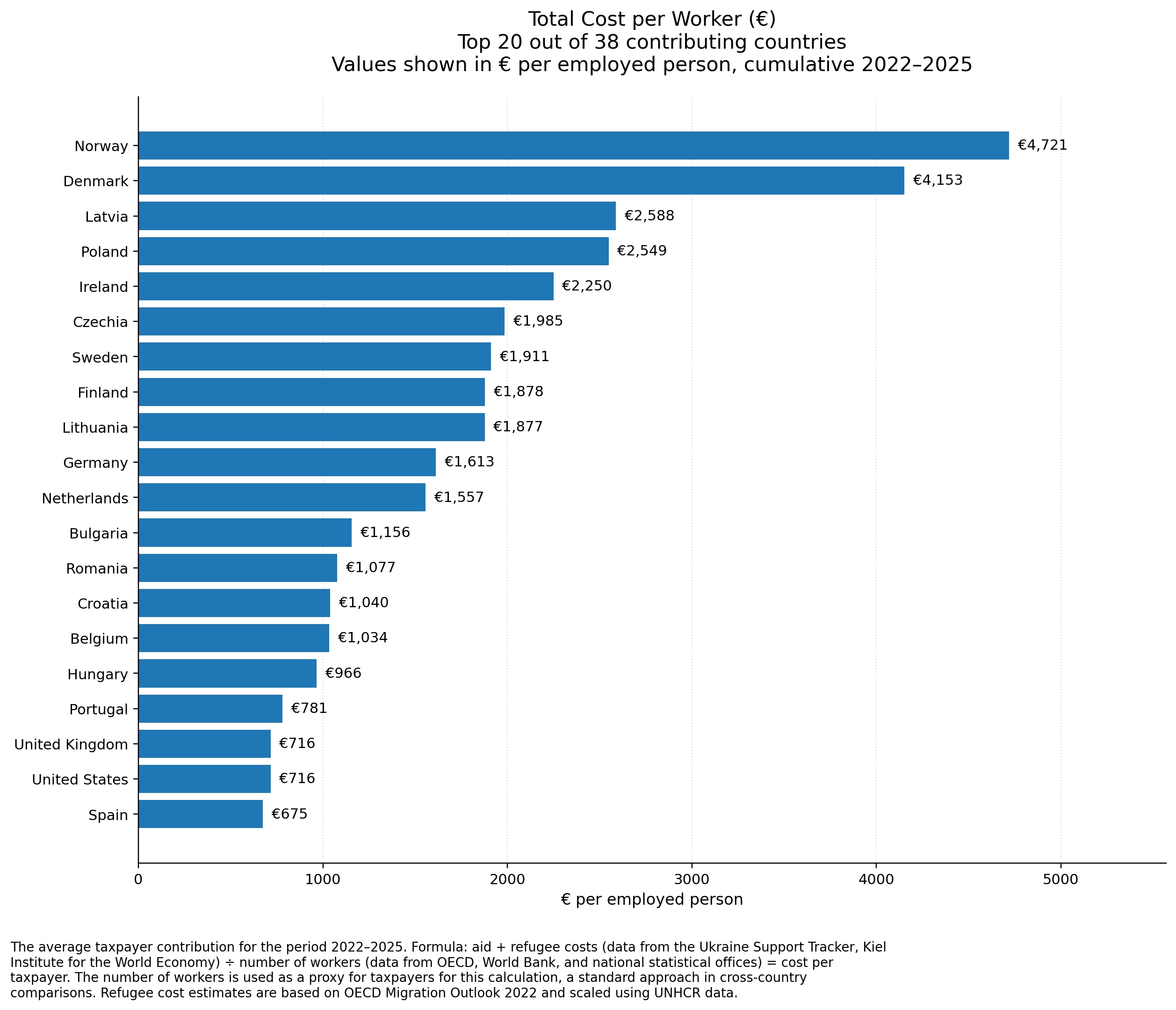
The average taxpayer contribution changes dramatically when factoring in the refugee support provided from each state.
While Norwegian (€4,721) and Danish (€4,153) taxpayers still lead, Latvia’s and Poland’s taxpayer expenditure now stands at €2,588 and €2,549 respectively. Ireland and Czechia, absent in the previous top 20, make it all the way to the top with €2,250 and €1,985 per taxpayer contribution. Lithuania also rises significantly to around €1,877 per taxpayer.
Other countries absent in the above chart, like Bulgaria, Romania, and Spain, also make it to the top 20, with the taxpayers’ contributions rising to €1,156, €1,077, and €1,040, and €675 respectively.
Even governments with more skeptical positions toward Ukraine aid, such as Hungary, are included. When refugee-related costs are included, the Hungarian taxpayer has effectively contributed around €966 per worker between 2022–2025.
There’s no winner here
Aid to Ukraine comes in many shapes and forms and not just money spent: from providing specialized equipment to sharing intel and know-how to other non-monetary means of assistance. Furthermore, even though some countries, like Japan, have not made it to the top 20, their help, given that Tokyo has no direct historical or security obligations comparable to those of European states, is tangible: €157 per taxpayer.
Since each country differs greatly in the list – from the size of the economy to the size of the population, to taxation systems – any comparisons or conclusions must be treated with caution, especially since these are merely estimates. Also, the refugee cost is often mitigated by the very same refugees taking work and becoming taxpayers themselves in either the mid- or long-term.
Besides, it must be considered that the EU institutions allocated €84 billion to Ukraine, which is also taxpayers money, though pooled differently. This means it ultimately comes from the same national tax bases rather than representing an entirely separate contribution.
Yet some conclusions can still be drawn.
Certain countries appear to take Russia’s threat more seriously overall compared to others, with defining factors including proximity to Russia, greater resistance to Russian propaganda and disinformation, and historical animosity. Factors like social nets and GDP per capita also appear to have an impact. Hence the established division between the North and the South, with the Spanish and Italian taxpayers not making it even to the top tier and Spain still struggling to meet NATO spending benchmarks.
France, despite making it to the top 20 and French President Emmanuel Macron’s landmark televised speech last year, where he dubbed Russia a threat and suggested extending France’s nuclear umbrella to other EU states, still appears to contribute less in relative terms than some of its European peers. Paris is reportedly still refusing to purchase weapons for Ukraine under the Prioritised Ukraine Requirements List (PURL), where leading contributors include Norway, the Netherlands, Germany, Canada, Sweden, and Denmark.
Considering that Russia’s military ambitions remain intact, with Moscow still generating enough revenue to sustain its war effort, the bottom line remains largely the same: the cost of supporting Ukraine, which continues to contain Russian aggression within its borders, while significant in absolute terms and often subject to political manipulation and disinformation, is far from overwhelming for the average taxpayer in many countries, though, admittedly, the burden is distributed unevenly.
The other more strategic question of what it will take for these larger economies to fully respond to the Russian threat remains open-ended.
Methodology
This article estimates the average taxpayer contribution to Ukraine support by combining publicly available data and applying a consistent cross-country method. Total aid figures are taken from the Ukraine Support Tracker compiled by the Kiel Institute for the World Economy, including military, financial and humanitarian commitments.
Domestic costs: To account for domestic costs, estimates of refugee-related spending are included where available. These are based on the OECD Migration Outlook 2022 and scaled using UNHCR data on Ukraine refugee populations.
Comparability method: To make countries comparable, total spending is divided by the number of people in employment rather than the total population. Employment data are drawn from the OECD, World Bank, and national statistical offices. The number of workers is used as a proxy for taxpayers, reflecting the group that primarily finances public spending.
Two measures are presented:
1) Aid per worker = total bilateral aid / number of workers
2) Total cost per worker = (aid + refugee-related spending) / number of workers
All figures are cumulative for the period 2022-2025 and expressed in euros.
Important notes
These estimates are intended to provide a consistent basis for cross-country comparison. They do not reflect actual individual tax payments and do not account for differences in tax systems, timing of expenditures, or potential long-term economic effects, including the contribution of refugees to host economies.


