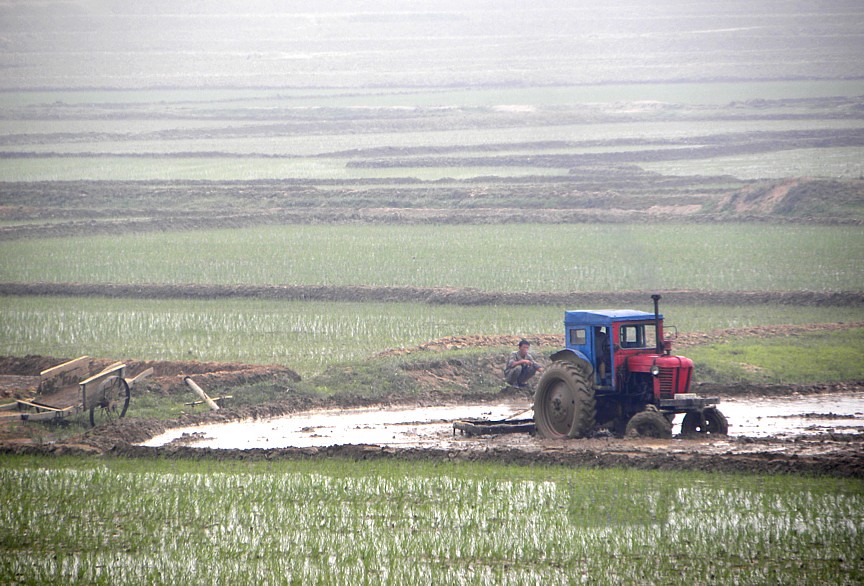
North Korea’s spring planting season derailed by acute fuel shortages on collective farms
Fuel shortages are forcing farm workers on North Korean collective farms to till fields by hand during the spring planting season of 2026, raising concerns about potential harvest shortfalls later in the year. A Daily NK source in North Pyongan province reported on Friday that “the government
Daily NK
75
4 دقيقة قراءة
0 مشاهدة

Fuel shortages are forcing farm workers on North Korean collective farms to till fields by hand during the spring planting season of 2026, raising concerns about potential harvest shortfalls later in the year.
A Daily NK source in North Pyongan province reported on Friday that “the government has issued instructions to prioritize fuel and electricity supplies to farms for the planting season, but many farms cannot secure even the minimum amount of fuel needed to run their machinery.”
North Korea routinely orders priority fuel allocations to farms during the planting and harvest seasons, distributing supplies through state-run fuel outlets. In practice, however, those allocations fall well short of actual needs, leaving farms to source fuel independently through markets. For farms in remote areas, accessing those markets is itself a challenge, and the cost of transporting purchased fuel adds another layer of difficulty.
“Farms closer to county seats are in somewhat better shape, but the more remote the area, the harder it is to get fuel,” the source said. “And even when fuel can be found, the transportation costs have to be factored in — so many farms can’t even consider running machinery.”
Planting delayed as fuel prices surge
The situation has worsened in recent months as market fuel prices have surged sharply, pushing the cost of running agricultural machinery beyond what many farms can afford. Some farms have abandoned the use of machinery altogether. The source said that after purchasing essential agricultural supplies such as plastic sheeting, seeds, and tools, farms have no remaining budget to secure fuel at current market prices.
According to the source, farms in remote border areas including Pyokdong county and Sakju county in North Pyongan province, and Usi county in Jagang province, have been particularly hard hit. With insufficient fuel, farm workers are carrying out plowing and harrowing by hand and with livestock — work that would normally be done by tractor. “Work that a tractor could finish in a single day now takes people several days,” the source said. “Because there’s no fuel, people end up pulling plows like oxen.”
With plowing, fertilizer application, and paddy field preparation all falling to manual labor, the physical burden on farm workers has increased dramatically. Workers on the ground have expressed open frustration, with complaints that conditions are “killing people.”
Harvest risks and pressure from above
The consequences extend beyond worker hardship. Delays caused by manual labor risk pushing planting past the optimal window, which could reduce yields at harvest time. North Korean authorities are aware of this risk and have been pressing farms through propaganda and ideological campaigns to complete planting on schedule — a burden that falls squarely on farm workers already stretched to their limits.
“The authorities emphasize mechanization, but in reality there’s no fuel to run the machines, and the farm workers are suffering for it,” the source said. “If things continue like this, even if planting is somehow completed through forced manual labor, there will inevitably be problems with the harvest.”
A Note to Readers


