Still Standing and Developing: Ukraine After 4 Years of Full-Scale War
In the days after the full-scale invasion, Ukraine was written off as doomed. Kyiv Post examines how after four years, despite enormous difficulties, Ukraine has been transformed.
Kyiv Post
75
9 хв читання
0 переглядів
Four years after the start of Russia’s full-scale invasion, Ukraine is simultaneously being ground down and rebuilt, regressing and developing, suffering and innovating. The country remains under extreme military, economic, and demographic pressure. At the same time, its socio-economic system develops and its administrative structure is being reformed under pressure from both civilian society and the European Union.
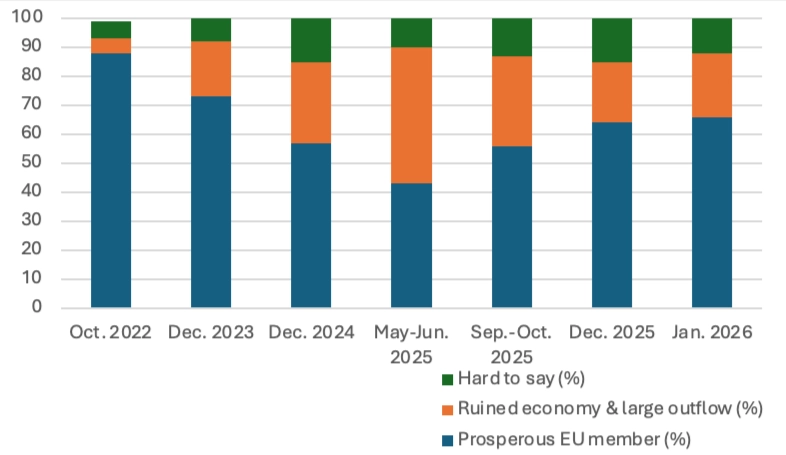
To be sure, Ukraine’s civilian toll rose sharply in 2025 – with 2,514 killed and 12,142 injured – compared to 2023 and 2024, making it the deadliest year for civilians after 2022. Yet public readiness to endure the war remains strikingly stable. In early 2026, around two thirds of Ukrainians were still ready to face war “as long as necessary.” Longer-term optimism about the country’s future has even been growing rather than falling – in spite of the especially deadly Russian terrorist campaign against civilians. Are these numbers expressions of force euphoria or based on real-life facts? How much longer will society’s continuing resilience sustain its ability to fight - and is it enough to win?
Figure 1: Ukrainians’ predictions for the next 10 years, October 2022 - January 2026 (Source: https://kiis.com.ua/?lang=eng&cat=reports&id=1583&page=1)
The IMF warned Ukraine could face delays in funding from its $8.1 billion program as lawmakers fail to pass key tax measures, raising concerns over fiscal stability.
Military dynamics
So far, approximately 55,000 Ukrainian soldiers have fallen since 2022. The war’s character in 2025 stayed largely positional, and Russia’s advances were costly: on average, conquering one square kilometer of Ukrainian land cost 93 Russian casualties. A chronic lack of manpower is one of the key issues not only for Ukraine, but for both parties.
Despite enormous fiscal pressures, Ukraine’s defense spending is expanding further. In 2026, the country is projected to adopt a record defense budget of Hr.2.8 trillion (27.2% of GDP), which would make Ukraine the world’s 20th largest defense spender. Most domestically collected revenues and borrowings will be directed into soldiers’ salaries, arms procurement, military logistics, troop reserves etc.
At the same time, Ukraine is accelerating the build-up of its military-industrial complex (MIC). It has become a leading innovator in inexpensive drones and cruise missiles, while also building cooperation with partners across multiple arms categories. Ukraine’s National Security and Defense Council predicts that the capacity of the Ukrainian military industry will almost double in 2026. Following a novel approach currently being implemented, a part of the production will be used for controlled exports to friendly countries, as a tool to self-finance the MIC.
Even with its drone production rising to over 7 million units, Ukraine still faces major capability gaps. These include shortages of air defense systems required not only at the front but also in the rear, particularly to protect energy infrastructure; insufficient tools to counter new Russian fiber-optic drones; and the continuing challenge of holding the front line. According to Ukraine’s Ministry of Defense, providing sufficient air defense and ammunition in 2026 would require $120 billion. Half is intended to come from Ukraine’s own budget and EU loans, while another $60 billion would need to be covered by allied security assistance.
War economy
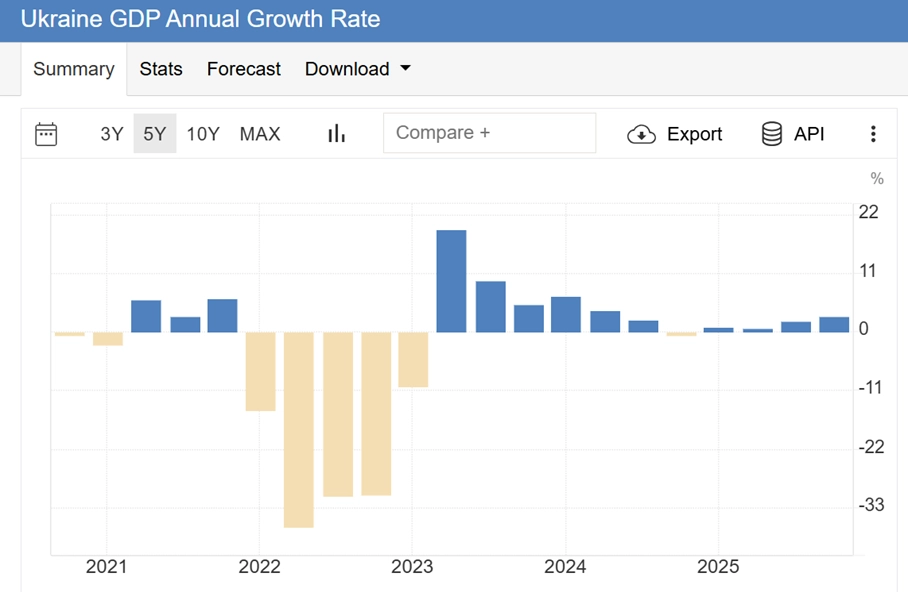
Economically, Ukraine has moved from a shock recession to partial stabilization. After a steep decline in 2022, the economy started recovering in 2023. Despite ongoing war and the deliberate destruction of infrastructure, output has since remained relatively stable. In 2025, real GDP growth slowed to about 2% due to remaining security risks, infrastructure and capacity losses, electricity shortages, and labor constraints. External trade illustrates the strain: the trade deficit widened as imports rose to $84.8 billion – twice the level of exports. Inflation during 2025 was comparatively low at around 8%. Business and consumer confidence, on average, improved compared to 2024, suggesting that society and firms are adjusting to a wartime environment rather than simply freezing.
Figure 2: The annual growth rate of Ukraine’s GDP in 2021-2025 (Source: https://tradingeconomics.com/ukraine/gdp-growth-annual)
Looking into 2026, the National Bank of Ukraine forecast growth of 1.8%, while the Ministry of Economy maintains a 2.5% target. Inflation is expected at 7.5%, indicating a further slowdown of price growth compared to 2025. A 2025 IMF report forecast that Ukraine’s national debt will peak in 2026 at above 110% of GDP and then decline thereafter.
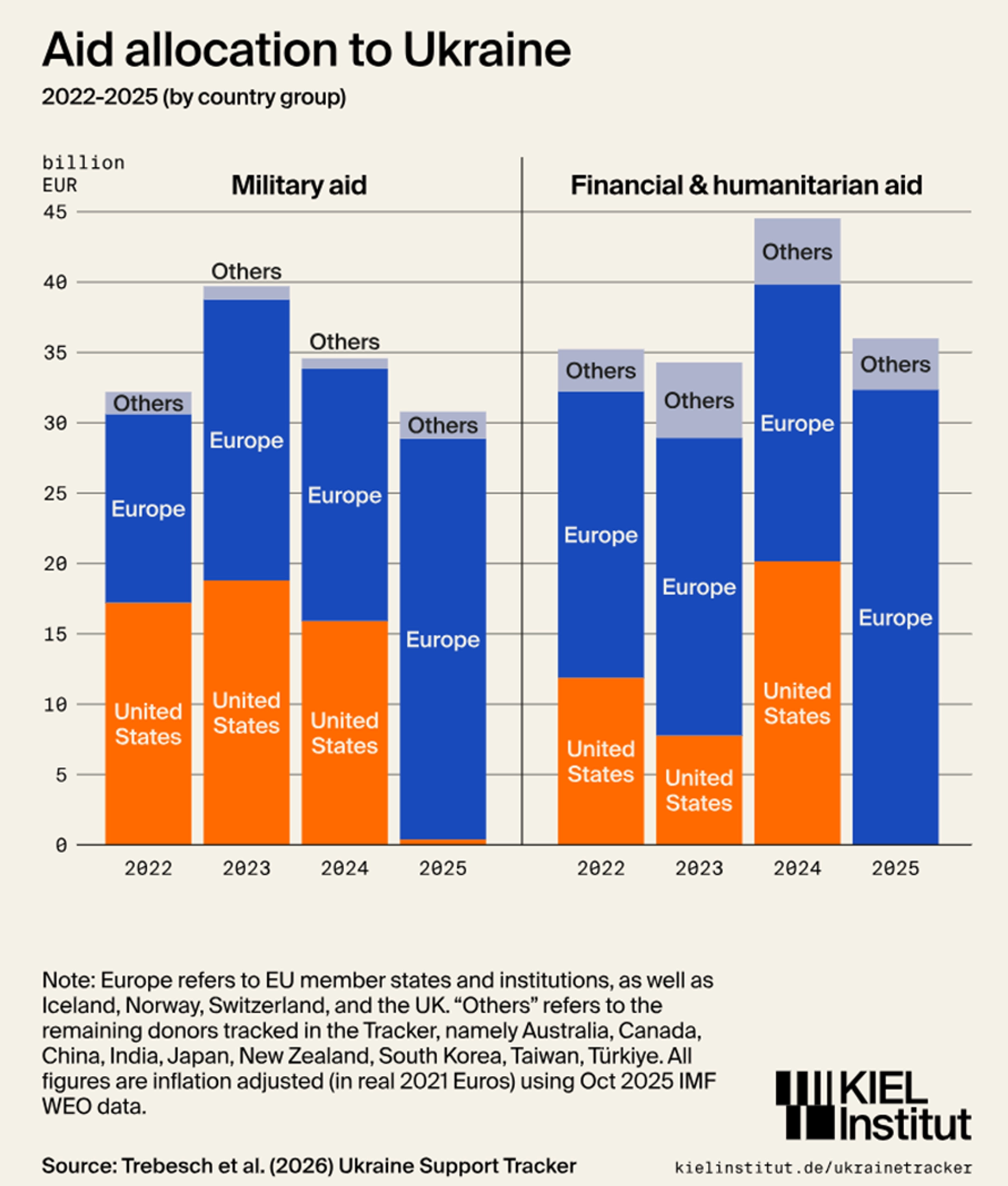
This stabilization is tightly linked to foreign financing. International support – predominantly from the EU and its member states – has become a major pillar of Ukraine’s budget and economy. In 2025, state revenues rose by 21% nominally, while international financial support reached $52.4 billion and covered 95% of the budget deficit. Since 2022, overall financial aid has amounted to €73 billion from the EU and €46.6 billion from the US. In 2025, direct US military and non-military aid was halted, with US arms now being bought by European countries for Ukraine.
Labor is a growing bottleneck for Ukrainian business. Mobilization and emigration have reduced skilled-worker availability, pushing companies toward hiring abroad or increasing automation. The labor shortages are becoming systemic rather than temporary, while wage growth poses challenges for business, inflation dynamics, and competitiveness. Some commentators, however, also point to a positive side: lower industrial density may benefit the environment, and fewer people could mean more opportunities for those who remain.
Wider demographic issues
The war has intensified Ukrainian demographic trends that were already visible before 2022, in line with broader post-Soviet patterns. ForbesUkraine estimated that around 30.5 million people currently live on Ukraine’s government-controlled territory – about 7 million less than the last official government estimate in 2019. Even before the full-scale invasion, Ukraine’s average age (around 42-43 years) placed it among “old nations.” After a 25% birth-rate decline in 2022, the downturn slowed to 6% in 2024 and to 4.5% in 2025. Yet in 2025 there were still three deaths for every newborn.
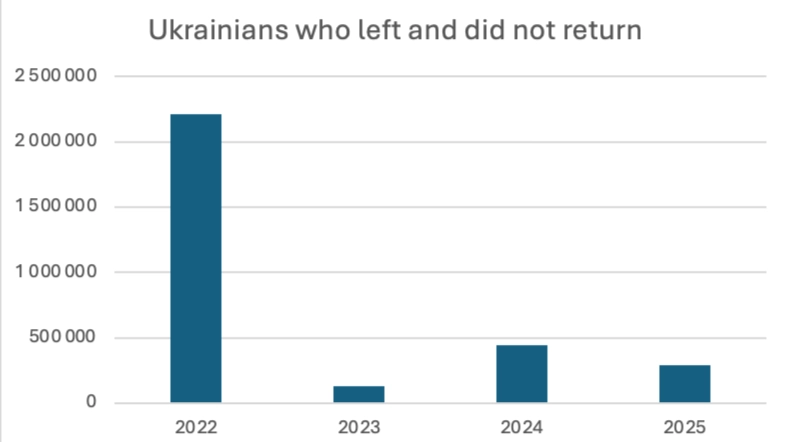
Over the course of four years of full-scale war, 3.1 million Ukrainians who left the country have not officially returned. At the same time, outmigration in 2025 was lower than might have been expected. Despite an escalating bombing campaign, frequent blackouts, and a new law allowing men aged 18-22 to leave, only 290,300 Ukrainians who went abroad in 2025 did not return – including approximately 60,000 young men. This was 1.5 times lower outmigration than in 2024.
Figure 3: Permanent outmigration from Ukraine, 2022-2025 (Source: https://opendatabot.ua/en/analytics/ukrainians-emigration-trend-2025-12)
Return decisions remain closely tied to prospects for future peace and security. Still, tens of thousands have now returned home despite continued war.
State capacity
Ukraine’s domestic agenda is shaped by more than the external threat. The country faces a wide set of internal challenges: social deprivation, political polarization, demographic decline, veterans’ integration, environmental devastation, cultural struggles, business conflicts, and more. Yet despite accumulating strain, the domestic situation in both civilian and military spheres has remained surprisingly stable, without violent confrontations.
Ukraine’s state apparatus – despite its often-problematic reputation – has been functioning relatively effectively when working together with civil society and foreign partners, and is expected to continue doing so. One illustration is social policy planning: in 2026, the Ministry of Social Policy’s expenditures on social support are projected at Hr.468.5 billion ($10.7 billion), which is Hr.47.6 billion more than in 2025, with emphasis on support for families.
There have been improvements in other areas as well. For example, in 2025, Ukraine moved up by one place in Transparency International’s Corruption Perceptions Index ranking. EU integration remains a major source of societal optimism and continues to advance despite Hungarian resistance. Moreover, partial accession to the EU could begin already in 2027. Meanwhile, Ukraine’s Parliament, Central Electoral Commission, and civil society are simultaneously preparing for post-war national and local elections – another indicator of the country’s continuing democratic commitment.
Partner strategy
Ukraine’s trajectory over four years cannot be reduced to battlefield outcomes alone. Beyond notable military successes, Ukraine has displayed social resilience, political cohesion, innovation potential, civic mobilization, economic resourcefulness, and a sustained capacity to adapt.
However, without Western help, Ukraine would not have withstood Russia’s assault for so long – especially given that Russia has also been supported by China, Iran, Belarus, and North Korea. At the same time, it is increasingly overlooked that Ukraine’s major victories – the Battles of Kyiv, Kharkiv, and Kherson – took place already in spring and autumn 2022, before most Western heavy weaponry had entered service in Ukraine’s Armed Forces.
Yet Western support has remained politically contested. Placed against the record of wartime Ukraine, the aid trend highlights a contradiction. Since 2022, Ukrainians have delivered remarkable results in resisting Russia and in continuing socio-political development under conditions of full-scale war and large-scale terror against civilians. Nevertheless, after a peak in 2024, overall Western support fell in 2025, mostly because of the new approach of the US to this issue. Meanwhile, Europe tried to cover the new gap in aid with its means, but it was not entirely successful. One driver of the hesitancy in supporting Ukraine has been the persistence of defeatist interpretations in Europe, North America, and elsewhere.
Figure 4: US American and European aid shares in 2022-2025. (Source: https://www.kielinstitut.de/publications/news/ukraine-support-after-4-years-of-war-europe-steps-up/)
This needs to be corrected in 2026. Considering the Ukrainian state’s past and recent performance, maintaining and increasing resolute support is a coherent and justified strategy – not a senseless effort, as claimed in a range of political commentaries by both openly pro-Russian and ostensibly neutral voices. Western and non-Western countries should, in the interest of defending the European Security Order and the rules-based world order, rapidly expand both military support and non-military aid to Ukraine in 2026. The last four years suggest that such investment will not be wasted. It can eventually lead to the achievement of a just peace between Ukraine and Russia.